Child Logic and Math Mastery
Introduction to Logical Reasoning
Thinking in Steps
Logical reasoning is the skill of thinking things through in a sensible, step-by-step way. It's not just for math class or solving tricky riddles. We use it every day, like when we figure out the quickest way to get to a friend's house or decide what to wear based on the weather. It’s about using what you already know to figure out something new.
Think of it as being a detective. You gather clues (information) and piece them together to solve a mystery (a problem).
This kind of thinking helps you make smart choices and solve problems more easily. By practicing, you build a strong foundation for learning all sorts of new things, especially in math.
Finding Patterns
One of the first steps in logical reasoning is learning to spot patterns. A pattern is something that repeats in a predictable way. Patterns are everywhere: in music, in nature, and even in our daily routines.
What comes next in the image above? You probably guessed a blue circle. You saw the pattern—circle, square, circle, square—and used logic to predict what would follow. That’s all there is to it.
Number patterns work the same way. Look at this sequence:
Each number is 2 more than the one before it. The rule is "add 2." The next number would be 10. Recognizing these simple rules is a key part of building your logical thinking skills.
Puzzles and Brain Games
Puzzles are a fun way to practice logical reasoning. They challenge you to use the information you're given to find a solution, just like a detective solving a case. Let's try one.
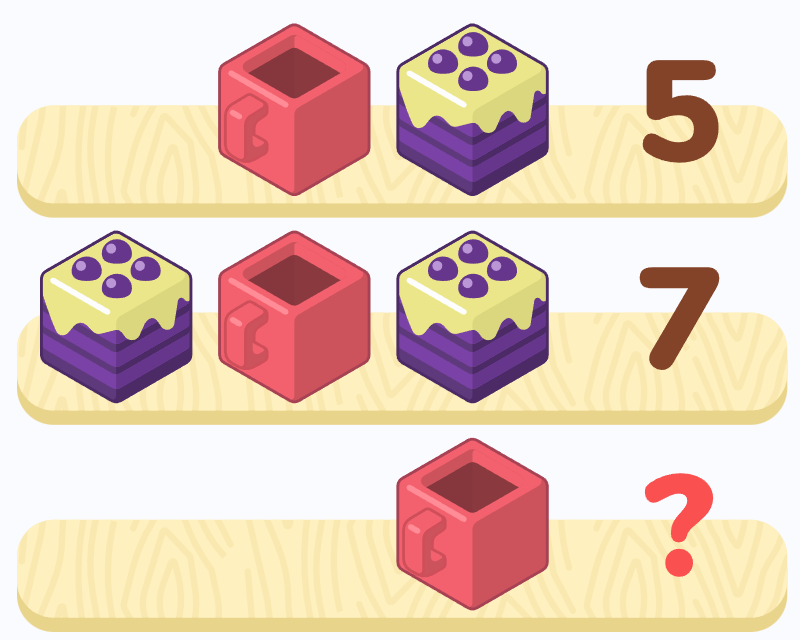
Look at the first row. A cup plus a cake equals 5. We don't know the value of each one yet, but we have our first clue.
Now, look at the second row. A cake plus a cup plus another cake equals 7. This is our second clue. We can use what we learned from the first row here. Since we know a cup and a cake together make 5, we can think of the second row as:
(cake + cup) + cake = 7 5 + cake = 7
This tells us the cake must have a value of 2. Now we can solve for the cup using the first row again:
cup + 2 = 5
The cup must have a value of 3. So the answer to the puzzle is 3. By taking it one step at a time and using the clues provided, we found the solution.
Puzzles are a great way to develop mathematical habits of mind and logical reasoning.
Ready to test your new detective skills?
Which of the following best describes logical reasoning?
Look at the following number pattern: 3, 7, 11, 15, ... What number comes next?
Spotting patterns and solving puzzles are the building blocks of logical thinking. As you practice more, you'll find it easier to tackle bigger and more complex problems, both in math and in everyday life.