Chewing Gum Science and Industry
Synthetic Polymer Science
Beyond Natural Resins
The era of chicle laid the groundwork, but modern chewing gum relies on a sophisticated blend of synthetic polymers. Manufacturers shifted away from natural resins for practical reasons: synthetic bases offer greater control over texture, flavor delivery, and cost. A modern gum base isn't a single substance but a carefully engineered composite, primarily built from elastomers, resins, and fillers.
Think of it like building a material from the ground up. Elastomers provide the rubbery bounce, resins add strength and body, and fillers and softeners adjust the final chew. Each component is a polymer with specific properties, chosen and blended to create the exact chewing experience a candy maker wants.
The Bouncy Backbone
The characteristic chewiness and elasticity of gum come from polymers called elastomers. These are long, coiled-up molecules that can be stretched but snap back to their original shape. The primary elastomer in many gum bases is (SBR).
SBR is a copolymer, meaning it's built from two different monomer units: styrene and butadiene. The butadiene units provide the rubbery, flexible quality, while the styrene units add thermoplastic properties, allowing the gum base to be melted and processed. These monomers link up to form long, entangled chains.
When you chew, you are essentially untangling these chains. When you stop chewing, they partially recoil, which gives gum its lasting elasticity. Because SBR is highly stable and insoluble in water, your body cannot digest it. It simply passes through the digestive system intact, which is why you shouldn't swallow gum.
Strength and Flexibility
An elastomer alone would feel like chewing on a rubber band. To get the right texture, manufacturers add resins. The most common resin is (PVA). PVA acts as a binder, giving the gum cohesive strength and a bit of stiffness. It helps integrate all the ingredients and reduces the stickiness of the elastomers.
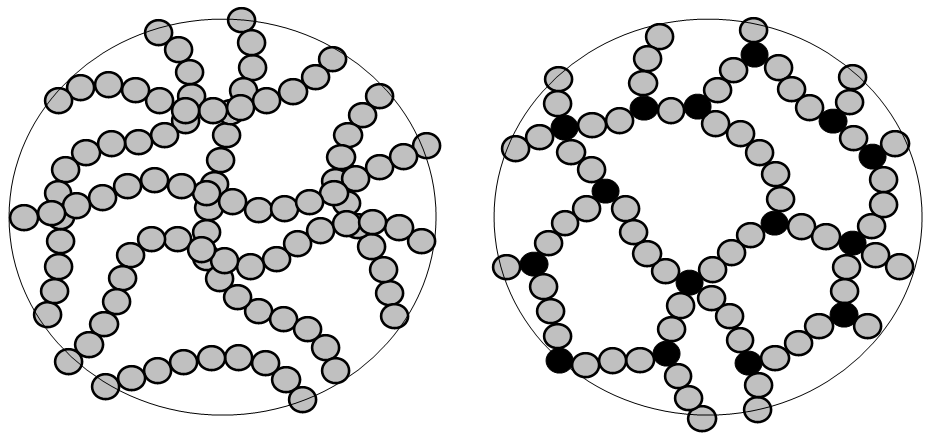
The properties of PVA can be fine-tuned by controlling its molecular weight. This is the key difference between a base for regular chewing gum and one for bubble gum. Bubble gum requires a base with higher molecular weight PVA.
Higher molecular weight means longer polymer chains. These long chains have more entanglement points, which allows the material to stretch into a thin, stable film—a bubble—before breaking.
Regular chewing gum uses lower molecular weight PVA, resulting in shorter polymer chains that break more easily when stretched. This provides a pleasant chew but prevents the formation of large, stable bubbles.
Fillers and Finishers
The final components of the gum base are fillers and softeners. These are not just for adding bulk; they are crucial for perfecting the texture. Common fillers include polyethylene and petroleum waxes. Polyethylene, the same plastic used in shopping bags, adds body to the gum base. Waxes, on the other hand, act as softeners and plasticizers. They lubricate the polymer chains, making the gum softer and more pliable at body temperature.
Together, these three classes of synthetic polymers—elastomers, resins, and fillers—create a stable, non-digestible, and highly customizable matrix. By varying the type and proportion of each polymer, manufacturers can create a vast range of chewing experiences, from soft bubble gums to firm, long-lasting chewing gums.
What is the primary reason manufacturers shifted from natural resins to synthetic polymers for chewing gum bases?
What is the main function of elastomers, such as Styrene-Butadiene Rubber (SBR), in a modern gum base?