Chemistry's Hybridization Explained
Atomic Orbitals
Where Electrons Live
Think of an atom. You probably picture a tiny solar system, with a nucleus for a sun and electrons orbiting like planets. This is a helpful starting point, but the reality is much stranger and more interesting.
Electrons don't follow neat, predictable paths. Instead, they exist in regions of space around the nucleus where they are most likely to be found. These regions are called atomic orbitals. An orbital isn't a physical container; it's a mathematical description of an electron's wavy, fuzzy behavior. It's a probability map for a specific electron.
An atomic orbital is a three-dimensional region around the nucleus that indicates the probable location of an electron.
Orbital Shapes
Orbitals come in different shapes and sizes, which are grouped into sets labeled s, p, d, and f. These letters originally came from descriptions of lines in atomic spectra, but now they just serve as labels for the orbital shapes.
The simplest is the s orbital. Every energy level has one s orbital, and it's always shaped like a sphere. The electron can be found anywhere within this sphere, centered on the nucleus.

Starting with the second energy level, we find p orbitals. Unlike the s orbital, p orbitals are directional. They have a dumbbell shape, with two lobes on opposite sides of the nucleus. There are three p orbitals in each set, oriented at 90-degree angles to each other along the x, y, and z axes. An electron in a p orbital is most likely to be found in one of these two lobes, but never in the center at the nucleus.
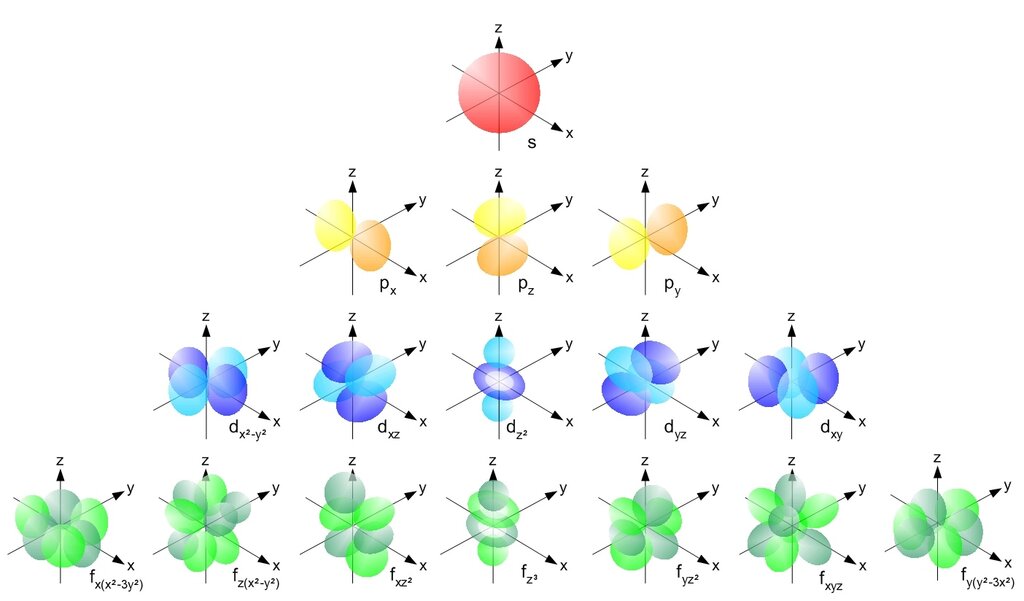
As we move to higher energy levels, we encounter the d and f orbitals. The shapes get much more complex. There are five d orbitals in each set, with shapes often described as cloverleaves or dumbbells with a donut. The seven f orbitals are even more intricate.
For now, you don't need to memorize every shape. The key takeaway is that each type of orbital (s, p, d, f) has a characteristic shape that dictates where its electrons can be.
Energy and Filling Order
Orbitals are organized by energy levels, also called shells. These are numbered 1, 2, 3, and so on, starting from the one closest to the nucleus. A higher number means a higher energy level.
Each energy level contains a specific set of orbitals:
- Level 1: one s orbital (1s)
- Level 2: one s orbital (2s) and three p orbitals (2p)
- Level 3: one s orbital (3s), three p orbitals (3p), and five d orbitals (3d)
- Level 4: one s orbital (4s), three p orbitals (4p), five d orbitals (4d), and seven f orbitals (4f)
Within a given energy level, the s orbital has the lowest energy, followed by the p orbitals, then d, and finally f. So, a 3p orbital has more energy than a 3s orbital, but less than a 3d orbital.
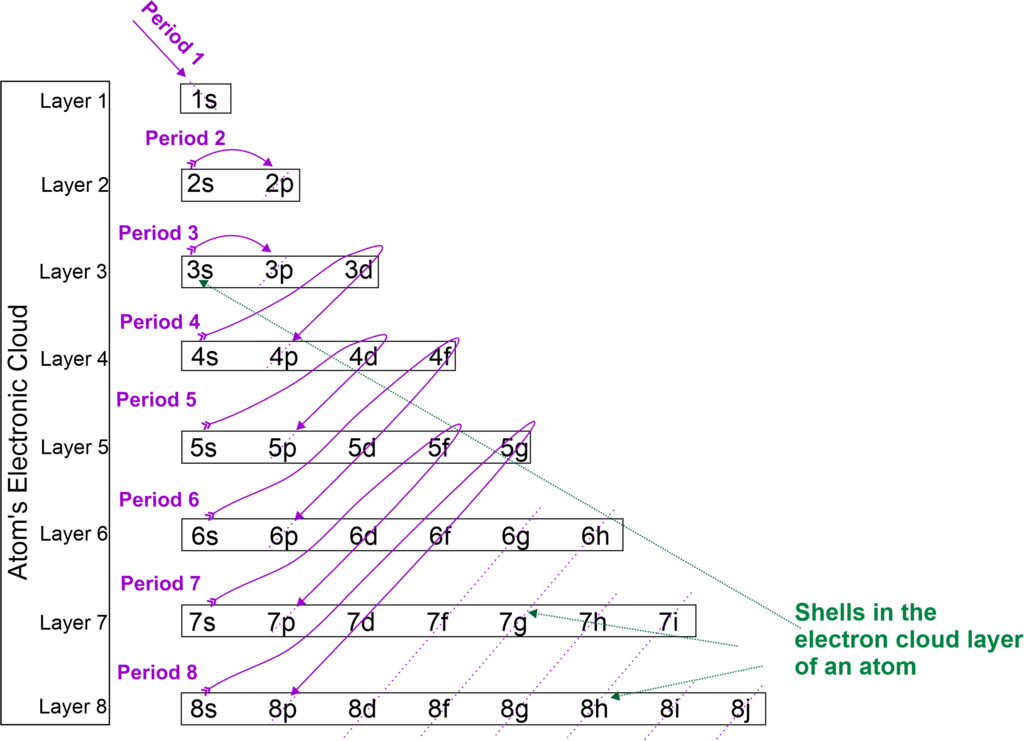
When we build an atom, electrons fill the lowest energy orbitals available first. This is known as the Aufbau principle. The filling order generally follows a simple pattern, but there are a few quirks. For instance, the 4s orbital actually has a lower energy than the 3d orbitals, so it gets filled first. This diagram shows the precise order.
Each individual orbital, regardless of its shape, can hold a maximum of two electrons. When two electrons occupy the same orbital, they must have opposite spins, a property described by the Pauli exclusion principle.
The arrangement of electrons in an atom's orbitals is called its electron configuration. This configuration determines an atom's chemical properties and how it will interact with other atoms.
Let's see this in action for a few simple elements.
| Element | Atomic Number | Electron Configuration |
|---|---|---|
| Hydrogen (H) | 1 | 1s¹ |
| Helium (He) | 2 | 1s² |
| Lithium (Li) | 3 | 1s² 2s¹ |
| Carbon (C) | 6 | 1s² 2s² 2p² |
| Neon (Ne) | 10 | 1s² 2s² 2p⁶ |
The superscript tells you how many electrons are in that orbital set. For carbon, we see two electrons in the 1s orbital, two in the 2s orbital, and two in the 2p orbitals. Since the 2p set can hold a total of six electrons, carbon has four empty spots in its outermost shell, which is key to understanding its bonding behavior.
Ready to check your understanding?
What is the most accurate description of an atomic orbital?
Which type of orbital has a spherical shape and is found in every principal energy level?
Understanding these electron roadmaps is the first step toward predicting how atoms will join together to form the molecules that make up our world.