Chemistry Fundamentals
Introduction to Matter
What is Matter?
Look around you. The chair you're sitting on, the water you drink, and the air you breathe are all made of matter. Simply put, matter is anything that has mass and takes up space. Mass is a measure of how much "stuff" is in an object, and taking up space means it has volume.
It's easy to see that a rock or a book is matter. They have weight (which is related to mass) and you can see the space they occupy. But what about things you can't see, like the air? Air is also matter. It's made of tiny particles that are too small to see, but they have mass and fill the room around you. You can feel air's presence when the wind blows.
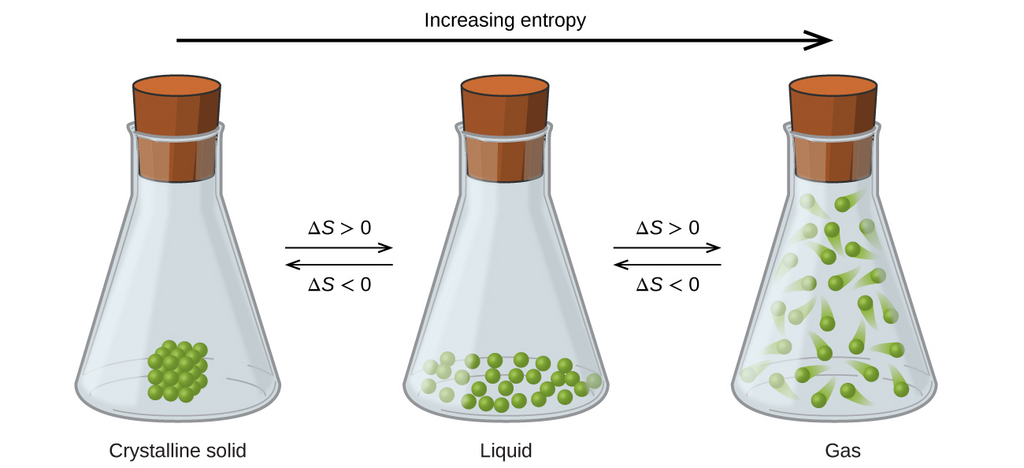
The States of Matter
Matter usually exists in one of four states, or phases. The state of a substance depends on factors like temperature and pressure, which affect how its particles are arranged and move.
Solids have a definite shape and a definite volume. The particles in a solid are packed tightly together in a fixed pattern. They vibrate, but they don't move around. Think of an ice cube: it keeps its shape whether it's in a bowl or on a plate.
Liquids have a definite volume but no fixed shape. They take the shape of the container they're in. The particles in a liquid are close together but can slide past one another. This is why water flows and can be poured.
Gases have no definite shape and no definite volume. A gas will expand to fill any container it's put into. Its particles are far apart and move around randomly and quickly. The steam from a boiling kettle is water in its gaseous state.
Plasma is the fourth state of matter. It's not as common on Earth, but it's the most abundant state in the universe—stars are made of plasma. Plasma is a lot like a gas, but its particles have an electrical charge. Lightning and the aurora borealis are natural examples of plasma.
Types of Matter
Besides its state, we can also classify matter by its composition. The first major distinction is between pure substances and mixtures.
A pure substance consists of only one type of matter and has distinct, unchanging properties. A mixture is a combination of two or more substances that are not chemically bonded.
Pure substances can be broken down further into elements and compounds.
An element is the simplest form of matter that cannot be broken down into anything simpler by chemical means. Each element, like oxygen (O), iron (Fe), or gold (Au), has a unique set of properties.
A compound is a pure substance made of two or more different elements that are chemically bonded together in a fixed ratio. For example, water () is a compound made of hydrogen and oxygen atoms always in a 2-to-1 ratio. Its properties are very different from those of hydrogen or oxygen on their own.
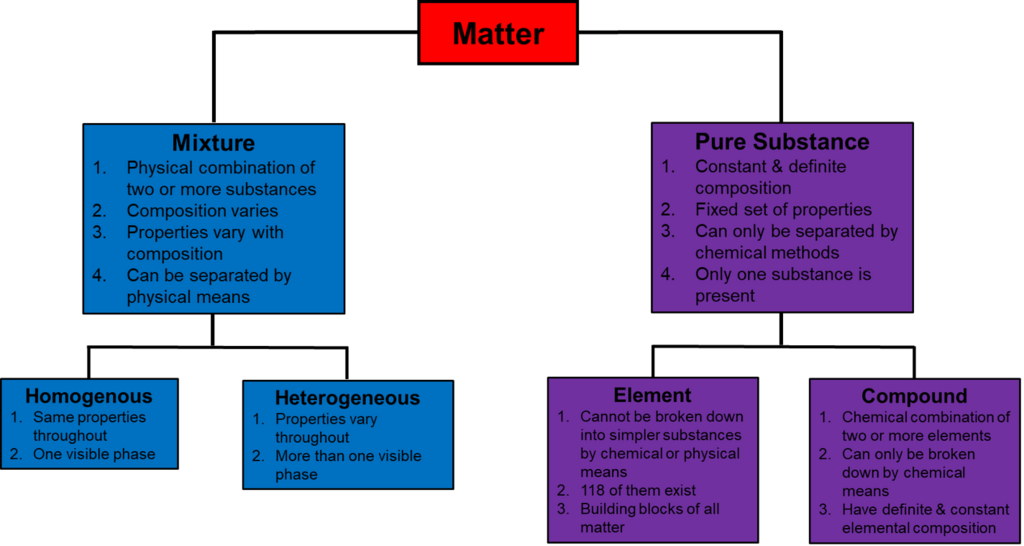
Mixtures are different. The substances in a mixture keep their own identities and properties, and they can usually be separated by physical means, like filtering or evaporation. There are two types of mixtures.
A homogeneous mixture is uniform throughout. That means a sample taken from any part of the mixture will have the same composition. Saltwater and air are good examples. You can't see the individual salt particles in the water.
A heterogeneous mixture is not uniform. You can often see the different components, and its composition varies from one part to another. A salad is a heterogeneous mixture; one bite might have lettuce and tomato, while another has cucumber and onion. Sand in water is another example.
Properties of Matter
Everything we've discussed so far—from the state of matter to its classification—is based on its properties. We can describe any piece of matter by its characteristics, which fall into two categories: physical and chemical.
Physical Property
noun
A characteristic of a substance that can be observed or measured without changing the identity of the substance.
Physical properties include things like color, hardness, density, and the temperature at which something melts or boils. When you observe a physical property, you're not changing what the substance is. An ice cube that melts into water is still water (), just in a different state.
Chemical Property
noun
A characteristic that describes a substance's ability to undergo changes that transform it into different substances.
Chemical properties describe how a substance can change into a new substance. Examples include flammability (the ability to burn), toxicity, and reactivity (how it reacts with other substances). When wood burns, it undergoes a chemical change. It combines with oxygen and turns into ash, smoke, and gases—completely new substances with different properties than the original wood.
Ready to check your understanding? Let's see what you've learned about the fundamentals of matter.
What two properties define a substance as matter?
The air you breathe is best described as a...
Understanding what matter is, how it behaves in different states, and how we classify it is the first step in exploring the world of chemistry.