Chemical Reactions Explained
Introduction to Matter
What Is Matter?
Everything around you is made of matter. The chair you're sitting on, the water you drink, and even the air you breathe are all forms of matter. So, what is it exactly?
Matter is anything that has mass and takes up space. Mass is just a measure of how much "stuff" is in an object. Taking up space is known as having volume. A bowling ball has more mass than a balloon and takes up a certain amount of space, so it's matter. A balloon is also matter, it just has less mass, but it still takes up space.
matter
noun
Anything that has mass and occupies space.
The Three Main States
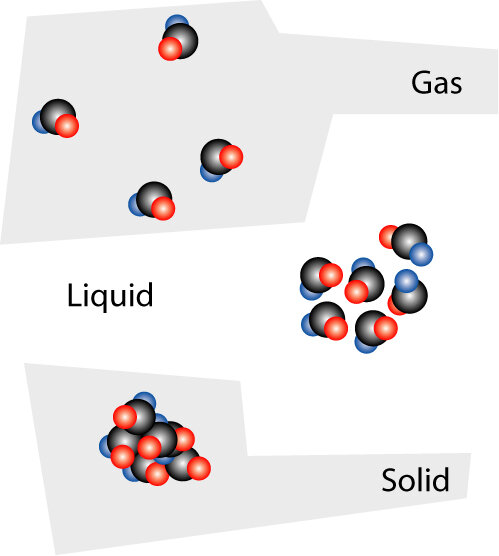
Matter usually exists in one of three states: solid, liquid, or gas. The state of a substance depends on how its tiny particles (atoms and molecules) are arranged and how they move.
Solids have a definite shape and a definite volume. The particles in a solid are packed tightly together in a fixed pattern. They jiggle and vibrate, but they don't move from their spot. Think of an ice cube; it holds its shape whether it's in a cup or on a plate.
Liquids have a definite volume but no definite shape. They take the shape of whatever container they're in. The particles in a liquid are close together but can slide past one another. This is why water pours easily from a pitcher into a glass.
Gases have no definite shape and no definite volume. They expand to fill any container they occupy. The particles in a gas are far apart and move around rapidly and randomly. When you smell cookies baking, it's because gas particles from the oven have spread throughout the room.
Changing From One State to Another
Matter can switch between these states. These transformations are called physical changes because the substance itself doesn't change, just its form. Adding or removing energy, usually in the form of heat, is what drives these changes.
A physical change is a change in the form of a substance, not in its chemical composition. H₂O is still H₂O whether it's ice, water, or steam.
Let's look at three common physical changes.
-
Melting: This is the change from a solid to a liquid. When you heat a solid, its particles vibrate faster and faster until they break free from their fixed positions. This is what happens when a chocolate bar melts in your hand. The temperature at which this occurs is called the melting point.
-
Freezing: This is the opposite of melting, a change from liquid to solid. When a liquid cools, its particles slow down. Eventually, they move slowly enough to lock into a fixed structure. Putting liquid water in the freezer to make ice cubes is a perfect example. The freezing point is the same temperature as the melting point.
-
Evaporation: This is the change from a liquid to a gas. When liquid particles gain enough energy, they can escape from the surface of the liquid and become a gas. A puddle drying up after it rains is due to evaporation. Boiling is a special, faster type of evaporation that happens throughout the liquid at a specific temperature, the boiling point.
These are the fundamentals of matter. Understanding these basic states and how they change is the first step in exploring the fascinating world of chemistry.