Chemical Engineering Fundamentals
Introduction to Chemical Engineering
More Than Just Chemistry
Think about baking a cake. You follow a recipe, mix ingredients, and apply heat. That's chemistry in action. Now, imagine you need to bake one million identical cakes every day. How do you design a factory that can do that safely, efficiently, and with consistent quality? That's chemical engineering.
Chemical engineering is the science of taking what works in a small lab and scaling it up to an industrial level. It combines principles from several fields to design and operate processes that turn raw materials into useful products. It's not just about knowing the chemical reactions; it's about managing them on a massive scale.
Chemical engineering involves managing plant processes and conditions to ensure optimal plant operation.
The core of this discipline rests on four pillars: chemistry, physics, mathematics, and biology. Chemical engineers use chemistry to understand reactions, physics to manage energy and fluid flow, mathematics to model and control processes, and biology to work with living systems in fields like pharmaceuticals and biofuels.
From Art to Science
The roots of chemical engineering trace back to the Industrial Revolution. As demand for products like soap, glass, and textiles exploded, manufacturers needed to produce chemicals like soda ash and sulfuric acid in huge quantities. Early chemical production was more of an art, relying on trial and error.
The field began to formalize in the late 19th century. In 1887, George E. Davis gave a series of lectures on chemical engineering in Manchester, England, laying the groundwork for it to be recognized as a distinct discipline. He introduced the concept of "unit operations."
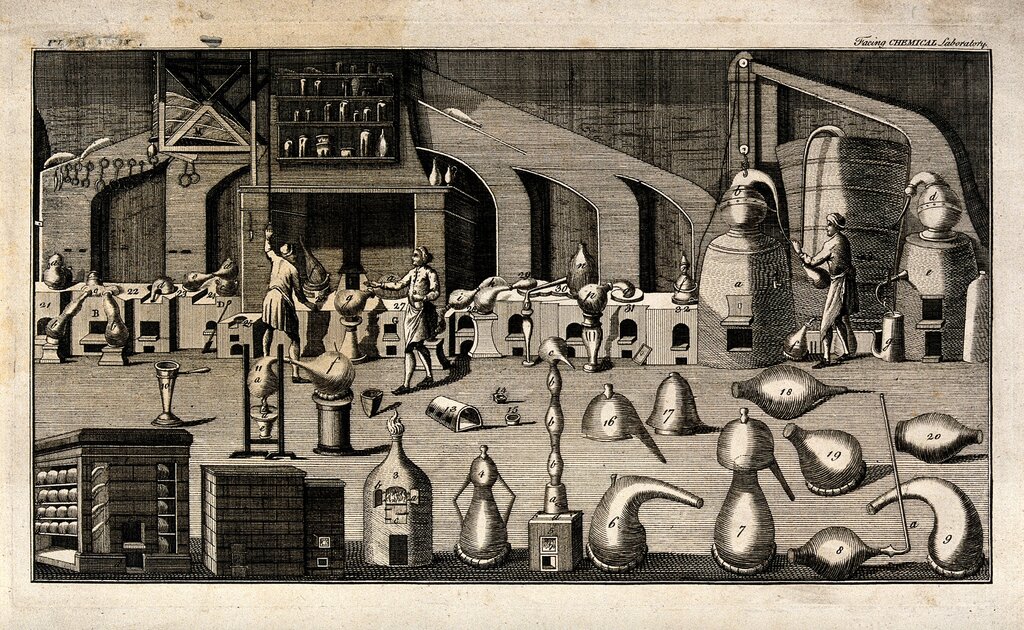
The idea of unit operations was revolutionary. It proposed that any chemical process, no matter how complex, could be broken down into a series of fundamental physical steps like fluid flow, heat transfer, distillation, and mixing. By understanding and optimizing these individual units, engineers could design and control entire manufacturing plants more effectively. This concept turned chemical manufacturing from a craft into a science-based engineering discipline.
A Chemical Engineer's Toolkit
At its heart, chemical engineering is about balance. Engineers must constantly balance the amount of material and energy that enters a system with what leaves it. This is governed by the principles of conservation of mass and energy. The simplest expression of a mass balance is:
This equation simply states that the change in the amount of a substance in a system (like a tank) is equal to what you put in, minus what you take out, plus what's created by a reaction, minus what's used up by a reaction. It's a fundamental accounting tool for any process.
From designing a massive oil refinery to producing a new life-saving drug or creating a more sustainable biofuel, chemical engineers are the masterminds behind the scenes. They figure out how to make things on a scale that can change the world. They work in nearly every industry imaginable:
| Industry | Example Contribution |
|---|---|
| Petrochemicals | Refining crude oil into gasoline, plastics, and other materials. |
| Pharmaceuticals | Developing processes to manufacture drugs like aspirin or antibiotics. |
| Food & Beverage | Mass-producing everything from yogurt to breakfast cereal. |
| Environmental | Designing systems for water purification and pollution control. |
| Biotechnology | Engineering microbes to produce insulin or biofuels. |
| Electronics | Manufacturing the ultra-pure silicon needed for computer chips. |
Their role is to solve problems, ensuring processes are safe for workers and the environment, economically viable, and result in a high-quality product. They are the bridge between scientific discovery and the products we use every day.
Time to check your understanding of the basics.
Which statement best describes the primary focus of chemical engineering?
The foundational concept of "unit operations" proposes that any complex chemical process can be analyzed as a series of fundamental physical steps.
With this foundation, you can see how chemical engineering is a broad and impactful field that combines scientific knowledge with practical problem-solving to shape our modern world.