Chariots and Conspiracies A Deep Dive into Thai Power Struggles
Ayutthaya Military Evolution
From Lords to Levies
The Ayutthaya Kingdom didn't emerge as a rigid, centralised state like a modern nation. Instead, its power structure resembled a web. At its centre was the king in the capital, but his direct control faded with distance. This political arrangement is often described as a , where smaller, subordinate rulers, or lords, controlled their own territories.
These local lords were not simply governors. They wielded significant autonomy, managing their own affairs and raising their own troops. Their loyalty to the king was based on personal relationships and the king's ability to project power. In exchange for their allegiance, they were expected to provide military support when called upon. This created a decentralised military force, a collection of smaller armies that could be assembled into a larger one under the king's command for major campaigns.
Power was a network of personal allegiances, not a top-down chain of command.
So how did Ayutthaya mobilise these forces for war? The answer lies in a widespread system of obligatory labour. The entire kingdom's manpower was organised through the , a form of state-controlled conscription. All able-bodied common men, known as phrai, were registered and required to provide labour to the state for a portion of the year. This service could take many forms, from building temples to fighting in the king's armies.
For military purposes, this system was incredibly effective. It gave the king access to a massive pool of manpower without the expense of maintaining a large standing army. When a campaign was announced, royal officials would call upon the registered phrai from different regions. These men would leave their farms and villages, equipped with basic weapons, and assemble under their local lords who would then lead them to join the main royal army. This ability to mobilise huge numbers of men for total war was a key factor in Ayutthaya's early military dominance and its centuries-long rivalry with Burma.
Reforms and Firearms
As the kingdom grew, this decentralised model began to show its limits. In the mid-15th century, King Borommatrailokkanat enacted sweeping administrative reforms to centralise power. He created distinct civil and military hierarchies, separating the administration of the kingdom from the command of its armies. This professionalised the state's functions, establishing clearer lines of authority and making military mobilisation more efficient.
He also established a more formal system for organising the populace based on their Corvée obligations. This laid the groundwork for a more structured and reliable military machine, moving away from a system reliant purely on the personal loyalty of regional lords.
The nature of warfare itself was transformed in the 16th century. In 1538, Portuguese traders and mercenaries arrived, bringing with them a disruptive new technology: the musket. The Ayutthayan court was quick to recognise the potential of firearms. They hired Portuguese mercenaries to train their troops and established their own units of musketeers.
These early firearms were slow to reload and inaccurate, but their psychological impact was immense. The noise, smoke, and ability to pierce traditional armour changed battlefield tactics forever. Elephants, long the tanks of Southeast Asian warfare, were vulnerable to concentrated musket fire. This technological shift forced Ayutthaya and its rivals, particularly Burma, into an arms race that would define the region's conflicts for centuries.
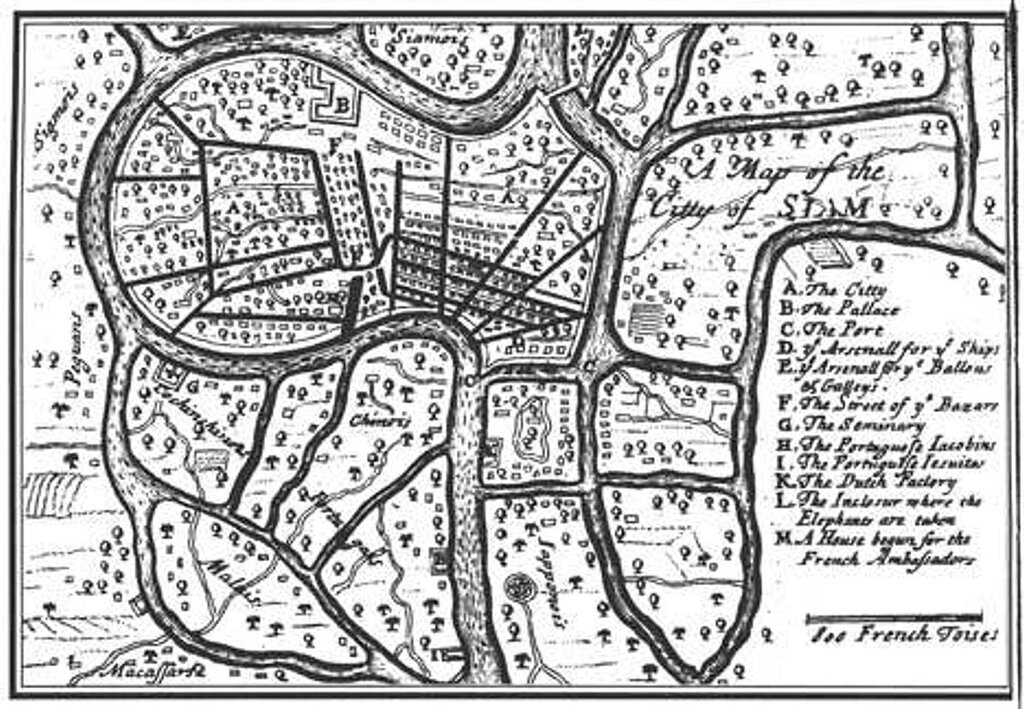
The introduction of firearms also spurred developments in defensive strategy. Ayutthaya's capital was a natural fortress, an island at the confluence of three rivers. This location was a key strategic advantage, making direct assault difficult. The kingdom further enhanced these natural defences by constructing extensive brick fortifications and watchtowers along the island's perimeter.
Early siege warfare involved surrounding the city and attempting to starve it out or find a weak point in its walls. The arrival of cannon, brought by Europeans, made these fortifications even more crucial. Battles increasingly became prolonged sieges, with defenders using the city's walls and waterways to fend off attackers armed with powerful new artillery.
Ready to test your knowledge on Ayutthaya's military evolution?
What term is often used to describe the decentralised political structure of the early Ayutthaya Kingdom, where the king's power was at the centre of a web of subordinate rulers?
How did the Ayutthaya Kingdom primarily mobilise its large military forces for campaigns?
Understanding these early structures is key to grasping how Ayutthaya managed to dominate the region and engage in a prolonged struggle with its neighbours.