Cerebral Hemisphere Anatomy and Functional Mapping
Cortical Landmarks
The Brain's Wrinkled Map
The surface of the human brain isn't smooth. It's a complex landscape of folds and grooves, which dramatically increases the surface area of the cerebral cortex, the brain's outer layer. This clever folding allows a large, powerful processing sheet to fit inside the skull. The ridges are called gyri, and the grooves are called sulci. Think of it like a crumpled piece of paper; you can fit a lot more surface into a small ball than if you just laid it flat.
Gyrus
noun
A ridge or fold between two clefts on the cerebral surface in the brain.
Deeper grooves are often called fissures. These folds aren't random; they form a consistent pattern across human brains. Neuroanatomists use the most prominent sulci and fissures as landmarks to divide the brain into functional regions called lobes.
Sulcus
noun
A groove or furrow, especially one on the surface of the brain.
Major Landmarks
Three main fissures act as the primary borders for the brain's lobes. They are the key to navigating the cerebral cortex.
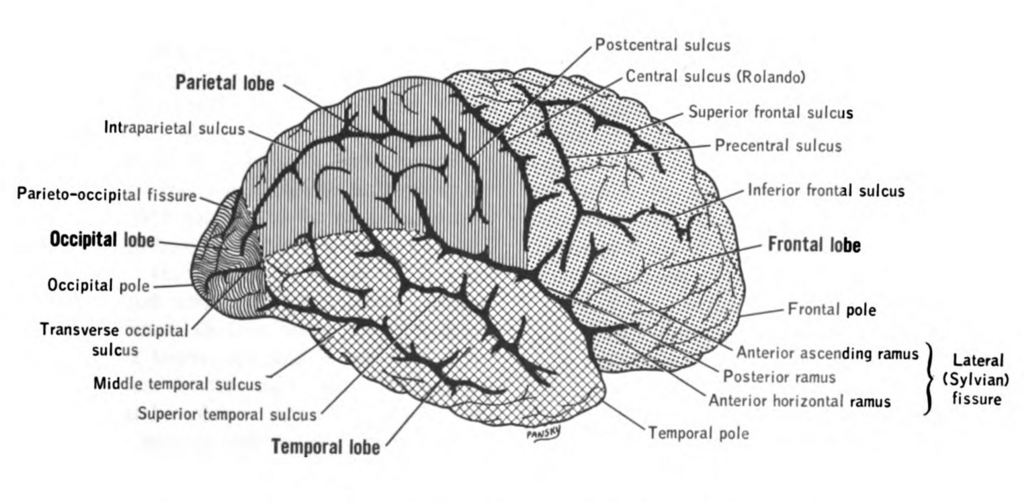
The Central Sulcus, also known as the Fissure of Rolando, runs down the side of the brain from the top. It creates a critical boundary between the frontal lobe at the front and the parietal lobe behind it. This isn't just a geographical border; it separates the primary motor cortex from the primary somatosensory cortex.
The Lateral Fissure, or Sylvian Fissure, is a deep groove that runs along the side of each hemisphere. It separates the temporal lobe below from the frontal and parietal lobes above. If you were to gently pull the lobes apart at this fissure, you would find another lobe, the insula, tucked away deep inside.
The Parieto-occipital Fissure is the third major landmark. Unlike the others, it's most clearly visible on the medial surface of the brain, the flat face between the two hemispheres. As its name suggests, it separates the parietal lobe from the rearmost occipital lobe.
A Tour of the Lobes
With our main landmarks established, we can explore the specific gyri on the surface of each lobe.
The Frontal Lobe is the largest lobe, responsible for executive functions like planning, decision-making, and voluntary movement.
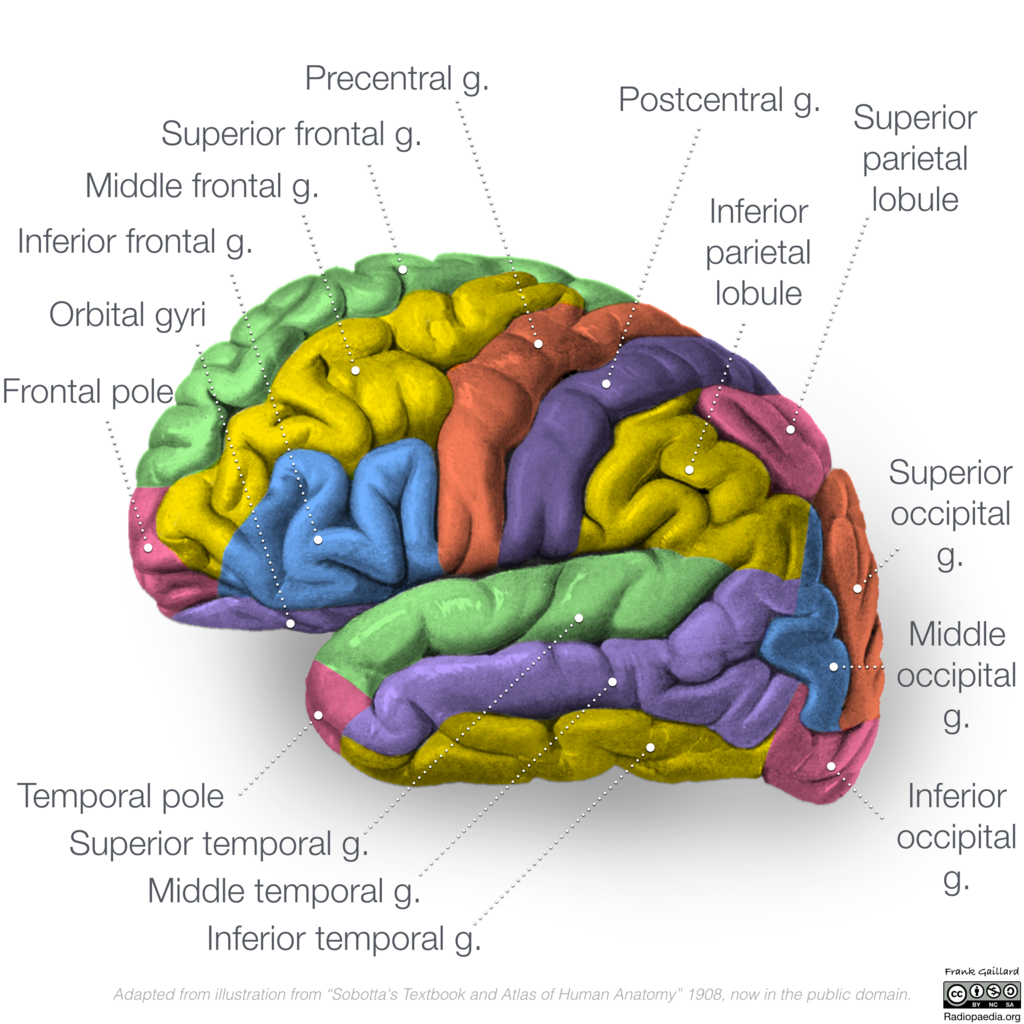
Just in front of the central sulcus is the precentral gyrus. This is a critically important strip of cortex that functions as the primary motor cortex, directing voluntary movements for the opposite side of the body. Further forward, the rest of the frontal lobe's lateral surface is organized into three parallel, horizontal gyri: the superior, middle, and inferior frontal gyri.
The Parietal Lobe processes sensory information, including touch, temperature, pain, and pressure. It's also involved in spatial awareness and navigation.
Immediately behind the central sulcus lies the postcentral gyrus. This is the anatomical home of the primary somatosensory cortex, which receives tactile information from the body. It's a mirror to the precentral gyrus in function. The rest of the parietal lobe is divided into a superior parietal lobule and an inferior parietal lobule.
The Temporal Lobe, situated beneath the lateral fissure, is the hub for hearing, memory, and recognizing objects and language.
Like the frontal lobe, the lateral surface of the temporal lobe is neatly organized into three parallel gyri: the superior, middle, and inferior temporal gyri. The superior temporal gyrus is particularly important, as it contains the primary auditory cortex.
Knowing these major landmarks is the first step in understanding how the brain is organized. This structural map provides the foundation for linking specific areas of the brain to their remarkable functions.
Now, test your knowledge of these cortical landmarks.
What is the primary advantage of the cerebral cortex being folded into gyri and sulci?
The landmark that separates the primary motor cortex from the primary somatosensory cortex is the:
By identifying these key gyri and sulci, we can begin to create a detailed map of the brain and its functions.