Ceramic Creation Fundamentals
Clay Preparation
Preparing Your Clay
Before you can shape clay into a pot or sculpture, you have to prepare it. This first step is the foundation for everything that follows. Think of it like a chef preparing ingredients before cooking. Skipping this stage can lead to cracks, unevenness, or even explosions in the kiln. Proper preparation ensures the clay is workable, consistent, and free of air bubbles.
Types of Clay
Not all clay is the same. Potters work with different 'clay bodies', which are mixtures of clay and other minerals blended to achieve specific properties. The three main types you'll encounter are earthenware, stoneware, and porcelain. Each has a unique character and is suited for different kinds of work.
| Clay Body | Firing Temperature | Common Color (Fired) | Key Properties |
|---|---|---|---|
| Earthenware | Low (1800-2100°F) | Red, brown, tan, white | Porous, easy to work with, good for decorative items. |
| Stoneware | Medium-High (2100-2350°F) | Gray, buff, brown | Dense, durable, non-porous. Great for functional pottery like mugs and plates. |
| Porcelain | High (2300-2400°F) | Bright white, translucent | Strong but less forgiving, excellent for fine details and elegant forms. |
Choosing the right clay depends on your project. If you're a beginner, stoneware is a great all-around choice. Its plasticity makes it forgiving to work with, and its durability is perfect for everyday dishes. Earthenware is often used for terracotta pots and sculpture, while porcelain is favored by experienced potters for its delicate, glass-like quality.
Wedging and Kneading
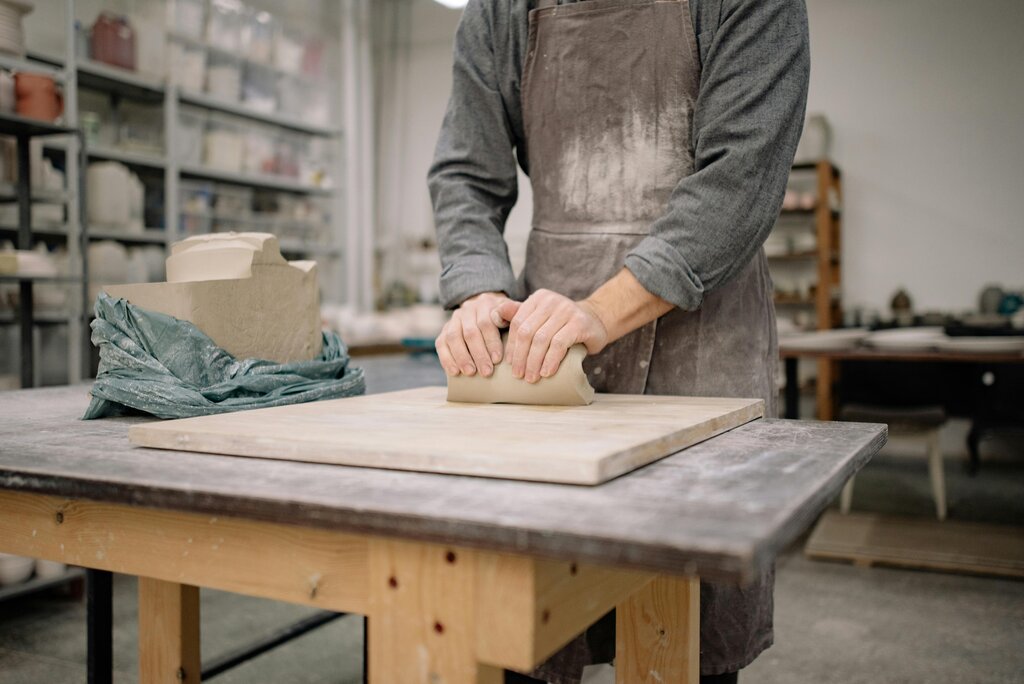
Once you've chosen your clay, the most important physical task is wedging. This is the process of kneading the clay to get it ready for use. It serves two critical functions: removing trapped air bubbles and ensuring the moisture and clay particles are evenly distributed.
Air bubbles trapped in clay will expand when heated in the kiln, causing your piece to crack or even shatter.
There are two popular methods for wedging clay.
wedging
verb
A process of kneading clay to expel air bubbles and create a homogenous consistency.
Ram's Head Wedging: This technique involves pushing the clay down and away from you on a sturdy surface, then rolling it back. Repeating this motion creates a spiral pattern inside the clay that looks like a ram's horn. It’s an efficient way to align the clay particles.
Stack and Slam Wedging: This is a simpler method. You cut the clay in half with a wire, then pick one half up and slam it down onto the other. You repeat this process many times. It’s great for combining clays of different moisture levels and is very effective at removing air.
You’ll know your clay is ready when it feels smooth and uniform. A good test is to slice through the wedged lump with a wire. The cut surface should be perfectly smooth, with no holes, lines, or streaks of different colors. Now your clay is in its most plastic state and ready to be transformed.
What are the two primary purposes of wedging clay?
Which type of clay is often recommended for beginners because it is forgiving and durable?
With well-prepared clay, you've set yourself up for a much smoother and more successful making process.