Central Processing Unit Explained
Introduction to CPU Architecture
Inside the Computer's Brain
The Central Processing Unit, or CPU, is the core of any computer. It's often called the brain, and for good reason. It’s where the computer does its thinking, processing instructions and making calculations that bring software to life. But this brain isn't one solid block; it's made of several key parts working together. To understand how a computer works, we first need to look at its anatomy.
The main components are the Control Unit, the Arithmetic Logic Unit (ALU), Registers, and Buses. Each has a distinct and vital job. Together, they form the engine that drives every task, from opening a file to playing a video.
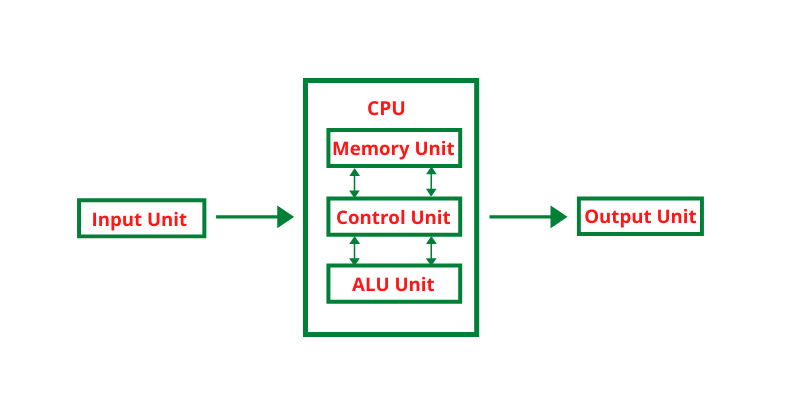
Let's break down what each of these components does.
The Control Unit
The Control Unit (CU) is the traffic cop or orchestra conductor of the CPU. It doesn't perform any calculations itself. Instead, its job is to manage and coordinate all the computer's operations. It reads instructions from memory and directs the other components on what to do next.
Think of it this way: when you double-click an icon, the Control Unit interprets that command. It then sends signals to the hard drive to load the program, tells the ALU if any math is needed, and directs the results to your screen. It manages the flow of data, ensuring everything happens in the right order and at the right time. Without the CU, the other parts of the CPU would be powerful but clueless.
The Control Unit directs the operation of the CPU by interpreting instructions from the computer’s memory and generating the control signals needed to execute them.
The Arithmetic Logic Unit
If the Control Unit is the director, the Arithmetic Logic Unit (ALU) is the brilliant mathematician. This is where the actual number-crunching and decision-making happens. The ALU has two primary functions.
Arithmetic Operations: This includes all the basic math: addition, subtraction, multiplication, and division. When a program needs to calculate a sum or figure out a percentage, the CU hands the task to the ALU.
Logical Operations: This involves comparisons. The ALU can determine if one number is greater than, less than, or equal to another. It also handles Boolean logic like AND, OR, and NOT. These operations are the foundation of all decision-making in computing, like an
ifstatement in code that checks if a password is correct.
Registers and Buses
While the ALU is busy calculating, it needs a place to hold the data it's working on. It can't just pull numbers from the main memory (RAM) for every single calculation—that would be far too slow. This is where registers come in.
Register
noun
A small, extremely fast storage location built directly into the CPU. Registers hold data, instructions, or memory addresses that are actively being used by the CPU.
Registers are like the CPU's personal scratchpad. They are small, but incredibly fast, memory locations. When the CU fetches an instruction, it's held in a register. When the ALU needs to add two numbers, those numbers are placed in registers. The result is then stored in another register. This high-speed access is crucial for the CPU's performance.
So how does all this data move around? That's the job of the buses.
A bus is an electrical pathway that connects the different components of the CPU and the computer itself. Think of it as a highway system for data.
There are different types of buses, each with a specific role:
- Data Bus: Carries the actual data being processed between the CPU, memory, and other devices.
- Address Bus: Carries the memory addresses that the CPU wants to read from or write to. It tells the data where to go.
- Control Bus: Carries control signals from the CU to other components, synchronizing all the activities.
Together, these components form a powerful, coordinated system. The Control Unit directs, the ALU calculates, Registers hold the immediate data, and Buses move everything where it needs to go.
Which component of the CPU is responsible for directing and coordinating the activities of all other computer components, but does not perform calculations itself?
If the CPU needs to perform a mathematical operation like addition or subtraction, which component does the actual calculation?
Understanding these core parts is the first step to seeing how a computer truly executes commands.