Cellular Biology Essentials
Introduction to Cell Biology
The Building Blocks of Life
Every living thing you can see, from the tallest tree to the smallest insect, is made of tiny units called cells. Even organisms too small to see, like bacteria, are cells. They are the fundamental building blocks of all life on Earth.
This idea is so central to biology that it's known as the cell theory. It's a simple but powerful concept with three main parts.
- All living organisms are made of one or more cells.
- The cell is the basic unit of structure and function in organisms.
- All cells come from pre-existing cells.
The first point means that whether an organism is a single, self-sufficient cell or a complex creature like a human with trillions of cells, the cell is the common denominator. The second point establishes that a cell is the smallest thing that can be considered alive. The third tells us that cells don't just appear from nowhere; they are born from other cells through division.
Two Basic Designs
While all cells share some basic features, they fall into two main categories: prokaryotic and eukaryotic. The biggest difference between them is how they store their genetic information, or DNA.
Prokaryotic cells are the simpler of the two. Their DNA floats freely within the cell in a region called the nucleoid. They don't have many internal structures, and they are always single-celled organisms. Bacteria are the most common example of prokaryotes.
Eukaryotic cells are more complex. Their most defining feature is a nucleus, a membrane-enclosed structure that houses the cell's DNA. This keeps the genetic material organized and protected. Eukaryotic cells also have other specialized compartments called organelles that perform specific jobs. Plants, animals, fungi, and protists are all made of eukaryotic cells.
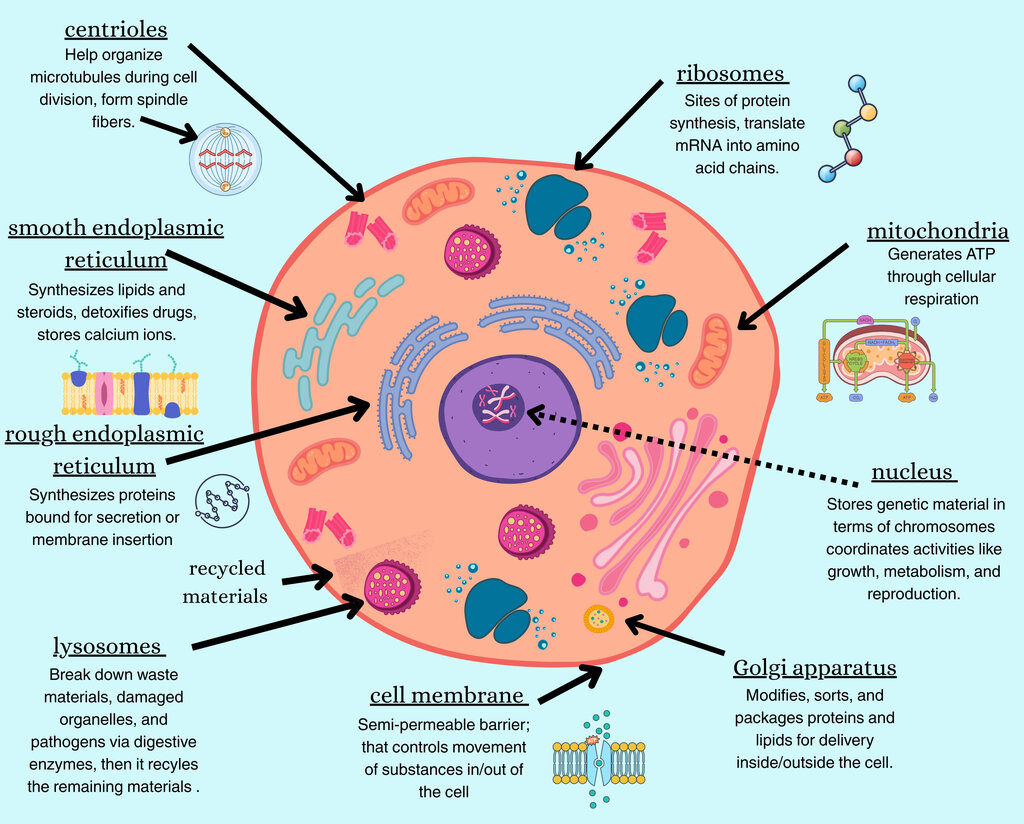
Here’s a quick breakdown of the key differences:
| Feature | Prokaryotic Cell | Eukaryotic Cell |
|---|---|---|
| Nucleus | Absent | Present |
| DNA Location | Free in cytoplasm (nucleoid) | Inside the nucleus |
| Organelles | Few to none | Many, membrane-bound |
| Size | Typically smaller (0.1–5.0 µm) | Typically larger (10–100 µm) |
| Examples | Bacteria, Archaea | Plants, Animals, Fungi |
A Cell's Basic Functions
Regardless of their type, all cells must perform a few essential tasks to stay alive. Think of it as a cell's basic job description.
First, they need to manage energy. Cells take in nutrients and convert them into usable energy to power their activities, a process known as metabolism. They also need to grow and maintain their structure, building and repairing their own parts.
Cells also respond to their environment. They can react to stimuli like temperature, light, or chemical signals. This allows them to adapt to changing conditions. Finally, and perhaps most importantly, cells reproduce by dividing. This process ensures the continuation of life, passing genetic information from one generation of cells to the next.
Which of the following is NOT a core principle of the cell theory?
What is the primary feature that distinguishes a eukaryotic cell from a prokaryotic cell?