Cell Membrane Dynamics and Indian Scientific Contributions
Membrane Fluidity and Structure
The Living Barrier
A cell isn't just a bag of chemicals. It's a highly organised, bustling city, and like any city, it needs borders. The plasma membrane acts as this border, a flexible, intelligent barrier that controls everything that goes in and out. But calling it a simple wall is misleading. It's far more dynamic.
In 1972, scientists S.J. Singer and G.L. Nicolson proposed a new way of thinking about this structure: the . This model pictures the membrane not as a rigid structure, but as a fluid sea of phospholipids. In this sea, various proteins are embedded or floating, much like icebergs. This fluidity is the key to the membrane's function.
The fluid mosaic model describes the structure of the plasma membrane as a mosaic of components—including phospholipids, cholesterol, proteins, and carbohydrates—that gives the membrane a fluid character.
Building Blocks of the Barrier
The foundation of this fluid sea is the phospholipid bilayer. Each phospholipid molecule is amphipathic—it has a dual personality. The 'head' is hydrophilic, meaning it loves water, while the two fatty acid 'tails' are hydrophobic, meaning they fear water. When placed in an aqueous environment like the body, they spontaneously arrange themselves into a bilayer. The water-loving heads face outwards, towards the cytoplasm and the extracellular fluid, while the water-fearing tails tuck inwards, creating a protected, oily core.
This clever arrangement makes the membrane selectively permeable. Small, uncharged molecules like oxygen and carbon dioxide can slip through the oily core easily. However, larger molecules like glucose and charged ions cannot pass through without help.
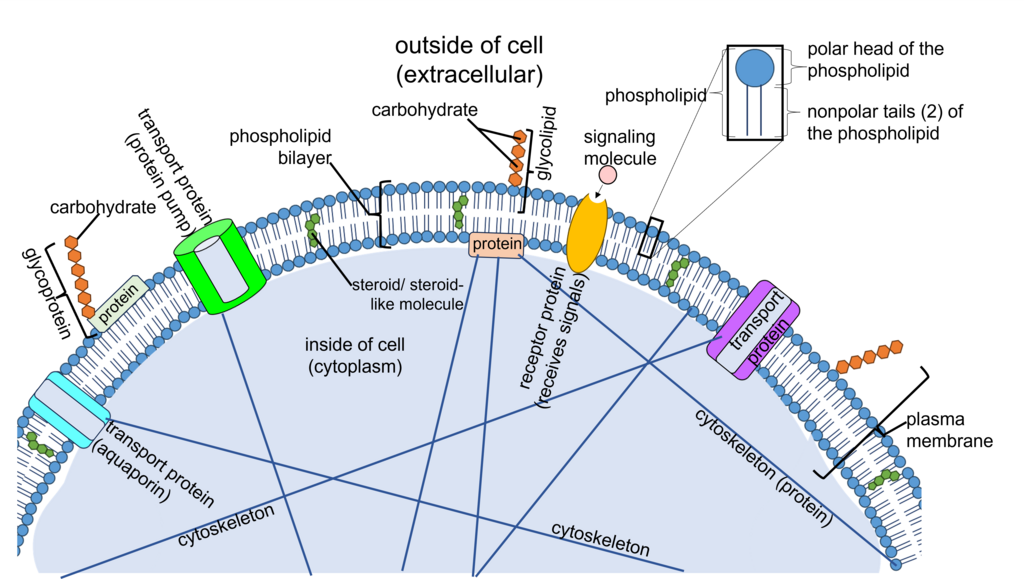
But a sea of just lipids would be too simple. The 'mosaic' part of the model comes from the proteins embedded within this bilayer. There are two main types:
- Integral Proteins: These are the 'icebergs'. They are embedded deep within the bilayer, often spanning its entire width. They act as channels or pumps, creating regulated pathways for specific substances to cross the membrane.
- Peripheral Proteins: These are more like boats tied to the shore. They are loosely attached to the inner or outer surface of the membrane, often bound to integral proteins. They play roles in cell signalling and anchoring the cytoskeleton.
Maintaining the Flow
The term 'fluid' isn't just a metaphor. The lipids and proteins can move laterally, like people mingling in a crowd. This fluidity is crucial for processes like cell growth, movement, and division. But the cell must maintain this fluidity at just the right level. Too rigid, and transport stops. Too fluid, and the membrane loses its structural integrity.
Two factors are key to regulating this fluidity:
- Fatty Acid Composition: The tails of phospholipids can be saturated (straight) or unsaturated (kinked). Saturated tails can pack tightly together, making the membrane more viscous and less fluid. Unsaturated tails have kinks that prevent tight packing, increasing fluidity.
- Cholesterol: In animal cells, cholesterol molecules are wedged between the phospholipids. At warm temperatures, cholesterol restrains the movement of phospholipids, preventing the membrane from becoming too fluid. At cool temperatures, it prevents them from packing too tightly, maintaining fluidity and preventing the membrane from freezing.
Cholesterol acts as a fluidity buffer, preventing the membrane from becoming too fluid or too rigid.
Finally, the membrane is also asymmetric. The two halves of the bilayer are not mirror images of each other. The types of lipids and the associated proteins and carbohydrates are different on the cytoplasmic side compared to the extracellular side. For instance, carbohydrate chains are only found on the outer surface, where they form the glycocalyx, which is involved in cell-to-cell recognition and protection.
This structural asymmetry is directly linked to the membrane's functional asymmetry. The inside and outside of the cell have very different jobs, and the membrane's structure on each side reflects that.
Modern research, including important work done at centres like the CCMB in Hyderabad, continues to unravel the complexities of membrane dynamics, exploring how the physical state of the membrane influences everything from nerve impulses to immune responses.
Let's test your understanding of the cell membrane's intricate structure.
According to the Fluid Mosaic Model, what does the 'mosaic' aspect refer to?
A phospholipid molecule is described as amphipathic. What does this term mean?
The Fluid Mosaic Model reveals the cell membrane as a dynamic, adaptable, and intelligent structure, perfectly suited for its role as the gatekeeper of the cell.