Cell Division in Medicine
Cell Division Basics
The Life of a Cell
Just like people, cells have a life cycle. They are born, they grow, they perform their jobs, and eventually, they divide to create new cells. This orderly sequence of events is the foundation for how organisms grow, heal, and continue to exist.
The sequence of events a cell undergoes from the end of one cell division to the end of next cell division is called Cell Cycle.
This cycle is happening in your body right now. Millions of cells are dividing to replace old skin, heal a paper cut, or simply help you grow. Understanding this fundamental process is key to understanding life itself.
A Cycle in Two Acts
The cell cycle can be split into two main parts: a long preparatory period and a much shorter period of actual division. Think of it like preparing for a big performance. Most of the time is spent backstage getting ready, while the show itself is relatively brief but dramatic.
The cell cycle involves two distinct phases as Interphase and Mitotis [M-Phase]
Interphase is the lengthy preparation stage, where the cell grows and copies its genetic material. The M phase, which includes mitosis and cytokinesis, is when the cell splits into two.
Interphase itself has three distinct sub-phases:
-
G1 (Gap 1) Phase: The cell gets bigger and carries out its normal, everyday functions. For a skin cell, this might mean producing proteins that form the skin barrier. It’s the longest phase for most cells.
-
S (Synthesis) Phase: This is a critical step. The cell makes a complete copy of its DNA, which is the genetic blueprint for life. Before division, every bit of this instruction manual must be duplicated so each new cell gets a full set.
-
G2 (Gap 2) Phase: After the DNA is copied, the cell enters a final growth spurt. It produces extra proteins and organelles (the cell's tiny organs) to ensure it has enough equipment to furnish two new daughter cells.
Finally, the cell is ready to enter the M (Mitotic) Phase. This is where the cell's nucleus divides (mitosis) and the cytoplasm splits in two (cytokinesis), forming two separate, identical cells.
| Phase | Name | Key Events |
|---|---|---|
| G1 | Gap 1 | Cell growth, carrying out normal metabolic functions |
| S | Synthesis | DNA replication (copying the genetic material) |
| G2 | Gap 2 | Further growth, final preparations for division |
| M | Mitotic | Division of the nucleus and cytoplasm |
Why Bother Dividing?
Cell division isn't just a biological curiosity; it's essential for life as we know it. It serves three primary purposes.
Growth: A single fertilized egg divides over and over to build a complex, multicellular organism like a human. Every part of you, from your bones to your brain, is the result of countless rounds of cell division.
The second major purpose is repair and maintenance.
Repair and Maintenance: Your body is constantly replacing old or damaged cells. Red blood cells live for about four months, and the cells lining your gut are replaced every few days. When you get a cut, cell division is what creates new skin to heal the wound.
And finally, cell division is the basis of reproduction for many organisms.
Reproduction: For single-celled organisms like bacteria, dividing into two is their way of creating offspring. In more complex organisms, a specialized type of cell division (meiosis) produces the egg and sperm cells necessary for sexual reproduction.
Keeping the Cycle in Check
A process this important can't be left to chance. The cell cycle is tightly regulated by a complex system of molecular signals, like a series of traffic lights. These control points, or checkpoints, ensure that each phase is completed correctly before the next one begins.
For example, there's a crucial checkpoint between the G1 and S phases. Here, the cell assesses if conditions are right for division. Is the cell large enough? Are there enough nutrients? Is the DNA undamaged? If the answer to any of these is no, the cell cycle will pause until the issues are resolved. Another checkpoint after the G2 phase makes sure the DNA was copied without any major errors.
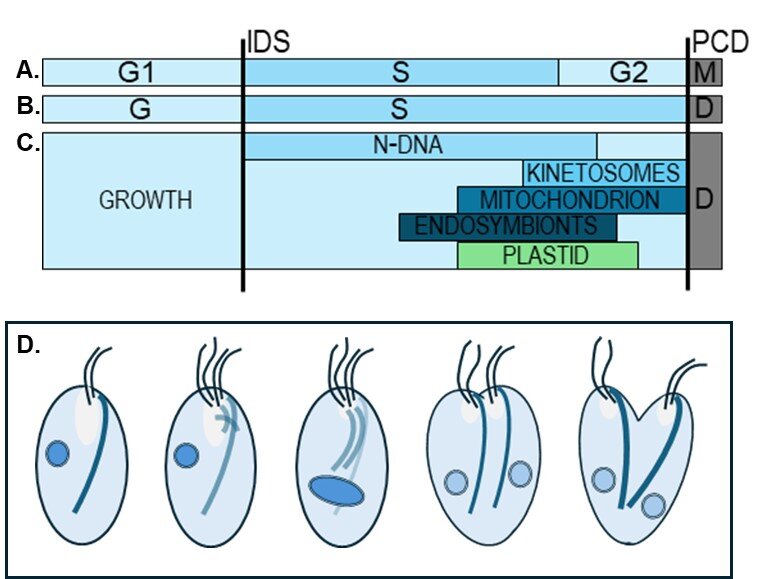
This regulation is vital. If a cell loses control of its cycle and begins to divide uncontrollably, it can lead to diseases like cancer. The checkpoints act as a safety mechanism, preventing damaged cells from multiplying and causing problems.
Time to see what you've learned about the life of a cell.
During which phase of the cell cycle is the cell's DNA replicated?
A cell that is actively carrying out its everyday functions and growing in size, but has not yet started copying its genetic material, is in which stage?
The cell cycle is a beautifully orchestrated process that makes life, growth, and healing possible. By carefully preparing and then dividing, cells ensure the continuity of life from one generation to the next.