Cell Division and Regulation
Molecular Cycle Regulation
The Cell's Molecular Engine
A cell doesn't just drift from growth to division. It follows a precise internal program, driven by a set of master regulatory proteins. Think of the cell cycle as a sophisticated engine. The core components of this engine are enzymes called Cyclin-Dependent Kinases (CDKs). By themselves, CDKs are inactive. They are like engines waiting for a key.
Kinase
noun
An enzyme that transfers phosphate groups from high-energy molecules, such as ATP, to specific target molecules (substrates). This process is called phosphorylation.
The keys are proteins called cyclins. Unlike CDKs, which are present at a fairly constant level, the concentration of different cyclins rises and falls in a predictable wave-like pattern throughout the cell cycle. When a specific cyclin reaches a high enough concentration, it binds to its partner CDK, forming a Cyclin-CDK complex. This binding is the first step in activating the CDK engine.
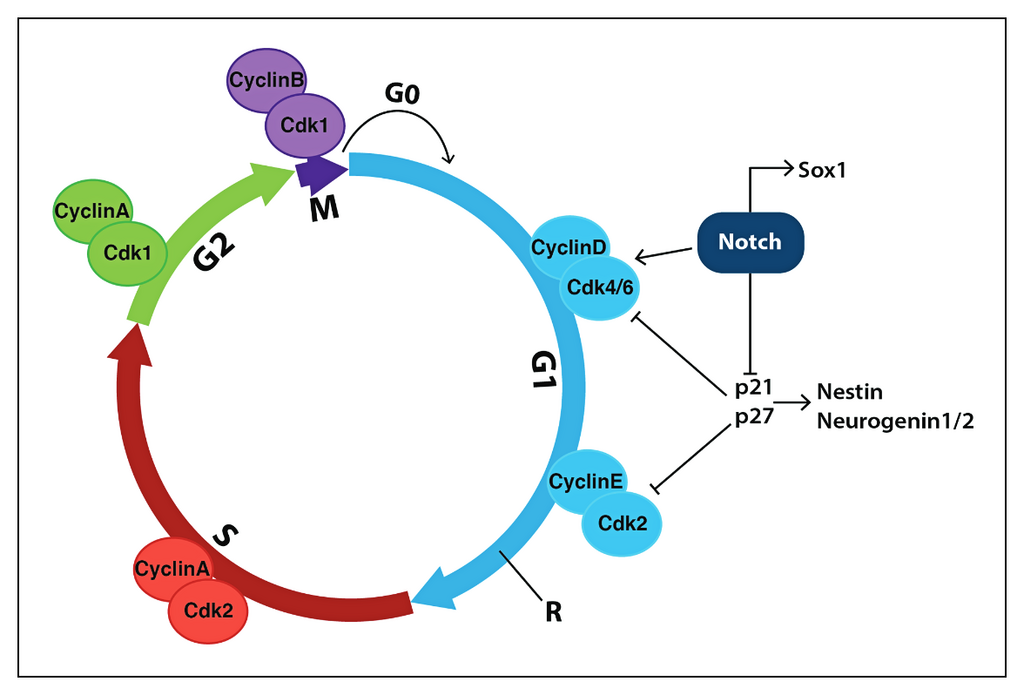
Once a Cyclin-CDK complex forms, it acts as a signaling hub. The active CDK is a kinase, meaning its job is to add a phosphate group to other proteins, a process called phosphorylation. This simple chemical tag acts like a switch, turning target proteins "on" or "off." By phosphorylating specific sets of proteins, each type of Cyclin-CDK complex pushes the cell into the next phase of the cycle. For example, the complexes active in S phase will phosphorylate proteins required for DNA replication.
Phosphorylation is one of the cell's most fundamental tools for controlling protein function. Adding or removing a phosphate group can change a protein's shape, activity, and location within the cell.
The Point of No Return
Early in the G1 phase, a cell is receptive to external signals. Growth factors, nutrient availability, and other cues from its environment influence whether it should prepare to divide. However, there comes a point where the decision becomes irreversible. This is the restriction point (R point).
Before the R point, a cell can halt its progress and enter a quiescent state (G0) if conditions aren't right. After crossing this threshold, it is committed to completing the entire cell cycle, regardless of external signals. It's like a rocket launching: once the main engines ignite, there's no turning back.
The molecular gatekeeper of the restriction point is a protein called Retinoblastoma (Rb). In its active state, Rb binds to and inhibits a group of transcription factors called E2F. This prevents the cell from producing the proteins needed for the S phase. To pass the restriction point, Cyclin D-CDK4/6 and Cyclin E-CDK2 complexes work together to phosphorylate Rb. This phosphorylation causes Rb to release E2F, allowing it to activate the genes necessary for DNA replication. The cell is now locked into the S phase.
Cleaning House
For the cell cycle to proceed in one direction, it's not enough to just turn proteins on. You also have to turn them off. Once a cyclin has done its job, it must be destroyed to prevent it from interfering with the next stage. If S-phase cyclins lingered into mitosis, for example, the cell might try to replicate its DNA again, which would be catastrophic.
The cell's primary disposal system is the ubiquitin-proteasome system an elegant mechanism for targeted protein destruction. Proteins slated for removal are tagged with a small protein called ubiquitin. This tagging is often initiated by a Cyclin-CDK complex itself, setting a timer on its own activity.
A chain of ubiquitin molecules acts as a signal, directing the tagged protein to a molecular wood chipper called the proteasome. The proteasome unfolds the protein and chops it into small pieces, effectively recycling its components. This process of proteolysis ensures that each stage of the cell cycle is definitive and irreversible. One of the most important ubiquitin ligase complexes is the Anaphase-Promoting Complex (APC/C), which tags mitotic cyclins for destruction, allowing the cell to exit mitosis and enter G1.
The interplay between synthesis, phosphorylation, and degradation creates a robust, self-regulating clock. Cyclin-CDK complexes drive the cell forward, while the ubiquitin-proteasome system ensures there's no going back. These molecular checks and balances guarantee that a cell divides only when it is truly ready, preserving the integrity of its genetic material for the next generation of cells.