Cell Biology Fundamentals
Introduction to Cell Biology
The Building Blocks of Life
Every living thing, from the smallest bacterium to the largest blue whale, is made of cells. Think of them as the basic building blocks of life, like bricks in a house. Some organisms, like yeast, are just a single cell. Others, like us, are made of trillions of cells working together.
A cell is the smallest independently functioning unit of a living organism.
Each cell is a tiny, self-contained unit that can take in nutrients, convert them into energy, and carry out specialized functions. This amazing ability is what makes life possible. Understanding cells is the first step to understanding how all living organisms work.
Discovering a Hidden World
For most of human history, we had no idea cells existed. They're too small to see with the naked eye. That all changed in the 1600s with the invention of the microscope. In 1665, a scientist named Robert Hooke looked at a thin slice of cork under his microscope. He saw a honeycomb of tiny, empty compartments, which he named "cells" because they reminded him of the small rooms in a monastery.
Over the next 200 years, scientists continued to observe cells in all sorts of plants and animals. By the 1830s, Theodor Schwann and Matthias Schleiden formally proposed that all living things are composed of cells. This idea, combined with the later discovery that cells only come from other cells, formed the basis of what we now call cell theory.
Cell theory is a cornerstone of biology. Its main points are:
- All living organisms are made of one or more cells.
- The cell is the most basic unit of life.
- All cells arise from pre-existing cells.
Two Main Designs
While all cells share some basic features, they come in two main designs: prokaryotic and eukaryotic.
The main difference between them is how they store their genetic material, or DNA. Think of DNA as the cell's blueprint. In a eukaryotic cell, the DNA is neatly tucked away inside a special compartment called the nucleus. Eukaryotic cells also have other membrane-bound compartments, called organelles, that perform specific jobs.
Prokaryotic cells are much simpler. They don't have a nucleus. Instead, their DNA just floats around in the cell's jelly-like interior, called the cytoplasm. They also lack the other complex organelles found in eukaryotes. Bacteria are the most common examples of prokaryotes.
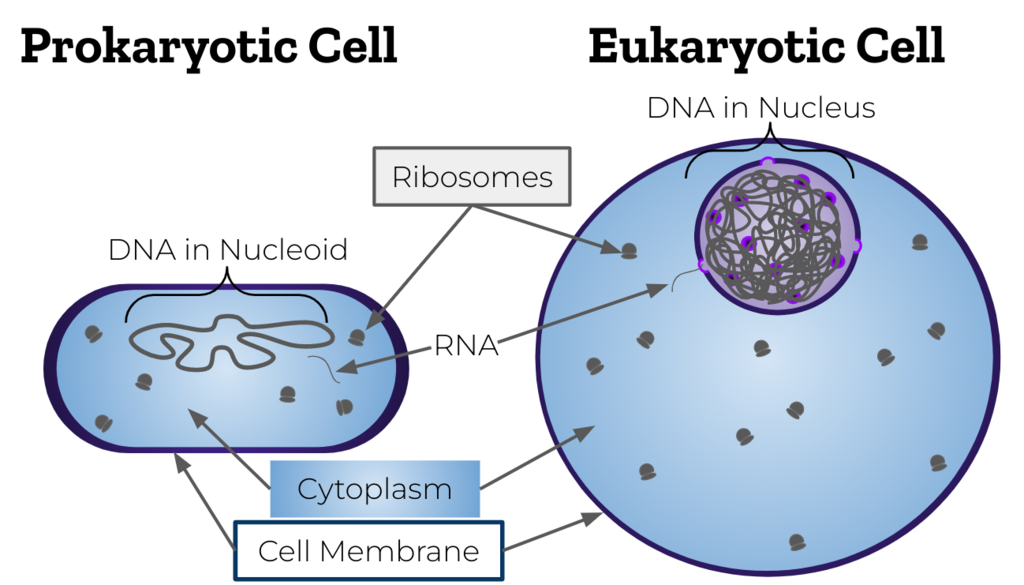
Eukaryotic cells make up everything from plants and animals to fungi and protists. They are generally larger and more complex than prokaryotic cells. This organization allows them to build much more complex, multicellular organisms, including you.
| Feature | Prokaryotic Cell | Eukaryotic Cell |
|---|---|---|
| Nucleus | Absent | Present |
| Membrane-bound Organelles | Absent | Present |
| Size | Typically smaller | Typically larger |
| Examples | Bacteria, Archaea | Plants, Animals, Fungi |
A Quick Tour Inside
Despite their differences, all cells have a few key parts in common. Let's briefly look at the universal components.
Cytoplasm
noun
The jelly-like substance that fills the cell and surrounds the internal components.
Every cell is enclosed by a cell membrane, which acts like a gatekeeper. It controls what enters and leaves the cell, protecting its internal environment. All cells also have ribosomes, which are tiny structures responsible for building proteins, the molecules that do most of the work in cells.
And of course, all cells have DNA, the genetic material that carries the instructions for building and operating the cell. In eukaryotes it's in the nucleus, and in prokaryotes it's in a region of the cytoplasm called the nucleoid.
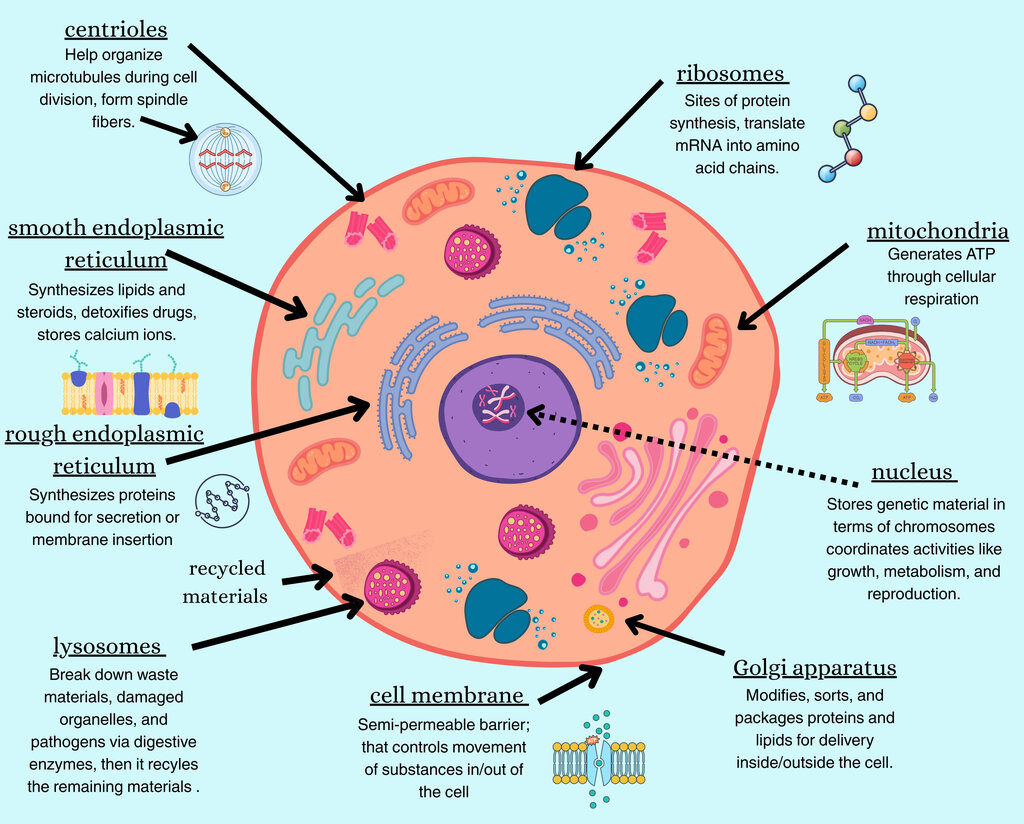
This basic toolkit—membrane, cytoplasm, ribosomes, and DNA—is the universal foundation upon which all life is built.
Who was the first scientist to observe and name "cells" after looking at a thin slice of cork?
What is the main feature that distinguishes a eukaryotic cell from a prokaryotic cell?