CBSE Grade 6 Mathematics Essentials
Numbers and Operations
The Building Blocks of Math
Let's start at the very beginning. The first numbers you ever learned were likely the ones you used for counting: 1, 2, 3, and so on. These are called natural numbers, and they're the most basic tool we have for understanding quantity.
Natural Numbers: {1, 2, 3, 4, ...}
Soon after, you probably learned about a special number: zero. When we add zero to the set of natural numbers, we get the whole numbers. Zero represents the absence of something, a concept that's simple yet powerful.
Whole Numbers: {0, 1, 2, 3, ...}
Expanding the Number Line
But what about numbers less than zero? Think about temperature on a cold day, or owing someone money. For these situations, we need negative numbers. When we combine the whole numbers with their negative counterparts (..., -3, -2, -1), we get a set called the integers.
Integers: {..., -3, -2, -1, 0, 1, 2, 3, ...}
A number line is a great way to visualize these. Zero sits in the middle. Positive numbers stretch out to the right, getting larger, while negative numbers go to the left, getting smaller.
Numbers Between Numbers
Of course, not everything can be measured in whole numbers. What if you eat half a pizza or run for 2.5 miles? For this, we need to explore the spaces between the integers on our number line. Two common ways to represent these values are fractions and decimals.
A fraction shows a part of a whole, like 1/2 or 3/4. It has two parts: the numerator (top number) tells you how many parts you have, and the denominator (bottom number) tells you how many parts make up the whole.
| Type | Description | Example |
|---|---|---|
| Proper Fraction | The numerator is smaller than the denominator. Its value is less than 1. | |
| Improper Fraction | The numerator is larger than or equal to the denominator. Its value is 1 or more. | |
| Mixed Number | A whole number combined with a proper fraction. |
Decimals are another way to write fractions, specifically those based on powers of ten (like 10, 100, 1000). The position of each digit after the decimal point has a specific place value, just like the digits in a whole number.
For the number 12.345:
- The 1 is in the tens place.
- The 2 is in the ones place.
- The 3 is in the tenths place ($3/10$).
- The 4 is in the hundredths place ($4/100$).
- The 5 is in the thousandths place ($5/1000$).
Putting Numbers to Work
Numbers aren't very useful if we can't do anything with them. The four basic operations of arithmetic allow us to combine and manipulate numbers to solve problems. They are addition, subtraction, multiplication, and division.
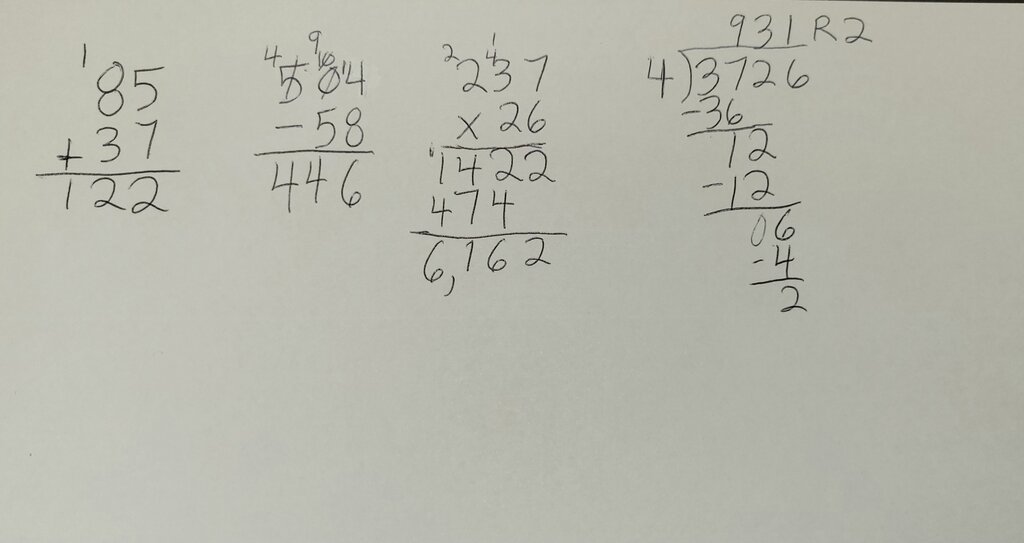
Addition (+): Combining values to find a total, or sum. For example, .
Subtraction (−): Finding the difference between two values. For example, .
Multiplication (×): Repeated addition. It's a fast way of adding the same number over and over. For example, is the same as , which equals 12.
Division (÷): Splitting a number into equal parts or groups. For example, means you can split 20 into 5 groups of 4.
It's important to know that with addition and multiplication, the order of the numbers doesn't change the result ( is the same as ). However, with subtraction and division, order matters a great deal ( is not the same as ).
Time to check your understanding of these building blocks.
Which of the following sets of numbers includes negative numbers, zero, and positive numbers?
In the fraction , what does the number 8 represent?
Grasping these fundamental types of numbers and how to operate on them is the first major step in your journey with mathematics. Everything that comes next builds on this foundation.