CBSE Grade 12 Physics Essentials
Electric Charges and Fields
The World of Electric Charge
Everything around us, from the air we breathe to the screen you're reading this on, is made of atoms. At the heart of these atoms are particles that carry a fundamental property called electric charge. It's this charge that governs how objects interact electrically.
There are two kinds of electric charge: positive and negative. Protons, found in the nucleus of an atom, are positively charged, while electrons, orbiting the nucleus, are negatively charged. The basic rule of interaction is simple but powerful: like charges repel each other, and opposite charges attract.
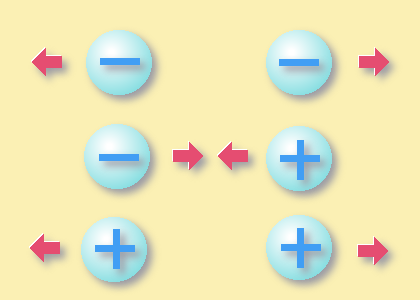
Electric charge has a few key properties. First, it's additive. If a system contains two charges, say units and unit, the total charge is simply the algebraic sum: unit. Second, charge is conserved. In an isolated system, the total electric charge never changes. It can be redistributed, but it can't be created or destroyed. Finally, charge is quantised.
Quantisation means that electric charge always exists in discrete packets, not as a continuous amount. The smallest possible unit of free charge is the charge of a single electron or proton, denoted by .
The Force Between Charges
We know that charges exert forces on each other, but how strong are these forces? In the 18th century, French physicist Charles-Augustin de Coulomb formulated a law that precisely describes this interaction. It's now known as Coulomb's Law.
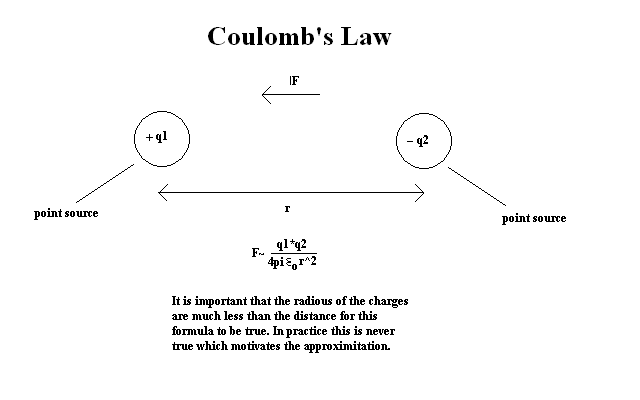
The law states that the force between two point charges is directly proportional to the product of the charges and inversely proportional to the square of the distance between them. This 'inverse-square' relationship is a common theme in physics, also appearing in Newton's law of gravitation.
What if you have more than two charges? The total force on any one charge is simply the vector sum of the forces exerted on it by all the other charges, one at a time. This is called the principle of superposition. You calculate the force from each charge individually using Coulomb's law and then add them all up as vectors.
The Electric Field
How does one charge 'know' that another is nearby to exert a force on it? The concept of the electric field helps explain this action-at-a-distance. Every charge modifies the space around it, creating an electric field. Any other charge that enters this field experiences a force.
Just like masses have gravitational fields, charged particles have electric fields.
We define the electric field strength () at a point as the force () that would be exerted on a small positive test charge () placed at that point, divided by the magnitude of the test charge.
To visualise these invisible fields, we use electric field lines. These are imaginary lines drawn in a way that their direction at any point is the same as the direction of the electric field at that point. The density of the lines represents the strength of the field; where the lines are close together, the field is strong, and where they are far apart, it's weak.
For a positive charge, field lines radiate outwards. For a negative charge, they point inwards.
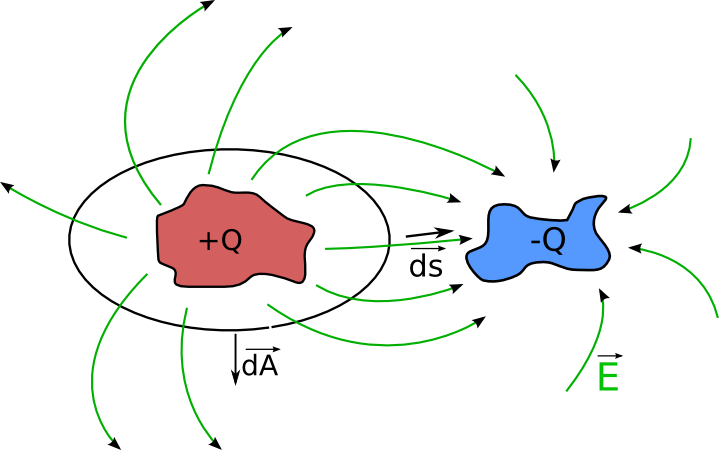
A simple and important configuration is the electric dipole, which consists of two equal and opposite charges separated by a small distance. In a uniform external electric field, a dipole experiences a torque that tries to align it with the field, but it experiences no net force.
Flux and Gauss's Law
Imagine holding a net in a river. The amount of water flowing through the net depends on the speed of the water, the size of the net, and how you orient it. Electric flux is a similar idea. It's a measure of the total number of electric field lines passing through a given surface.
Electric Flux
noun
The measure of the flow of the electric field through a given area. It is proportional to the number of electric field lines going through a normally perpendicular surface.
This concept leads to one of the most powerful and elegant laws in electromagnetism: Gauss's Law. It provides a way to calculate the electric field for highly symmetric charge distributions, like a charged sphere or an infinite line of charge, much more easily than using Coulomb's Law and superposition.
Gauss's Law states that the net electric flux through any closed surface is directly proportional to the net electric charge enclosed by that surface.
The magic of Gauss's law is in the choice of the closed surface, known as a 'Gaussian surface'. By choosing a surface that matches the symmetry of the charge distribution (like a cylinder for a long wire or a sphere for a point charge), the calculation of the electric field becomes remarkably simple. It elegantly connects the charge inside a surface to the electric field pattern on that surface.
Now that you've been introduced to the core concepts of electrostatics, test your understanding.
What is the fundamental rule governing the interaction between electric charges?
According to Coulomb's Law, if the distance between two point charges is doubled, the electric force between them becomes...
This chapter has laid the foundation for understanding static electricity, from the nature of charge to the forces and fields it creates. These principles are not just abstract concepts; they are the bedrock of nearly all modern electrical and electronic technology.