CBSE 6th Grade Grammar Essentials
Parts of Speech
The Building Blocks of Language
Every sentence you read or speak is built from a few basic types of words. Think of them like ingredients in a recipe. Each has a specific job to do. When you combine them correctly, you create a clear and meaningful sentence. These categories are called the parts of speech.
To start expanding your grammar knowledge, it’s helpful to begin with an understanding of the eight traditional parts of speech that make up our sentences: nouns, pronouns, verbs, adjectives, adverbs, prepositions, interjections, and conjunctions.
Understanding these eight categories is the first step toward mastering English grammar. Let's look at each one.
Words that Name
The first two parts of speech give names to the characters and objects in our sentences.
Noun
noun
A word that represents a person, place, thing, or idea.
Nouns are everywhere. Your name is a noun. The device you're reading this on is a noun. Words like teacher, city, book, happiness, and science are all nouns. They give us the 'who' or 'what' in a sentence.
Examples of nouns: Maria, London, chair, freedom.
Writing would get very repetitive if we had to use the same noun over and over. That’s where pronouns come in.
Pronoun
noun
A word used in place of a noun.
Pronouns are shortcuts. Instead of saying, "David bought a coffee because David was thirsty," you can say, "David bought a coffee because he was thirsty." Common pronouns include I, you, he, she, it, we, and they.
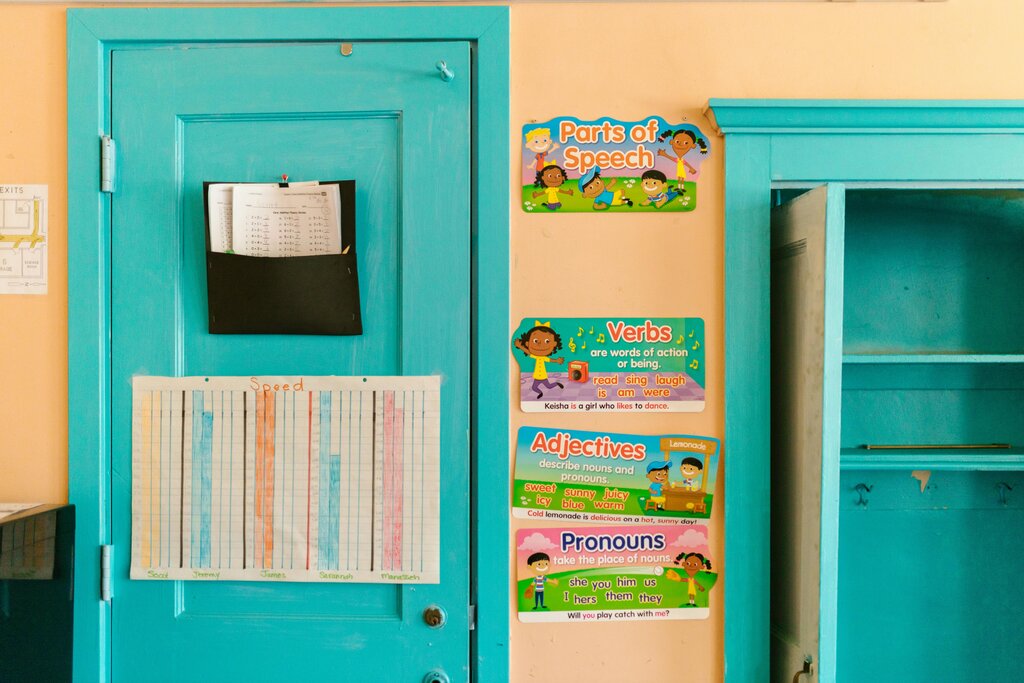
Words that Act and Describe
Once we have our nouns, we need words to make them do things and to describe what they're like. This is where verbs, adjectives, and adverbs come into play.
Verb
noun
A word that expresses an action or a state of being.
Every complete sentence needs a verb. Verbs can show action, like run, think, or write. They can also show a state of being, linking the subject to a description. These are often forms of the verb 'to be,' such as is, am, are, was, and were.
Action: The dog barks. State of being: The dog is happy.
Next, we have adjectives, which add color and detail to our nouns.
Adjective
noun
A word that describes or modifies a noun or pronoun.
Adjectives answer questions like 'what kind?', 'which one?', or 'how many?'. They give us more information about the nouns in our sentence. Words like happy, tall, blue, and five are all adjectives.
The tall girl wore a blue dress.
Adverbs are similar, but instead of modifying nouns, they typically modify verbs, adjectives, or even other adverbs. Many adverbs end in '-ly'.
Adverb
noun
A word that modifies a verb, an adjective, or another adverb.
Adverbs answer questions like 'how?', 'when?', 'where?', or 'to what extent?'.
Modifying a verb: He ran quickly. Modifying an adjective: He is very fast. Modifying another adverb: He ran incredibly quickly.
Words that Connect and React
The final three parts of speech help connect our words and phrases, show relationships, and express sudden feelings.
Preposition
noun
A word that shows the relationship between a noun or pronoun and another word in the sentence.
Prepositions often indicate location (under the table), time (after the show), or direction (to the store). They connect a noun or pronoun (called the object of the preposition) to the rest of the sentence.
The cat is on the roof. The keys are in my pocket.
Conjunctions are the glue of our language. They join words, phrases, and clauses together.
Conjunction
noun
A word used to connect words, phrases, or clauses.
Without conjunctions, we'd be stuck with short, choppy sentences. They allow us to build more complex and flowing ideas.
I like coffee and tea. (Connects two words) He is tired but he is happy. (Connects two clauses)
Finally, we have interjections. They aren't grammatically connected to the rest of the sentence, but they pack a punch.
Interjection
noun
A word or phrase that expresses a strong, sudden feeling.
Interjections are often followed by an exclamation point. They add emotion and personality to writing.
Wow! That's amazing. Ouch! That hurt.
Ready to see how well you've grasped these building blocks? Let's try a few questions.
In the sentence "The teacher wrote the lesson on the board," what part of speech is the word teacher?
Which word modifies the verb in the sentence: "The happy dog ran quickly across the yard."
Knowing the parts of speech is the first major step in understanding how language works. By identifying the role each word plays, you can build clearer, more effective sentences.