Cash Balance Plans Explained
Retirement Plan Basics
Two Paths to Retirement
When you think about saving for retirement through a job, most plans fall into one of two major categories. They differ in one fundamental way: who is responsible for the final outcome. Let's break down each type.
Defined Benefit Plans
A defined benefit plan is like a promise from your employer. They guarantee you a specific, predictable monthly income when you retire. This is why they're often called traditional pension plans.
The amount you receive is typically calculated using a formula. This formula usually considers factors like your salary, how many years you worked for the company, and your age at retirement. For example, a formula might be 1.5% of your average final salary for each year of service.
With this type of plan, the employer is in the driver's seat. They are responsible for contributing enough money to a pension fund and managing the investments. If the investments do poorly, the company has to make up the difference to ensure they can meet their promise to you. The risk is all on them. Your only job is to work long enough to become vested and eligible for the benefit.
In a defined benefit plan, the retirement payout is fixed, but the employer's contribution to fund it can change.
These plans were once very common, but they have become much rarer in the private sector. They are still frequently offered to government employees, like teachers and public safety officers.
Defined Contribution Plans
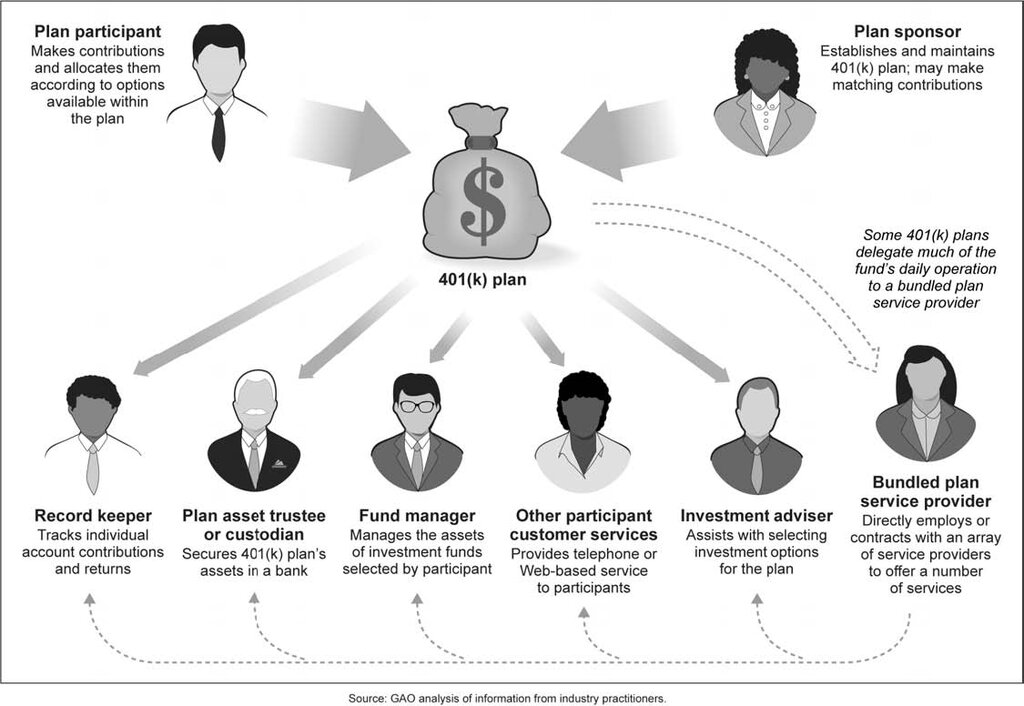
The more common type of plan today is the defined contribution plan. You've probably heard of its most popular versions, the 401(k) or the 403(b) for non-profit employees.
In this setup, the focus isn't on a promised future payout. Instead, the focus is on the contributions going into the account. The "defined" part is the contribution, not the benefit. You, and often your employer, contribute a specific amount or percentage of your salary to an investment account in your name.
Defined contributions plans such as 401(k)s, and 403(b)s are currently the most popular workplace retirement schemes.
Unlike a pension, you are in control. You decide how much to contribute from each paycheck (up to legal limits), and you choose how to invest that money from a menu of options your employer provides. This puts the investment risk squarely on your shoulders. The amount of money you have at retirement depends entirely on how much you and your employer contributed and how well your investments performed over time.
Your employer’s main roles are to administer the plan, provide the investment options, and sometimes, to help you save by matching a portion of your contributions. An employer match is a powerful incentive. For instance, an employer might match 100% of your contributions up to 4% of your salary. It's essentially free money that can significantly boost your savings.
| Feature | Defined Benefit Plan | Defined Contribution Plan |
|---|---|---|
| Key Feature | A promised monthly payout at retirement. | An individual investment account for retirement. |
| Who Contributes? | Primarily the employer. | The employee and often the employer. |
| Who Bears Risk? | The employer. | The employee. |
| Payout | A predictable, fixed monthly payment. | Varies based on contributions and investment returns. |
| Common Example | Traditional Pension | 401(k), 403(b) |
Now, let's test your knowledge on these two fundamental plan types.
Who is primarily responsible for the investment risk in a defined contribution plan, such as a 401(k)?
In a defined benefit plan, the final retirement payout is typically calculated using a formula based on which factors?
Understanding the difference between these two approaches is the first step in mastering your retirement strategy. It helps you know what to expect from your employer and what responsibilities fall on you.