Carter G. Woodson and the Birth of Black History Month
Early Life and Education
Humble Beginnings
Carter G. Woodson was born in 1875 in New Canton, Virginia, to parents who had been enslaved. His family was poor, but they deeply valued education. Growing up, Woodson spent much of his time working on the family farm, which meant he could only attend school for a few months each year.
Despite these challenges, his father, James, and his mother, Anne, instilled in him a strong sense of pride and a thirst for knowledge. They taught their children to stand up for themselves and to learn as much as they could. This foundation would shape the rest of Woodson's life.
From Coal Mines to High School
To help support his family, Woodson moved with his brother to West Virginia to work in the coal mines. The work was grueling and dangerous, but he didn't let it stop his education. During his six years as a miner, he dedicated his nights to studying, teaching himself fundamental subjects like arithmetic and reading.

His informal studies paid off. At the age of 20, Woodson finally had the means to enroll in high school. He moved back to West Virginia and attended Douglass High School, where his determination was clear. He completed the four-year curriculum in just two years, graduating in 1896.
A Scholar's Path
Woodson's academic journey was just beginning. He attended Berea College in Kentucky, one of the few integrated colleges in the South at the time. After earning his bachelor's degree, he took a position that expanded his worldview significantly: he became a school supervisor for the United States in the Philippines.
Upon his return to the United States, Woodson continued his studies. He earned both a bachelor's and a master's degree from the University of Chicago. But his ultimate academic goal was a doctorate from one of the nation's most prestigious institutions.
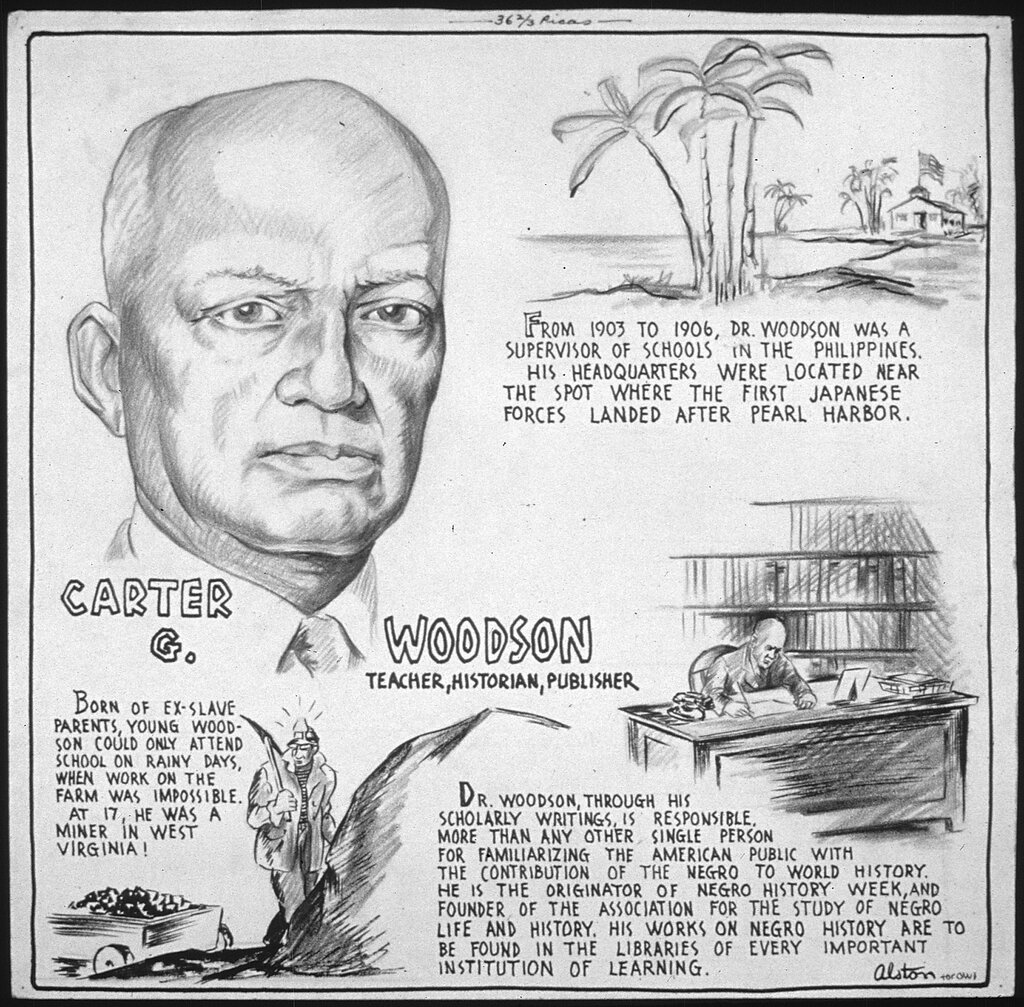
In 1912, Carter G. Woodson earned his Ph.D. in history from Harvard University. He was only the second African American to achieve this, following W. E. B. Du Bois.
This achievement was monumental. By earning a doctorate from Harvard, Woodson broke through a significant racial barrier in academia, proving that African Americans could excel at the highest levels of scholarly pursuit.
These formative years—from the farm in Virginia to the coal mines of West Virginia and the halls of Harvard—forged Woodson's conviction. He realized that the history of his people was either ignored or misrepresented, and he decided to dedicate his life to changing that.