Cardiovascular Mechanics and Function
Advanced Cardiac Mechanics
The Heart's Helical Engine
The heart isn't just a simple bag of muscle that squeezes. Its efficiency comes from a surprisingly complex, three-dimensional architecture. The myocardial fibers, or muscle cells, of the ventricles are arranged in a helical, or spiral, pattern. Imagine wrapping a rope around a cone, first in one direction and then in the opposite direction over the top.
In the outer wall (subepicardium), the fibers spiral in a right-handed direction. Deeper inside, in the inner wall (subendocardium), they spiral in a left-handed direction. This opposing arrangement is the key to the heart's powerful and efficient pumping motion.
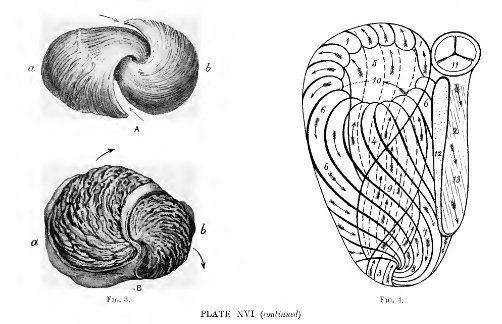
When the ventricles contract, these two opposing layers of muscle fibers slide past each other. This doesn't just squeeze the blood out; it creates a wringing or twisting motion. This ventricular torsion is like wringing water from a towel. The apex of the heart rotates counter-clockwise while the base rotates clockwise, efficiently ejecting blood with minimal fiber shortening. This twisting motion generates high pressure and expels blood into the aorta and pulmonary artery with incredible force.
During relaxation (diastole), this stored torsional energy is released, causing the ventricle to rapidly untwist. This untwisting creates a suction effect, actively pulling blood in from the atrium. It's a beautiful example of mechanical efficiency, using the energy of contraction to kick-start the filling process for the next beat.
A Framework for Force
This complex dance of muscle fibers needs a stable anchor. That's the role of the cardiac —a dense, connective tissue structure that separates the atria from the ventricles. It's not bone, but it acts like a chassis, providing structural support and electrically insulating the upper and lower chambers.
This skeleton forms the rings around the heart valves (the annuli), giving them a firm base to open and close against. It also serves as the attachment point for the very muscle fibers we've been discussing. By anchoring the spiraling myocardial bands, the fibrous skeleton ensures that their contraction translates into a coordinated twisting motion rather than just a disorganized squeeze.
Stress, Strain, and Physics
The forces acting on the heart wall are immense. The stress within the ventricular wall is described by the , which relates wall stress to the pressure inside the chamber and the chamber's radius and wall thickness. In simple terms, it tells us that as the heart chamber gets larger (dilates) or the wall gets thinner, the stress on each muscle fiber increases for a given blood pressure.
This physical law has major clinical implications. In a condition like dilated cardiomyopathy, the ventricle enlarges. According to Laplace's law, this enlargement increases wall stress, forcing the heart to work harder to generate the same pressure. This creates a vicious cycle where the increased stress can lead to further damage and dilation.
This leads us to the final piece: how the ventricles fill. Filling isn't just a passive process. In early diastole, the rapid untwisting we discussed earlier creates suction, causing active filling. This is a low-pressure, high-volume phase where blood is literally pulled into the ventricle.
Later in diastole, as the ventricle's elastic limit is reached, filling becomes passive. The rate of filling slows and depends more on the pressure gradient from the atrium and the compliance (or stretchiness) of the ventricle itself. The final top-off of blood comes from the atrial contraction, or "atrial kick," just before the ventricle begins its next squeeze.
The interplay between active untwisting and passive compliance is crucial for ensuring the heart fills adequately before each beat, directly influencing cardiac output.
The opposing helical arrangement of myocardial fibers in the ventricles results in what type of motion during contraction?
According to the Law of Laplace as it applies to the heart, what happens to the stress on the ventricular wall if the chamber enlarges (dilates) without a change in wall thickness?
Understanding these mechanical principles—from the helical fiber arrangement to the laws of physics governing wall stress—provides a much deeper insight into how the heart functions as a remarkably efficient pump.