Carburetor Fundamentals and Operation
Carburetor Components
Core Components
A carburetor might seem complex, but it's built around a few key parts working together. Their shared goal is to create the perfect combustible cocktail of air and fuel for the engine. Let's break down the main players and what they do.
The Fuel Reservoir
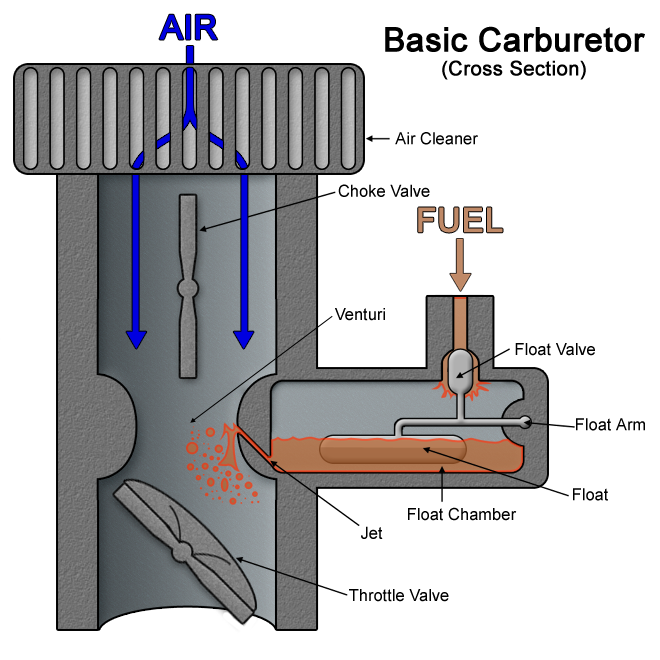
Before fuel can be mixed with air, it needs a place to wait. This is the job of the float chamber, a small reservoir of gasoline inside the carburetor. It's like the water tank on a toilet. A float inside the chamber rises and falls with the fuel level. When the level drops, the float opens a needle valve, letting more fuel in from the gas tank. When it's full, the float closes the valve.
This simple mechanism ensures a constant, ready supply of fuel at a consistent pressure. Without it, the fuel delivery would be erratic, leading to poor engine performance.
Creating the Mix
The heart of the carburetor is where air and fuel finally meet. This happens in a specially shaped passage called the venturi. As air flows from the intake into the engine, it's forced through this narrowed section.
Physics dictates that as the speed of a fluid (like air) increases, its pressure decreases. The venturi is designed to speed up the incoming air, creating a low-pressure zone. It's this pressure drop that pulls fuel out of the float chamber and into the airstream.
The Venturi effect is the key principle behind a carburetor's operation. Faster air creates a vacuum that siphons fuel into the engine.
But how is the amount of fuel controlled? That's the job of the fuel jets. These are precision-drilled nozzles that connect the float chamber to the venturi. The size of the jet's opening determines how much fuel can be drawn into the airstream at any given moment. Different jets can be used to fine-tune the air-fuel ratio for optimal performance or efficiency.
Controlling Power
The entire assembly, including the venturi, is housed within the throttle body. The driver controls the engine's power using a component inside this housing: the throttle valve, often called a butterfly valve. This is a flat disc that pivots to open or block the airway.
When you press the gas pedal, you're opening this valve, allowing more of the air-fuel mixture to enter the engine. This increases engine speed and power. When you let off the pedal, the valve closes, restricting the flow and causing the engine to idle.
Finally, for starting a cold engine, there's the choke valve. This is another valve located before the venturi, at the air intake. When an engine is cold, gasoline doesn't vaporize easily, so it needs a much richer (more fuel-heavy) mixture to start.
Closing the choke valve restricts the amount of air entering the carburetor. This creates a stronger vacuum, which pulls significantly more fuel through the jets. Once the engine warms up, the choke is opened to restore the normal air-fuel balance.
Let's test your understanding of these parts.
What is the primary function of the float chamber in a carburetor?
The venturi in a carburetor creates a low-pressure zone that pulls fuel into the airstream. How does it accomplish this?
Understanding these five components is the foundation for knowing how any carburetor works. Each part has a distinct role, but they all work in concert to manage the engine's appetite for fuel and air.