Carbon Footprint Explorer Explained
Introduction to Carbon Footprints
What is a Carbon Footprint?
Think of it like a shadow. Everything you do, from turning on a light to buying a new pair of shoes, casts an environmental shadow. A carbon footprint is a way to measure the size of that shadow. It totals up all the greenhouse gases released into the atmosphere because of an activity, an individual, a company, or even a country.
carbon footprint
noun
The total amount of greenhouse gases—including carbon dioxide and methane—that are generated by our actions.
While it's called a carbon footprint, it doesn't just count carbon dioxide (). It also includes other potent greenhouse gases like methane () and nitrous oxide (). To keep things simple, scientists convert the impact of all these gases into a single number: the carbon dioxide equivalent, or . This gives us a common unit to compare different impacts.
What Makes Up a Footprint?
A carbon footprint is the sum of many different parts. The electricity that powers your home, the fuel in your car, the food on your plate, and the clothes you wear all contribute. Every product has a life cycle that starts with sourcing raw materials and ends with disposal, and emissions are produced at every step.
Essentially, if an activity requires energy or resources, it has a carbon footprint.
These emissions can be grouped into two main categories: direct and indirect. Direct emissions come from sources you own or control, like the tailpipe of your car. Indirect emissions are created on your behalf, such as the emissions from the power plant that generates your electricity or the factory that made your laptop.
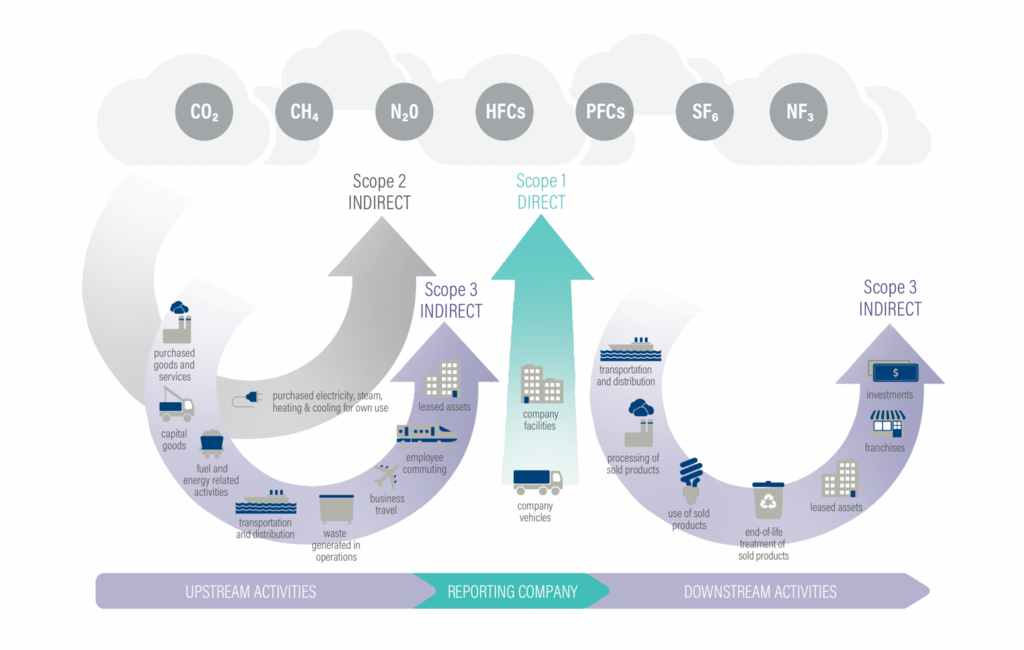
For organizations, this concept is formalized into "scopes." Scope 1 covers direct emissions. Scope 2 covers indirect emissions from purchased energy. Scope 3 includes all other indirect emissions from a company's value chain, like those from suppliers or from customers using the company's products. For most businesses, Scope 3 emissions are the largest and most complex part of their footprint.
Why Bother Measuring?
Measuring a carbon footprint is the first step toward managing it. You can't reduce what you don't measure. For individuals, understanding your footprint can help you make more informed choices about your lifestyle, like driving less or eating locally sourced food. You can see where your biggest impacts are and focus your efforts there.
For companies and governments, the stakes are even higher. A carbon footprint is a key metric for understanding environmental risk, identifying inefficiencies, and setting sustainability goals. It provides a baseline to track progress and demonstrate a commitment to reducing environmental impact. Many investors and consumers now look at a company's carbon footprint when making decisions.
An environmental footprint is defined as the measure of the impact of human activities on the environment, while an ecological footprint refers to the measure of the amount of resources required to fulfil the needs of those same activities and of the humans engaging in those activities.
Calculating a carbon footprint involves a process called a life cycle assessment (LCA). This method analyzes the environmental impacts associated with all stages of a product's life, from raw material extraction through to its use and disposal. It's a comprehensive way to capture the full picture.
For an individual, the calculation is simpler. It typically involves multiplying your consumption data—like your monthly electricity usage in kilowatt-hours or the miles you drive—by standard emission factors. These factors are averages that convert your activity into an estimate of greenhouse gas emissions.
While the exact numbers can be complex to pinpoint, the goal isn't necessarily perfect precision. It's about gaining awareness and identifying the most effective areas for change. A rough estimate is often enough to start making a real difference.
What does the term "carbon footprint" primarily measure?
The standard unit used to express a carbon footprint, which accounts for various greenhouse gases, is known as the carbon dioxide ______.