Capitalism vs Socialism Explained
Economic Systems Overview
How Societies Get Stuff Done
Every society needs things to survive and thrive, from food and shelter to smartphones and entertainment. But resources like time, money, and raw materials are limited. This creates a fundamental challenge: how do we decide what to make, how to make it, and who gets it? The answer is an economic system.
An economic system is the set of rules and methods a society uses to organize the production and distribution of goods and services. It’s the framework that governs how we all work together to meet our needs and wants.
Three Key Questions
No matter where you live or what the economy looks like, every system must answer three basic questions. The way a society answers them defines its economic system.
What will be produced? Should we build more hospitals or more shopping malls? Grow wheat or build electric cars?
How will it be produced? Will factories be run by people or robots? Will we use renewable energy or fossil fuels?
For whom will it be produced? Does everyone get an equal share? Do people who work harder get more? Should goods and services go to those who can pay the most?
Think of a small, self-sufficient community. They have to decide whether to spend their time fishing or farming (the what). They must figure out if they'll use modern tools or traditional methods (the how). Finally, they need a system to decide how the food is shared among all the members of the community (the for whom). These same questions apply to massive, global economies, just on a much larger scale.
Four Economic Models
Economists generally group economic systems into four main types. It's helpful to think of these as simplified models. In the real world, nearly every country's economy is a blend of different types.
Traditional Economy
noun
An economic system where traditions, customs, and beliefs shape the goods and services the economy produces, as well as the rules and manner of their distribution.
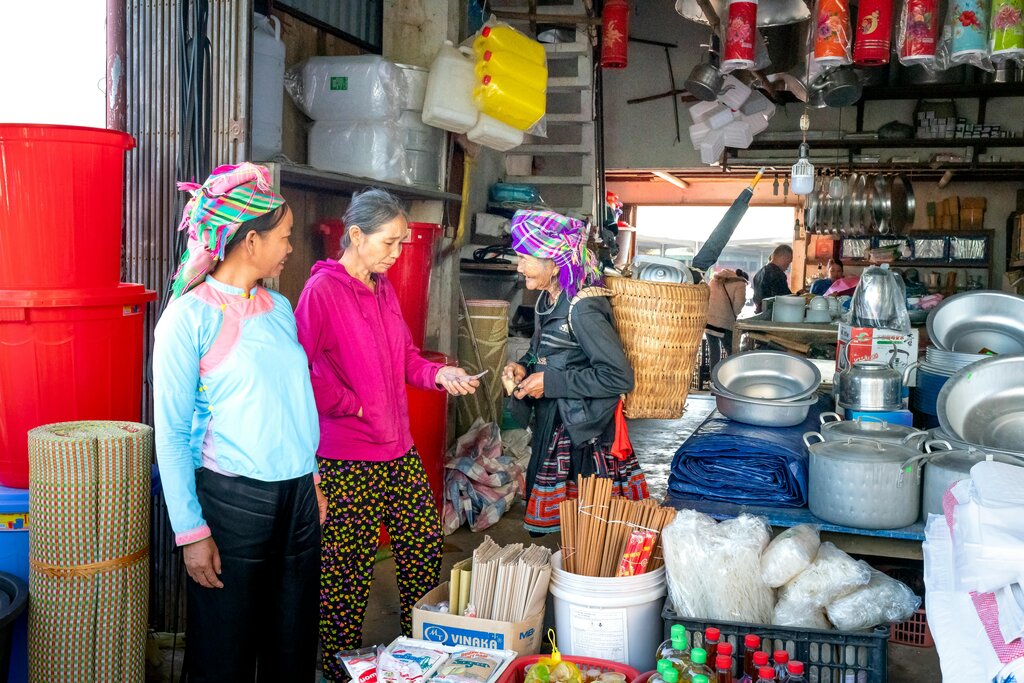
This is the oldest type of economic system. In a traditional economy, economic decisions are based on customs and what has been done in the past. Occupations often stay in the family. If your parents were farmers, you'll likely be a farmer. What is produced is what the community needs to survive, and it's distributed based on social roles and traditions. These systems are often found in rural or indigenous communities.
Next is an economy where a central authority is in charge.
Command Economy
noun
An economic system in which production, investment, prices, and incomes are determined centrally by a government.
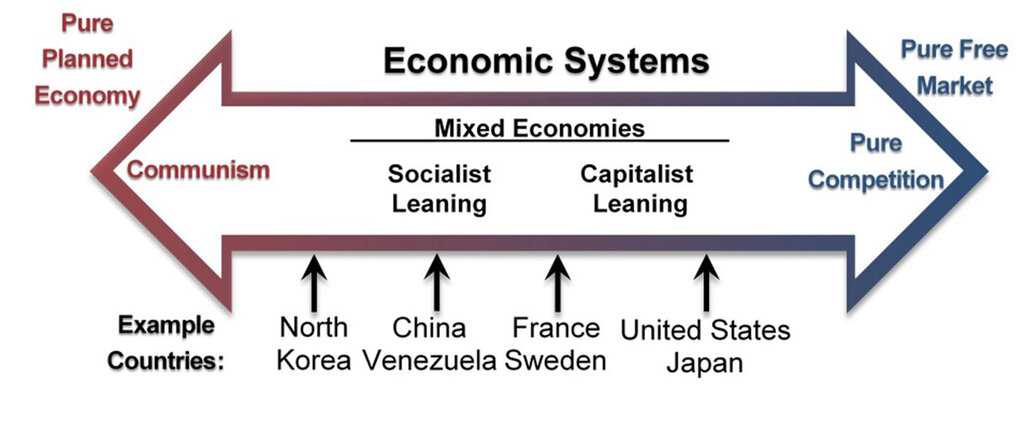
In a command economy, also known as a planned economy, the government makes all the key economic decisions. A central authority decides what goods and services to produce, how much to produce, and what prices to charge. The government typically owns major industries like utilities and transportation. Countries like North Korea and Cuba are modern examples.
The opposite of a command economy is one driven by individual choices.
Market Economy
noun
An economic system in which economic decisions and the pricing of goods and services are guided by the interactions of a country's individual citizens and businesses.
In a market economy, decisions are made by individuals and businesses. The three big questions are answered by the forces of supply and demand. What gets produced is whatever consumers are willing to buy. How it’s produced is determined by businesses seeking to make a profit. Who gets the goods and services? Those who can afford to pay for them. There is no such thing as a pure market economy, but the United States is often considered a prime example of a country on this end of the spectrum.
This leads to the final, and most common, type of system.
Mixed Economy
noun
An economic system combining private and public enterprise.
As the name suggests, a mixed economy combines elements of both market and command economies. No country is purely one or the other. In a mixed economy, some decisions are made by individuals and businesses, while others are made by the government. Most countries today, including the United States, France, and Sweden, have mixed economies. They allow for private ownership and economic freedom but also have government intervention to achieve social goals, like providing education, healthcare, and regulating industries.
Understanding these basic systems is the first step in exploring the more complex economic ideas that shape our world. Now, let's test your knowledge.
Every society must decide how to organize the production and distribution of goods and services. What is this set of rules and methods called?
Which of the following is NOT one of the three fundamental questions every economic system must answer?