Capacitors in Level Physics
Capacitor Basics
What is a Capacitor?
In the world of electronics, capacitors are fundamental components. Think of them as tiny, temporary batteries. Their main job is to store electrical energy and then release it when needed. Unlike a battery, which stores energy chemically and releases it slowly, a capacitor stores energy in an electric field and can charge and discharge very quickly.
This ability to rapidly store and release energy makes them essential in countless applications, from smoothing out power supplies in your phone charger to creating the flash on a camera.
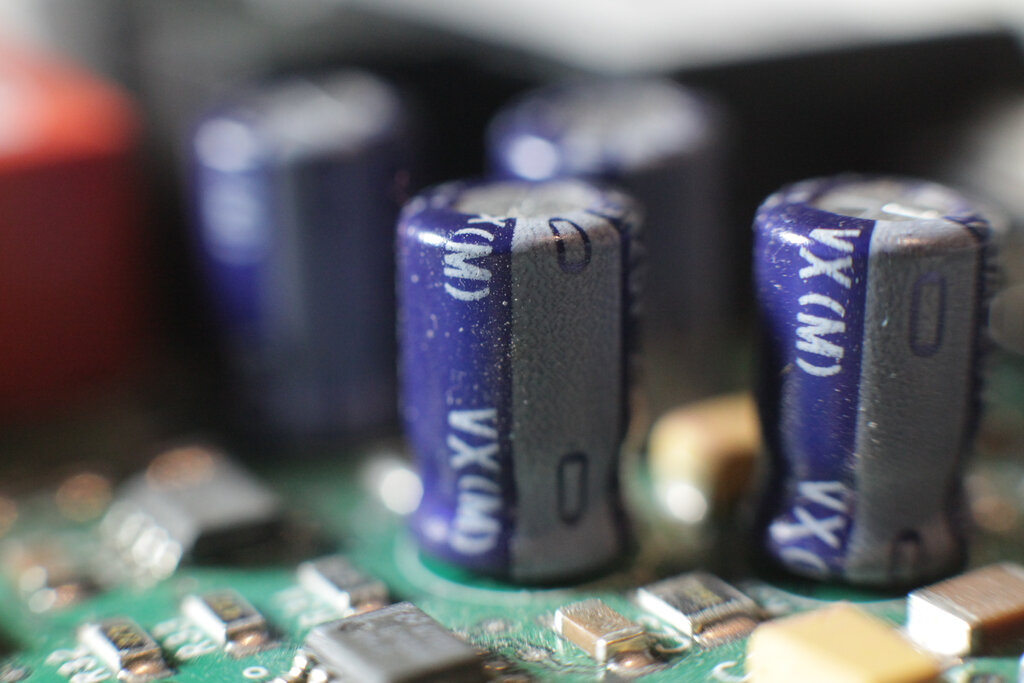
The Basic Structure
At its heart, a capacitor has a very simple design. It consists of two conductive plates separated by an insulating material called a dielectric.
The conductive plates can be made of materials like aluminum or copper foil, while the dielectric can be anything from air and paper to ceramic and plastic.
When a voltage is applied across the capacitor, positive charge builds up on one plate and an equal amount of negative charge builds up on the other. The plates are kept separate by the dielectric, which prevents the charge from flowing directly between them. This separation of charge is what creates the electric field where the energy is stored.
Capacitance Explained
A capacitor's ability to store charge is called capacitance. It's a measure of how much charge a capacitor can hold for a given voltage applied across it. The standard unit of capacitance is the farad, named after the physicist Michael Faraday, and is abbreviated as F.
farad
noun
The SI unit of capacitance, equal to the capacitance of a capacitor in which one coulomb of charge causes a potential difference of one volt.
The relationship between capacitance (), charge (), and voltage () is described by a simple equation. Capacitance is the ratio of the charge stored on one plate to the voltage difference between the two plates.
This means that for a specific voltage, a capacitor with a higher capacitance can store more charge. If you rearrange the formula to , you can see that the stored charge is directly proportional to both the capacitance and the voltage.
Storing Energy
The process of moving charge onto a capacitor's plates requires work, and this work is stored as potential energy in the electric field between the plates. The amount of stored energy () depends on both the capacitance and the square of the voltage.
The squared voltage term is important. It tells us that doubling the voltage across a capacitor doesn't just double the stored energy—it quadruples it. This relationship is key to understanding why capacitors are so effective at delivering quick bursts of energy, like for a camera flash or in a defibrillator.
For example, a 10 microfarad (10 x F) capacitor charged to 5 volts stores Joules. If you charge it to 10 volts, it stores Joules, four times as much energy.
Now you know the fundamentals of how capacitors are built and how they work. They are simple devices that play a crucial role in storing and releasing electrical energy.