Cannabinoid Receptors Explained
Introduction to the Endocannabinoid System
Your Body's Balancing Act
Deep within your body, a complex network is constantly working to keep everything in balance. This network is the endocannabinoid system, or ECS. Discovered in the early 1990s, the ECS is a crucial cell-signaling system that helps regulate a wide range of functions, from your mood and appetite to your sleep and memory.
Think of it as a master regulator. When something is out of whack, like when you're stressed or in pain, the ECS steps in to help restore equilibrium. This process of maintaining a stable internal environment is called homeostasis. The ECS doesn't run all the time; instead, it activates on-demand, precisely when and where it's needed.
The Three Key Players
The endocannabinoid system has three core components that work together seamlessly: endocannabinoids, receptors, and enzymes.
- Endocannabinoids: These are the messengers. They are molecules made by your body that are similar to compounds found in the cannabis plant.
- Receptors: These are the receivers. Found on the surface of cells, they wait to receive messages from endocannabinoids.
- Enzymes: This is the cleanup crew. They break down the endocannabinoids after they’ve delivered their message.
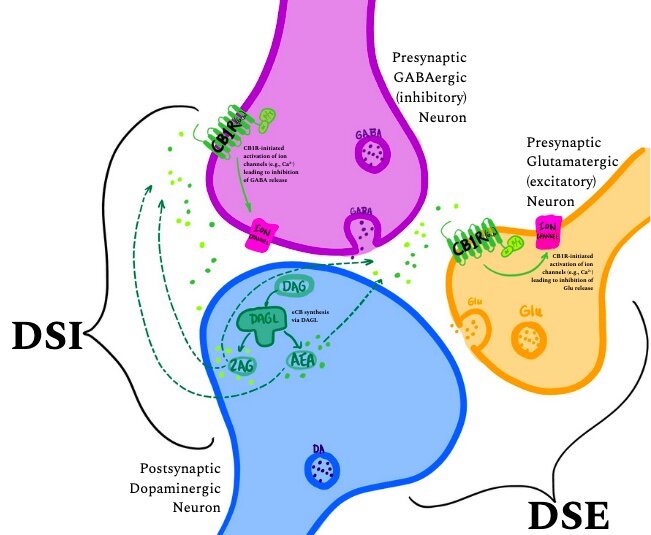
This trio acts like a highly specific communication system. An endocannabinoid travels to a receptor, binds to it, and delivers a signal that tells the cell what to do. Once the message is received and the job is done, an enzyme swoops in to break down the endocannabinoid, preventing it from overstaying its welcome.
Meet the Messengers
The
endocannabinoid
noun
A type of neurotransmitter produced naturally in the body that binds to cannabinoid receptors. The prefix "endo-" means "within."
is the star of the show. Your body produces several of these molecules, but scientists have focused primarily on two key ones: anandamide and 2-arachidonoylglycerol.
Anandamide (AEA): Its name comes from the Sanskrit word "ananda," which means "bliss" or "joy." AEA is often called the "bliss molecule" for its role in mood regulation and feelings of well-being. It's also involved in memory, appetite, and pain perception.
2-Arachidonoylglycerol (2-AG): While not as famously named, 2-AG is the most abundant endocannabinoid in the brain. It plays a significant role in managing inflammation, regulating immune function, and influencing emotional states.
Unlike other signaling molecules that are made in advance and stored for later, endocannabinoids are synthesized on demand. Your body produces them exactly when they are needed, making the ECS a precise and efficient system.
The Cleanup Crew
To maintain balance, a signal can't go on forever. Once an endocannabinoid has delivered its message, it needs to be cleared away. That's where the enzymes come in. Each of the main endocannabinoids has a primary enzyme responsible for its breakdown.
| Enzyme | Target Endocannabinoid | Function |
|---|---|---|
| FAAH (Fatty Acid Amide Hydrolase) | Anandamide (AEA) | Breaks down anandamide after it has been used. |
| MAGL (Monoacylglycerol Lipase) | 2-Arachidonoylglycerol (2-AG) | Primarily responsible for breaking down 2-AG. |
This process of synthesis, signaling, and degradation ensures that the ECS acts with precision. By regulating everything from nerve function to immune response, this internal system plays a vital role in keeping you healthy and balanced every day.
Let's check your understanding of these fundamental concepts.
What is the primary function of the endocannabinoid system (ECS)?
Which of the following lists the three core components of the ECS?