Canine Neuroethology and Cognitive-Emotional Education
Introduction to Canine Neuroethology
A Window Into Your Dog's Mind
Why does your dog spin in a circle before lying down, or greet you with such frantic joy? To get to the root of these behaviors, we turn to canine neuroethology. It's a field that combines two powerful ideas: neuroscience (the study of the nervous system) and ethology (the study of animal behavior in natural settings).
In short, canine neuroethology explores how a dog's brain, senses, and evolutionary past work together to produce the behaviors we see every day. It's less about teaching a dog to sit and more about understanding the ancient wiring that makes them want to chase a ball or protect their home.
By looking at both the brain and the species' history, we can start to piece together the puzzle of why dogs act the way they do.
The Canine Brain
A dog's brain isn't just a smaller version of a human's. It's a specialized tool shaped by millions of years of evolution to be an expert at survival. While it shares the same basic sections as our own brain, the proportions and priorities are very different.
Here’s a quick tour:
- Cerebrum: The largest part, responsible for learning, memory, and voluntary actions. This is where your dog processes the cue for "shake" and decides whether to do it.
- Cerebellum: Located at the back, this coordinates movement. It’s what allows a dog to leap for a frisbee with such grace and precision.
- Brainstem: This connects the brain to the spinal cord and manages essential functions like breathing, heart rate, and sleep. It's the brain's automatic pilot.
- Olfactory Bulb: This is the dog's superpower. The part of the brain dedicated to processing smells is, proportionally, about 40 times larger than in humans. It dominates their perception of the world.
A dog experiences the world primarily through scent, much like we experience it through sight. Their brain is built for it.
From Wolf to Woof
Every domestic dog, from a tiny Chihuahua to a massive Great Dane, is descended from wolves. This isn't just a fun fact; it's the key to understanding their core instincts. The process of domestication began thousands of years ago when less fearful, more cooperative wolves began living near human settlements.
Over countless generations, humans favored animals that were friendlier, more useful, and better at understanding human cues. This selection process, both accidental and intentional, didn't just change their appearance—it reshaped their brains and behavior.
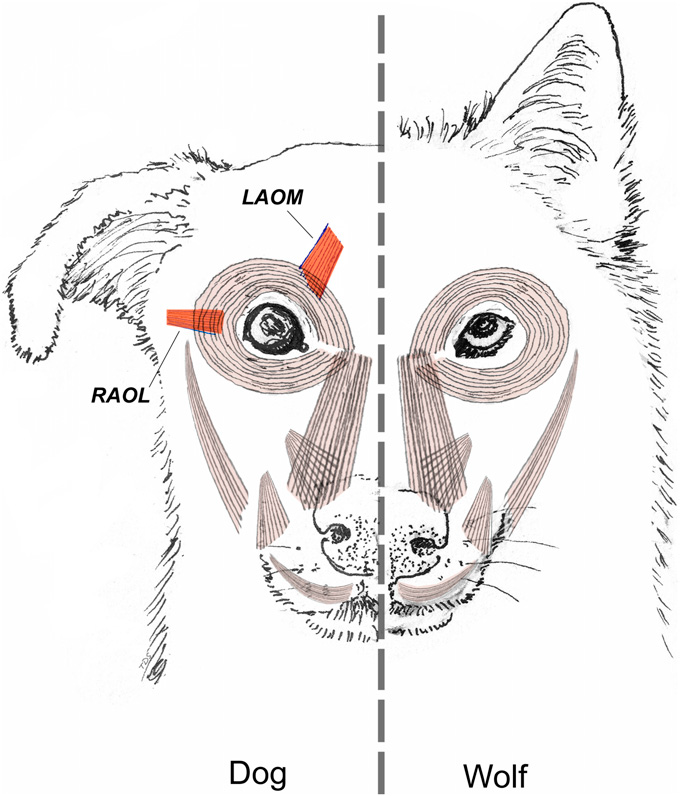
One of the most significant changes was a reduction in the
fight-or-flight
other
A physiological reaction that occurs in response to a perceived harmful event, attack, or threat to survival.
response. Domestic dogs are generally less fearful and more playful than adult wolves. They've retained juvenile, or puppy-like, characteristics into adulthood—a phenomenon known as neoteny.
This "puppy-like" brain is more flexible, more social, and more open to forming strong bonds with other species, namely us. Domestication also fine-tuned their ability to pay attention to human gestures and expressions. A dog's ability to follow a pointing finger, for example, is a sophisticated cognitive skill that even our closest primate relatives struggle with. It's a direct result of their long, shared history with humans.
Ready to check your understanding?
Canine neuroethology is best described as the study of what?
Which part of a dog's brain is proportionally about 40 times larger than the same part in a human brain, dominating their perception of the world?
Understanding these foundations—the brain's structure and the deep history of domestication—is the first step toward a more scientific and empathetic approach to our canine companions.