CAN Bus and SAE J1939
Introduction to CAN Bus
The Car's Nervous System
In the early 1980s, cars were getting smarter. Features like anti-lock brakes, electronic fuel injection, and power seats each relied on their own little computer, called an Electronic Control Unit, or ECU. This was great for drivers, but created a massive headache for engineers.
Each ECU needed to communicate with others, which meant running dedicated wires between them. A wire from the engine ECU to the transmission ECU. Another from the brake ECU to the instrument cluster. The result was a complex, heavy, and expensive web of copper wiring running throughout the vehicle. It was a point-to-point nightmare.
Engineers at Bosch, a German technology company, saw this problem and developed a solution. In the mid-1980s, they created the Controller Area Network, or CAN bus. The idea was elegantly simple: instead of a web of direct connections, all ECUs would connect to a single, shared pair of wires. This bus would act like a central nervous system, allowing any ECU to broadcast a message that all other ECUs could hear.
This design drastically reduced the amount of wiring needed, which cut down on weight, complexity, and cost. Today, CAN bus is the standard in nearly every car, truck, and bus. It's also widely used in industrial machinery, medical devices, and even spacecraft.
How It Works
The elegance of CAN bus lies in its simplicity. The core of the system is a two-wire cable that runs through the vehicle, connecting the different ECUs. These two wires are called CAN High (CAN_H) and CAN Low (CAN_L).
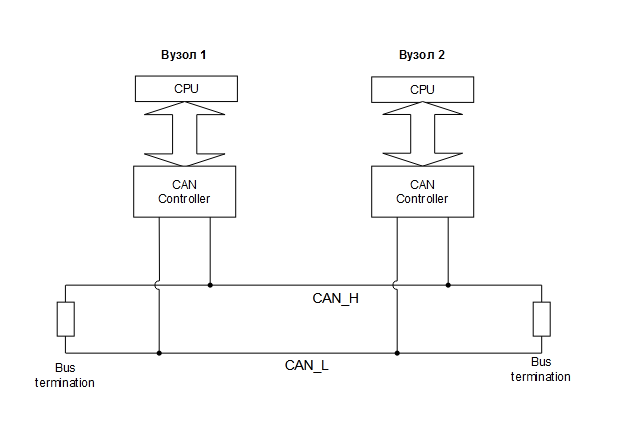
CAN bus uses a clever technique called differential signaling. Instead of sending a signal on just one wire, it sends the same signal on CAN_H and its exact inverse on CAN_L. For a digital '1', CAN_H and CAN_L might both be at 2.5 volts. To send a '0', the voltage on CAN_H might go up to 3.5 volts while CAN_L goes down to 1.5 volts.
The receiving ECU doesn't measure the absolute voltage on either wire. It only looks at the difference between them. This makes the system incredibly resilient to electrical noise. If an outside source of interference boosts the voltage on both wires equally, the difference between them stays the same, and the message gets through cleanly. This is crucial in an electrically noisy environment like a car.
A Decentralized Network
The CAN bus is a decentralized communication protocol.
Unlike many networks, a CAN bus has no central computer or master controller managing the flow of traffic. This is known as a multi-master system. Any ECU on the network can start sending a message whenever the bus is free.
Think of it like a dinner table conversation where everyone is very polite. Before speaking, each person listens to make sure nobody else is talking. If two people start talking at the exact same time, there's a simple, built-in rule to decide which message is more important and gets to go first, without disrupting the conversation. This multi-master design makes the network robust. If one ECU fails, the rest of the network keeps communicating without interruption.
What was the primary problem with automotive electronics in the early 1980s that led to the development of the CAN bus?
CAN bus uses a technique called 'differential signaling' to transmit data. What is the main advantage of this method?
This simple, robust, and decentralized design is why CAN bus has been a cornerstone of automotive and industrial technology for decades.