Calculus Optimization Sequences and Series
Definite and Indefinite Integrals
The Two Sides of Integration
In calculus, integration is the flip side of differentiation. While derivatives measure rates of change, integrals measure accumulation. Think of it like this: if you know your speed at every moment of a car trip (a rate), integration can tell you the total distance you've traveled (an accumulation).
There are two fundamental types of integrals: indefinite and definite. They look similar and are closely related, but they answer different questions.
An indefinite integral gives you a general function, the antiderivative. A definite integral gives you a specific numerical value, like an area or a total amount.
Indefinite Integrals
An indefinite integral asks a simple question: What function, when differentiated, gives us the function we started with? This process is also called finding the antiderivative.
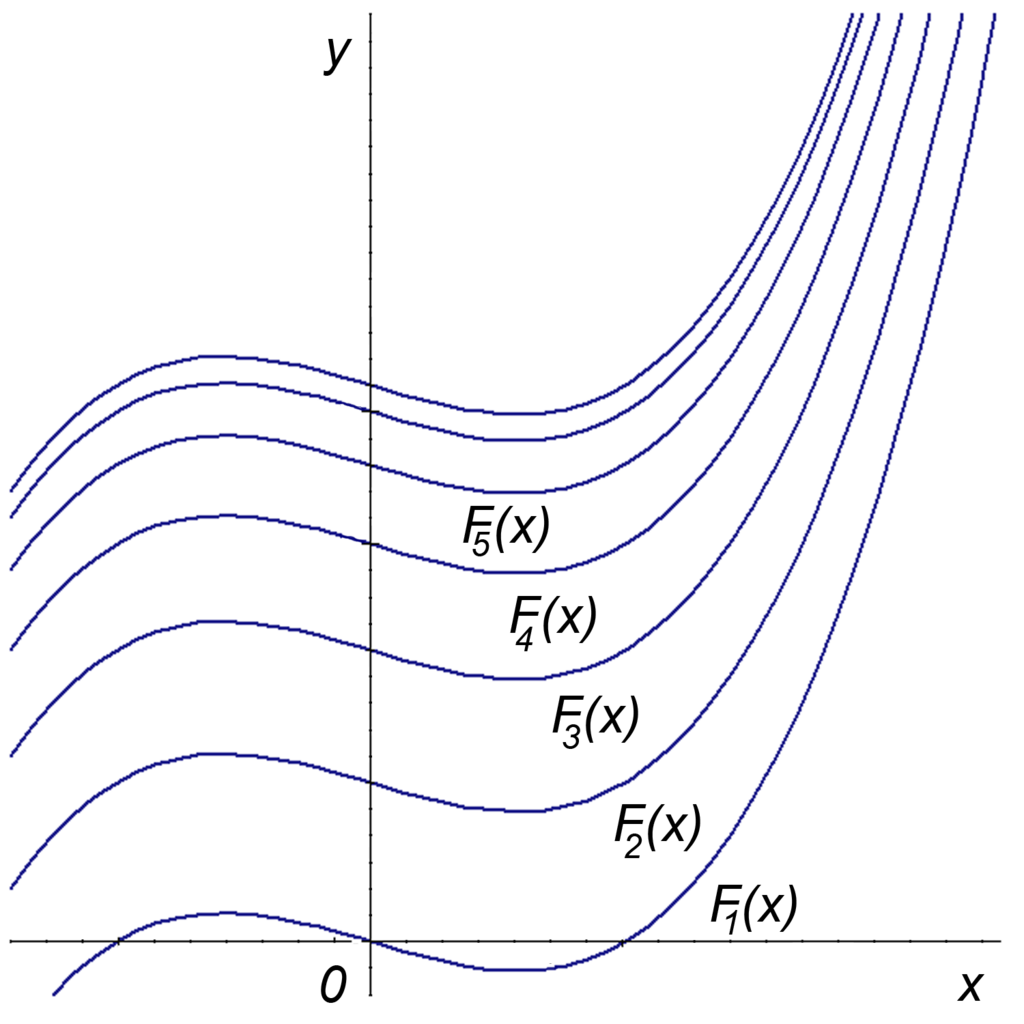
Let's say we have the function . We know that the derivative of is . So, the antiderivative of is . But wait, the derivative of is also . So is the derivative of . Any constant term disappears during differentiation.
To account for all possibilities, we add a constant of integration, written as . So, the indefinite integral of is . This represents an entire family of functions, each shifted vertically.
The symbol is the integral sign, and indicates that we are integrating with respect to the variable . The function we are integrating, , is called the integrand.
Definite Integrals
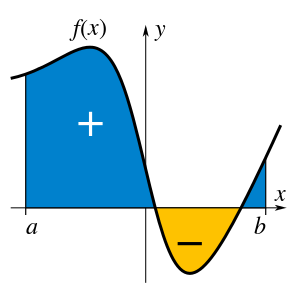
A definite integral calculates the net accumulation of a quantity between two specific points. Most often, we visualize this as finding the area under a curve between two points on the x-axis, say from to .
Here, and are the limits of integration, with being the lower limit and the upper limit. The result of a definite integral is always a single number, not a function.
This number represents the net area. If the function dips below the x-axis, that area is counted as negative. The definite integral adds up the positive areas and subtracts the negative areas.
This has powerful applications. If represents the rate of water flowing into a reservoir, the definite integral from noon to 1 p.m. tells you exactly how much water was added during that hour.
Properties of Integrals
Both types of integrals share some basic properties that help simplify calculations. These rules work just like they do for derivatives.
| Property | Formula | Description |
|---|---|---|
| Constant Multiple | You can pull constants out in front of the integral. | |
| Sum/Difference | The integral of a sum is the sum of the integrals. |
Definite integrals have a few extra properties related to their limits of integration.
Integrating from a point back to itself results in zero area: .
Flipping the limits of integration negates the answer: .
You can split an integral into two parts: .
These concepts form the bedrock of integral calculus. Understanding them allows you to calculate total change from a rate of change, a process with applications everywhere from physics to finance.
Now, let's test your understanding of these foundational ideas.
What is the primary purpose of integration in calculus?
What is the result of calculating an indefinite integral, such as ?