Calculus Limits and Continuity Explained
Introduction to Limits
Approaching a Value
Calculus is the study of change. To understand change at a single instant, we first need to understand what it means for something to get closer and closer to a value. This is the idea of a limit.
A limit tells us what value a function approaches as its input gets closer and closer to a certain number. The key idea is that we don't care what the function's value is at that number, only what it's doing nearby.
Let's look at the function . What happens when gets close to 2? If we try to plug in , we get , which is undefined. Our function has a hole at that exact spot.
But we can see what happens near . This is where limits come in. We write the limit as:
This expression asks: "As gets infinitely close to 2 (but not equal to 2), what value does the function get infinitely close to?"
Finding Limits with Tables and Graphs
One way to estimate a limit is to plug in numbers that are very close to our target value. Let's try some numbers close to 2 for our function .
| x | f(x) |
|---|---|
| 1.9 | 3.9 |
| 1.99 | 3.99 |
| 1.999 | 3.999 |
| ? | ? |
| 2.001 | 4.001 |
| 2.01 | 4.01 |
| 2.1 | 4.1 |
As we get closer to 2 from both sides, the value of seems to be getting closer and closer to 4. So, we'd guess that the limit is 4.
We can also see this visually on a graph. The graph of our function looks just like the line , but with a hole at the point where .
As you trace the line from the left towards , your finger approaches a height of . As you trace it from the right towards , your finger also approaches a height of . Since the approach from both sides leads to the same value, the limit exists and is equal to 4.
One-Sided Limits
Sometimes, a function approaches different values depending on which side you approach from. This brings us to the idea of one-sided limits.
The left-hand limit is the value the function approaches as gets close to a number from values less than . We denote this with a minus sign:
The right-hand limit is the value the function approaches as gets close to from values greater than . We denote this with a plus sign:
A limit exists if and only if the left-hand limit equals the right-hand limit. If they are different, the overall limit does not exist.
Consider a function with a "jump" at . From the left, it approaches one value, and from the right, it approaches another.
For this graph, as we approach from the left, the function's value gets closer to 1. So, .
As we approach from the right, the function's value is 3. So, .
Since , the overall limit does not exist.
The Formal Definition
The ideas of "getting close" are useful, but not mathematically precise. The formal definition of a limit, called the epsilon-delta definition, provides this rigor. It's a bit of a mind-bender at first, but the core idea is about winning a challenge.
Let's say we claim that . The formal definition says that for any distance from you choose (no matter how small), we can find a corresponding distance from to guarantee the function stays within your chosen distance of .
The limit of as approaches is if for every number , there is a number such that if , then .
Let's break that down:
- For every number : This is the challenge. You give me a small positive number, epsilon (), which defines a horizontal target band around the limit (from to ).
- There is a number : This is my response. I have to find a small positive number, delta (), which defines a vertical band around (from to ).
- Such that...: If I can always find a that works for any you give me, then the limit is proven to be . My -corridor must be narrow enough to force the function's output into your -target band.
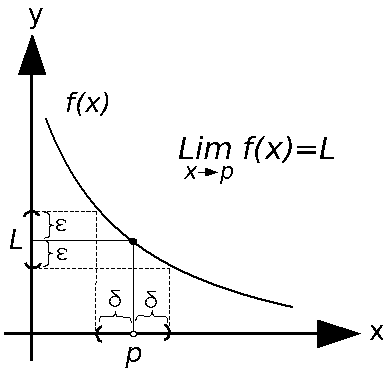
This definition is the bedrock on which calculus is built. While we often rely on graphs, tables, and algebraic rules to find limits, the epsilon-delta definition is what guarantees those methods work.
What does the limit of a function at a certain point primarily describe?
What is the value of the following limit: ?
Limits are a fundamental concept that describes how functions behave as inputs get closer to a particular value, regardless of the function's value at that exact point. They are the first major step into the world of calculus.