Calculus II Essentials
Sequences and Series
Sequences and Series
Let's start with a simple idea: an ordered list of numbers. This is a sequence. Each number in the list is called a term, and we can often describe the entire sequence with a formula for its -th term, usually written as . For example, the sequence can be described by the formula for .
The key question for a sequence is whether it converges or diverges. A sequence converges if its terms get closer and closer to a single, finite number as approaches infinity. We call this number the limit. In our example, as gets huge, gets very close to 0. So, we say the sequence converges to 0.
If a sequence doesn't approach a specific finite number, it diverges. This can happen if the terms grow without bound (like ) or oscillate (like ).
A series is what you get when you add up all the terms of a sequence. We write this using sigma notation:
The main question for a series is the same: does it converge or diverge? A series converges if the sum of its terms approaches a finite number. Otherwise, it diverges. This is a much trickier question than it is for sequences. Just because the terms of a sequence approach zero doesn't guarantee that their sum will be finite.
The classic example is the Harmonic Series: . The terms of the sequence go to zero, but the series itself diverges. The sum grows infinitely large, just very, very slowly.
Testing for Convergence
To figure out if a series converges, we have a toolkit of tests. It's often a process of elimination, and recognizing the form of the series is key to choosing the right tool.
Because there are so many tests for determining the convergence or divergence of an infinite series, students often feel overwhelmed when faced with a series and have to decide whether it converges (C), diverges (D), converges absolutely (CA), or converges conditionally (CC).
Let's walk through the most common tests.
Divergence Test
other
If the limit of the sequence's terms is not zero, the series must diverge.
This should always be your first step. It's a quick check. If the terms you're adding don't even go to zero, there's no way their sum can be finite.
Rule: If or the limit doesn't exist, then diverges.
Crucially, if the limit is zero, this test tells you nothing. The series might converge or it might diverge (like the harmonic series). You must use another test.
Integral Test
other
Compares an infinite series to an improper integral to determine convergence.
This test connects series to the integrals we've already studied. Suppose there's a function that corresponds to the terms of your series, so . If this function is continuous, positive, and decreasing for , then the series and the improper integral either both converge or both diverge.
This is the formal way to prove that the harmonic series diverges, by comparing it to , which we know diverges.
Comparison Test
other
Determines convergence by comparing a series to another series whose convergence is known.
The idea here is simple. If you have a series with positive terms, you can compare it to a known series.
- If your series is term-by-term smaller than a known convergent series, your series must also converge.
- If your series is term-by-term larger than a known divergent series, your series must also diverge.
For example, to test , we can see that . We know that is a convergent p-series. Since our series is smaller, it must also converge.
Alternating Series Test
other
A test for the convergence of a series whose terms alternate in sign.
What about series with negative terms, like ? This is the alternating harmonic series. For these, we have a special test. An alternating series converges if two conditions are met:
- The terms (ignoring the sign) are decreasing. So, .
- The limit of the terms (ignoring the sign) is zero. So, .
The alternating harmonic series meets both conditions, so it converges.
Ratio and Root Tests
The final two tests are powerful, especially for series involving factorials or -th powers.
Ratio Test: Look at the limit of the ratio of consecutive terms (in absolute value).
If , the series converges absolutely. If , the series diverges. If , the test is inconclusive.
Root Test: Look at the limit of the -th root of the terms (in absolute value).
The conclusion is the same as the ratio test. If , it converges. If , it diverges. If , the test fails and you need another method.
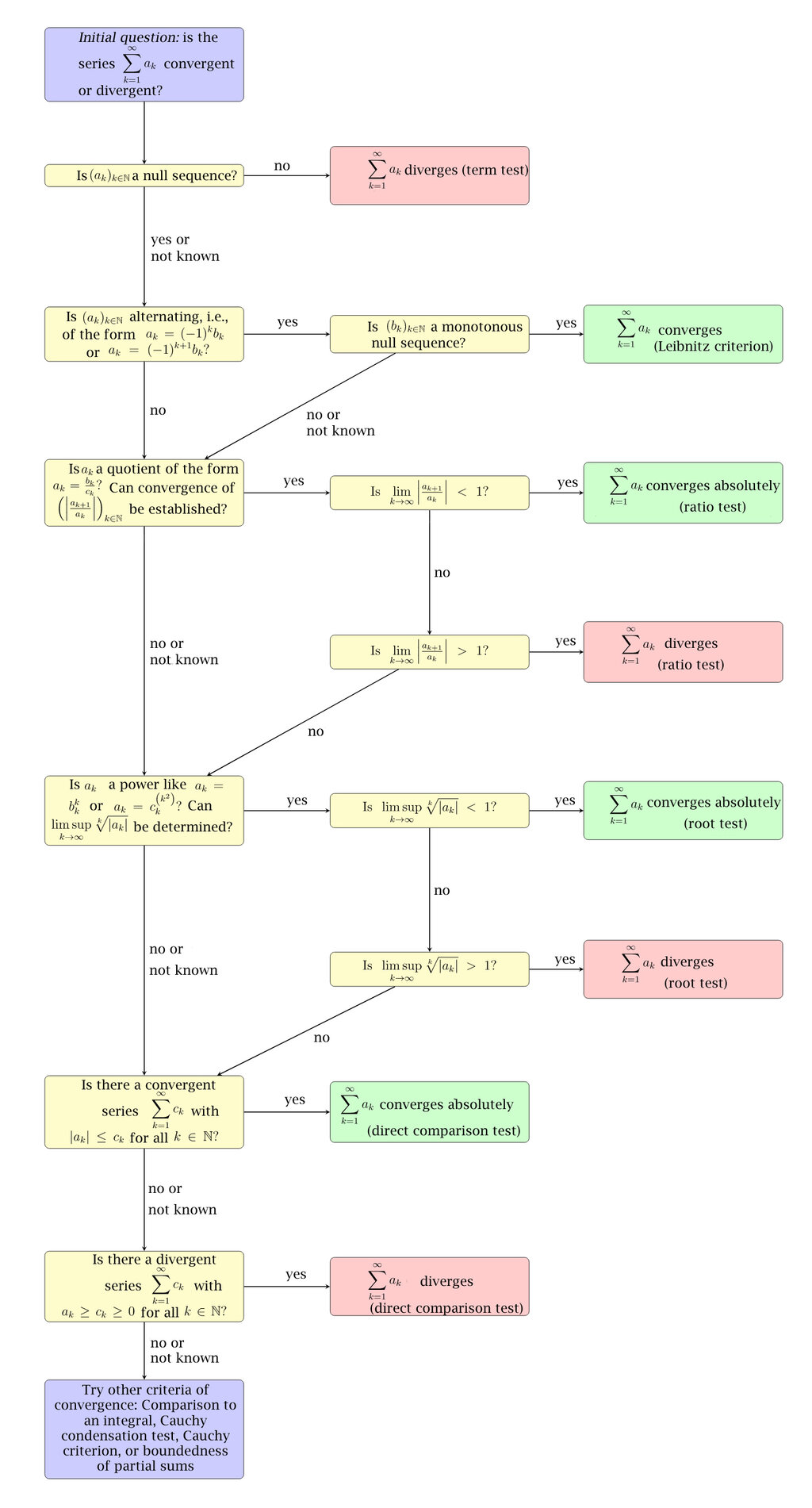
Choosing the right test takes practice. Start by looking at the form of . Does it alternate? Is it a rational function? Does it have factorials or powers of ? Answering these questions will point you toward the most effective test.
What is the result of adding up all the terms of an ordered list of numbers (a sequence)?
According to the Test for Divergence, what can you conclude about the series if ?