Calculus I Review for Calculus II Success
Understanding Limits
Approaching a Point
Calculus is the study of change, and the most fundamental idea that powers this study is the concept of a limit. A limit is about getting incredibly close to a point without actually touching it. It's the value a function approaches as its input gets closer and closer to a certain number.
Think about walking towards a wall. You can take steps that are half the remaining distance. First you cover half the distance. Then you cover half of what's left. Then half of that remainder, and so on. You'll get infinitely close to the wall, but you'll never technically touch it. A limit describes where you are heading: the wall.
A limit is the value a function gets closer and closer to as the input approaches a specific point.
Mathematically, we write the limit of a function as approaches a number like this:
This equation says, "The limit of as approaches is ." Notice that we don't care what the function's value is at . The function might not even be defined at that point. All that matters is the journey, not the destination.
How to Find Limits
Finding limits can be straightforward. For many simple functions, you can find the limit by just plugging the value into the function. This is called direct substitution.
Example: Find .
Here, we can just substitute into the expression: . The limit is 7.
But what happens if direct substitution gives you an undefined expression, like dividing by zero? This is where things get interesting. A common case is getting the indeterminate form . This doesn't mean the limit is 0, 1, or undefined. It's a signal that we need to do more work, usually by simplifying the expression.
One common technique is factoring and canceling.
If we plug in , we get . No good. But we can factor the numerator: .
Now our limit becomes:
Since the limit only cares about values near 3, but not at 3, we know that is not zero. So, we can safely cancel the terms.
Now we can use direct substitution: . So, the limit is 6. Even though the original function is undefined at , it approaches a value of 6 as gets closer and closer to 3.
Different Paths
Sometimes, the value a function approaches depends on the direction of approach. We can look at the limit as approaches from the left side (values less than ) or from the right side (values greater than ). These are called one-sided limits.
| Notation | Meaning |
|---|---|
| The limit as approaches from the left. | |
| The limit as approaches from the right. |
For a regular limit (called a two-sided limit) to exist, the left-hand limit and the right-hand limit must be equal. If they are different, the overall limit does not exist.
exists if and only if .
What if the function's value shoots up or down forever as we approach a point? This is an infinite limit. The function is heading towards positive or negative infinity. This often happens at vertical asymptotes.
We can also ask what happens to a function as gets extremely large, either positive or negative. These are limits at infinity. They tell us about the long-term behavior of a function and help us find horizontal asymptotes.
For the function , as becomes a huge positive number, gets very close to 0. So, .
Limits and Continuity
The concept of a limit leads directly to the idea of continuity. Informally, a function is continuous if you can draw its graph without lifting your pen from the paper. There are no holes, jumps, or breaks.
More formally, continuity is defined using limits. A function is continuous at a point if three conditions are met:
| Condition | In Plain English |
|---|---|
| 1. is defined. | The point must exist. |
| 2. exists. | The function must be approaching a single value. |
| 3. . | The value the function approaches must be the same as the function's actual value at that point. |
If any of these conditions fail, the function has a discontinuity at . Look back at our factoring example, . It has a discontinuity at because the first condition fails: is not defined. This is called a removable discontinuity, or a "hole," because the limit exists.
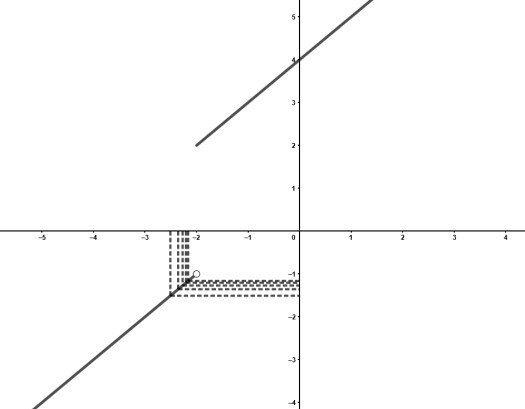
Another type is a jump discontinuity, where the left- and right-hand limits exist but are not equal. The function 'jumps' from one value to another. Finally, an infinite discontinuity occurs where the function has a vertical asymptote.
Understanding these ideas is the first major step into the world of calculus. Limits form the bedrock upon which derivatives and integrals are built.
Time to test your knowledge on these foundational concepts.