Calculus Fundamentals
Introduction to Functions
What is a Function?
Think of a function as a simple machine. You put something in, and it gives you something back. For every specific input, you get exactly one specific output. This rule of one-to-one correspondence is what makes a function special.
For every input, there is exactly one output.
In math, we write functions using notation like , which you read as "f of x". Here, is the name of the function (the machine), and is the input. What comes out is the result of applying the function's rule to .
For example, a function could have the rule "double the input and add one." We would write this as:
If you put in a 3, the function gives you . If you put in a -5, you get . Each input has only one possible result.
Domain and Range
Every function has a set of possible inputs and a set of possible outputs. These have special names.
Domain
noun
The set of all possible input values for a function.
Range
noun
The set of all possible output values of a function.
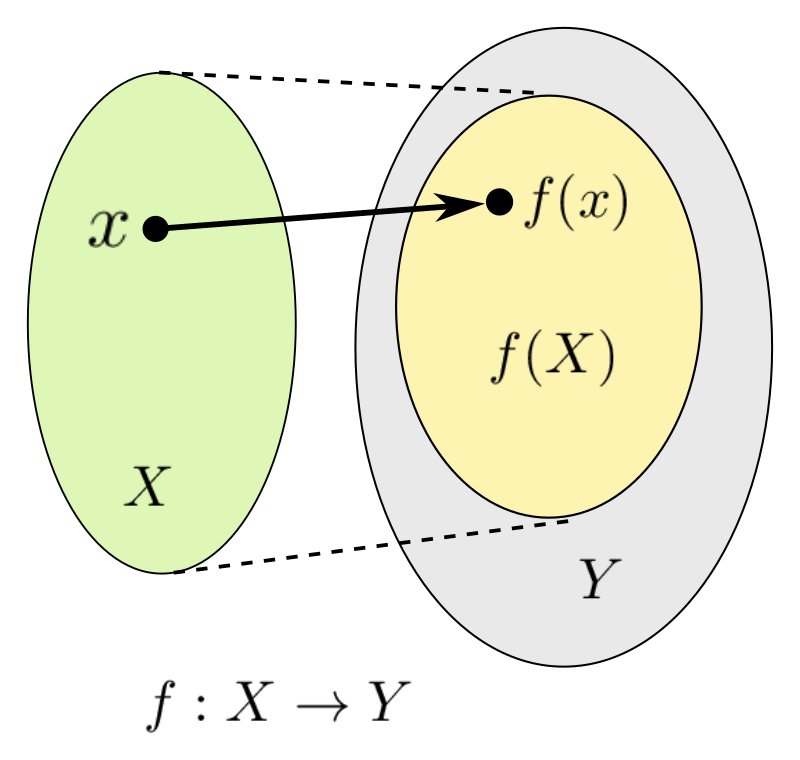
Let's visualize this. Imagine we have a set of allowed inputs (the domain) and another set for the outputs. The function is the set of arrows that connects each input to its unique output in the other set.
Some functions have restrictions on their domains. For example, in the function f(x) = rac{1}{x}, the input cannot be 0, because division by zero is undefined. So, its domain is all real numbers except 0.
Similarly, the range can be limited. For the function , the output can never be negative, no matter what real number you plug in for . Its range is all real numbers greater than or equal to 0.
A Tour of Common Functions
Functions come in many varieties, each with its own characteristic shape and behavior. Let's look at a few of the most common families of functions you'll encounter.
Linear Functions These are the simplest functions. Their graphs are always straight lines. The general form is . The value represents the slope, or steepness, of the line, and is the y-intercept, where the line crosses the vertical y-axis.
Quadratic Functions Written as , these functions produce a U-shaped curve called a parabola. The parabola opens upwards if is positive and downwards if is negative. They are used to model things like the path of a thrown ball.
Polynomial Functions Linear and quadratic functions are actually specific types of polynomial functions. A polynomial is a function made up of terms with non-negative integer powers of , like . Their graphs are smooth, continuous curves that can have various hills and valleys.
Rational Functions These are fractions where the numerator and denominator are both polynomials, like f(x) = rac{x+1}{x-2}. Their graphs are interesting because they often have asymptotes, which are lines the graph approaches but never touches. This happens where the denominator would be zero (in this example, at ).
Exponential and Logarithmic Functions Exponential functions, like , model rapid growth or decay. They start slow and then increase or decrease dramatically. Logarithmic functions, such as , are the inverses of exponential functions. They grow very slowly.
These two types of functions are deeply related and appear often in finance, biology, and computer science.
Function is the central underlying concept in calculus.
Understanding these different function types and how their graphs look is a key first step. They are the building blocks for almost everything else you'll learn in calculus.
What is the defining characteristic of a mathematical function?
If a function is defined by the rule , what is the output for an input of -2?