Calculus Fundamentals
Functions and Graphs
What is a Function?
A function is like a rule or a recipe. You give it an input, and it gives you a specific output. For every input you provide, you get exactly one output back. Think of a coffee machine: you put in coffee grounds (input), and you get brewed coffee (output). You wouldn't expect to get both coffee and tea from the same input.
The key idea is consistency. One input, one output.
In math, we often call a function . We write the input as . The function's output is then written as , which you read as "f of x." It's just a way to say "the output of function when the input is ."
So if we have a function that doubles the input, we can write the rule as . If you put in a 3, you get out a 6. If you put in a -5, you get out a -10.
One quick way to see if a graph represents a function is the vertical line test. If you can draw a vertical line anywhere on the graph that crosses the curve more than once, it's not a function. That's because it would mean one input (the x-value where you drew the line) has more than one output (the y-values where it crosses).
Domain and Range
Every function has a domain and a range. These terms sound technical, but the ideas are simple.
- Domain: The set of all possible inputs the function can accept.
- Range: The set of all possible outputs the function can produce.
For our coffee machine, the domain might be {coffee grounds, water, filter}, and the range would be {brewed coffee}. If you try to put a toaster in (an input not in the domain), it won't work.
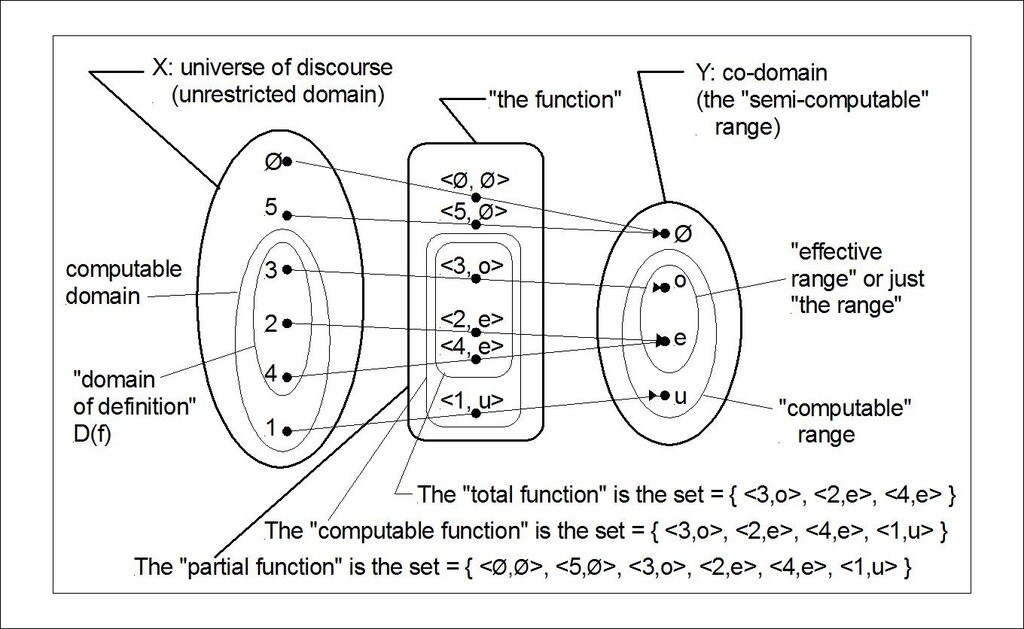
Let's look at a mathematical example, . You can square any real number, so its domain is all real numbers. But what about the output? When you square any number (positive or negative), the result is always positive or zero. So, the range of is all non-negative numbers ().
Sometimes, a function has natural restrictions. For example, in the function , the input cannot be 0, because division by zero is undefined. So, 0 is not in the domain.
A Tour of Common Functions
You'll encounter a few families of functions over and over. Getting to know their basic shapes and rules is essential.
Linear Function
adjective
A function that represents a constant rate of change. Its graph is always a straight line.
Linear functions are defined by the equation:
Here, is the slope (how steep the line is) and is the y-intercept (where the line crosses the vertical y-axis). They show up everywhere, from calculating a taxi fare to converting temperatures.
Quadratic Function
adjective
A function where the highest power of the variable is two. Its graph is a parabola.
These functions have the general form:
Their graphs are U-shaped curves called parabolas. Depending on whether the term is positive or negative, the U can open upwards or downwards. They are used to model things like the flight of a baseball or the shape of a satellite dish.
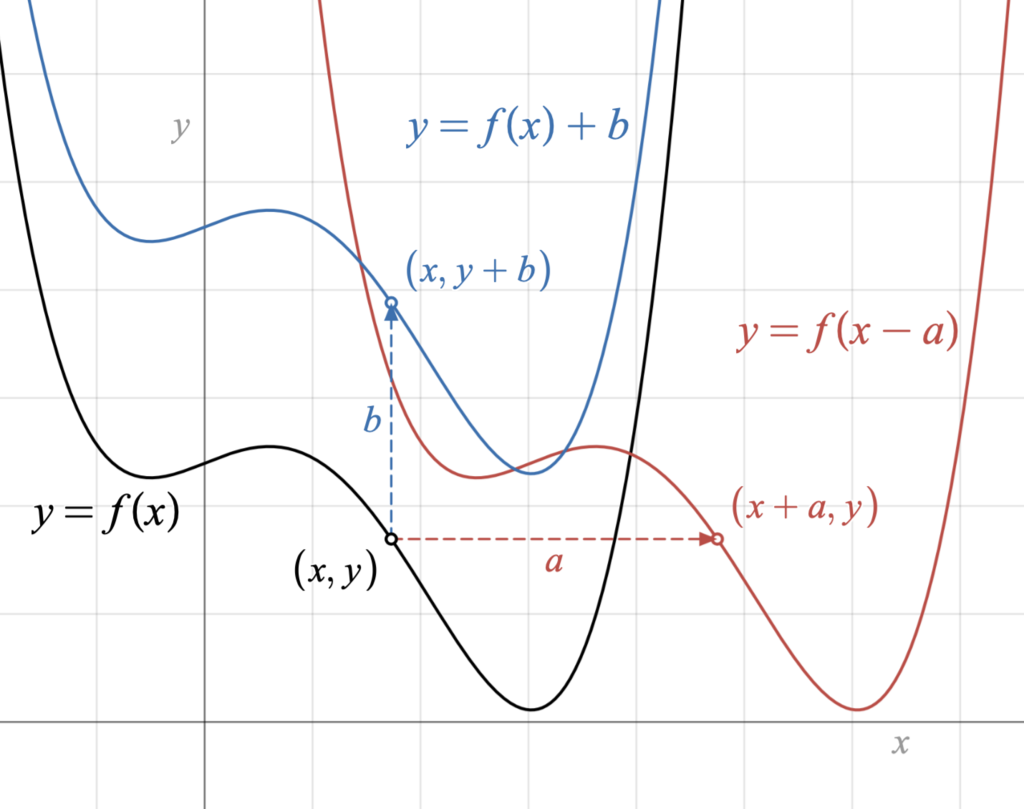
Polynomial Functions are a broader category that includes linear and quadratic functions. They are built from variables raised to positive integer powers, like . Their graphs can be smooth, wavy curves with various twists and turns.
Exponential Functions model rapid growth or decay, like population growth or radioactive decay. Their form is , where the variable is in the exponent. Their graphs start flat and then shoot up (or down) very quickly.
Logarithmic Functions are the inverses of exponential functions. They answer the question, "What exponent do I need to raise a certain base to in order to get this number?" They are written as . Logarithmic functions grow very slowly.
Understanding the behavior and shapes of these core functions is the first step toward the more dynamic concepts in calculus.
Ready to check your understanding?
What is the defining characteristic of a function in mathematics?
If a vertical line can be drawn on a graph that intersects the curve at more than one point, the graph represents a function.
Grasping these ideas about functions and how they look on a graph provides the visual and conceptual language for everything that comes next.