Calculus Fundamentals Explained
Functions and Graphs
What is a Function?
Think of a function as a simple machine. You put something in (an input), and it gives you something back (an output). The rule is that for every one input, you get exactly one output. It's a consistent, predictable relationship.
Function
noun
A mathematical rule that assigns to each input value exactly one output value.
We usually write functions using a special notation. If we have a function named , we write to represent the output when the input is . You can read as "f of x."
For example, a function that doubles the input can be written as:
If you plug in 3, you get . The input is 3, the output is 6.
Domain and Range
Every function has two important sets of values associated with it: its domain and its range.
The domain is the complete set of all possible inputs a function can accept. The range is the complete set of all possible outputs it can produce.
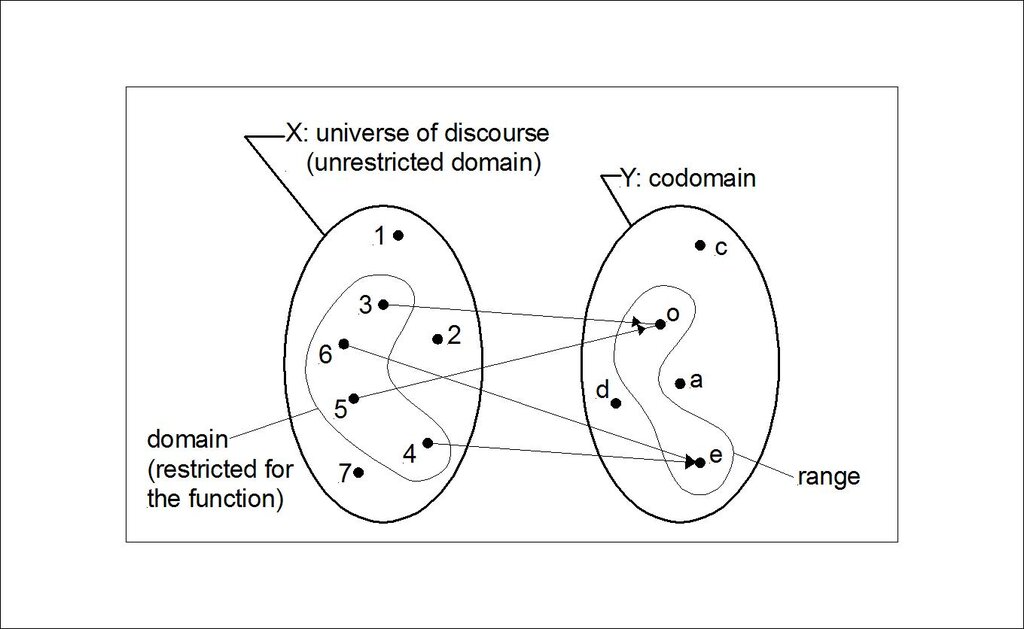
Consider our doubling function, . If we can plug in any real number, its domain is all real numbers. Since doubling any real number results in another real number, its range is also all real numbers.
But sometimes domains are restricted. For the function , we can't take the square root of a negative number (and get a real result). So, its domain is all non-negative numbers, . The outputs are also never negative, so its range is also all non-negative numbers, .
A Tour of Common Functions
Different types of functions have distinct formulas and create unique shapes when graphed. Let's look at some of the most common ones.
Linear Functions A linear function has the form . Its graph is always a straight line. The value is the slope (how steep the line is), and is the y-intercept (where the line crosses the vertical y-axis).
Quadratic Functions These have the form . Their graphs are U-shaped curves called parabolas. If is positive, the parabola opens upwards. If is negative, it opens downwards.
Polynomial Functions Linear and quadratic functions are types of polynomial functions. The general form is . Their graphs are smooth, continuous curves that can have various twists and turns.
Rational Functions A rational function is a fraction of two polynomials, like . Their graphs can have breaks called asymptotes, which are lines the graph approaches but never touches. These occur where the denominator is zero.
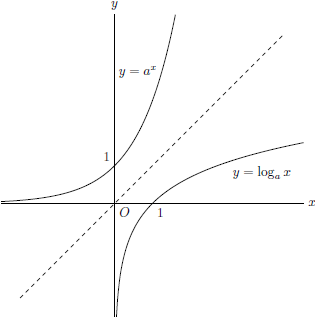
Exponential and Logarithmic Functions Exponential functions, like , model rapid growth or decay. Logarithmic functions, like , are their inverses. They grow very slowly.
Transforming Graphs
Once you know the basic shape of a function's graph, you can move it around without replotting every point. These movements are called transformations.
| Transformation | How to Write It | Effect on Graph |
|---|---|---|
| Vertical Shift | Moves up by units | |
| Vertical Shift | Moves down by units | |
| Horizontal Shift | Moves right by units | |
| Horizontal Shift | Moves left by units | |
| Vertical Stretch | , for | Stretches vertically |
| Vertical Compression | , for | Compresses vertically |
| Reflection | Flips over the x-axis | |
| Reflection | Flips over the y-axis |
For example, if we know the graph of is a parabola centered at the origin , then the graph of is the exact same parabola, just shifted 3 units to the right and 5 units up.
What is the fundamental rule that defines a relationship as a function?
What is the domain of the function ?