Calculus Fundamentals
Introduction to Limits
What is a Limit?
In calculus, we're often interested in how functions behave near a certain point. Sometimes, plugging a value directly into a function works perfectly. Other times, it might lead to a mathematical dead end, like division by zero. This is where limits come in.
A limit doesn't ask what a function's value is at a specific point. Instead, it asks: what value is the function approaching as its input gets closer and closer to that point?
To bypass this mathematical impossibility, we use limits: asking not "what is the value at this point," but "what value do we approach as we get infinitely close?"
Think of it like walking towards a wall. As you take smaller and smaller steps, you get infinitely close to the wall. The wall represents the limit, the location you are approaching, regardless of whether you ever actually touch it.
The notation for a limit looks like this:
Finding Limits
So, how do we find these values? The simplest way is to try plugging the number in directly.
Direct Substitution For many simple functions, the limit at a point is just the function's value at that point. Let's find the limit of as approaches 2.
But what happens when direct substitution gives us an undefined result, like ? This is called an indeterminate form, and it's a sign that we need to do more work. It doesn't mean the limit doesn't exist.
Factoring and Canceling One common technique is to simplify the expression algebraically. Let's look at this limit:
We can factor the numerator. The term is a difference of squares, which factors into . This allows us to simplify.
Now, we can use direct substitution on the simplified expression.
One-Sided Limits
Sometimes a function behaves differently depending on which direction you approach a point from. We can look at the limit from the left side or the right side.
A left-hand limit means we're approaching the value with numbers that are slightly smaller. It's written with a minus sign in the superscript.
A right-hand limit means we're approaching with numbers that are slightly larger. This is noted with a plus sign.
For a general limit to exist at a point, the left-hand limit and the right-hand limit must both exist, and they must be equal.
In the graph above, as approaches 2 from the left, the function's value gets closer to 2. As approaches 2 from the right, the value gets closer to 3. Since the left and right limits are not the same, the overall limit does not exist.
Limit Laws and a Final Tool
To make evaluating limits easier, we can use a set of rules known as the Limit Laws. These let us break down complex limits into simpler ones. Assuming that and both exist, these laws hold true.
| Law | Formula | Description |
|---|---|---|
| Sum Rule | The limit of a sum is the sum of the limits. | |
| Difference Rule | The limit of a difference is the difference of the limits. | |
| Product Rule | The limit of a product is the product of the limits. | |
| Quotient Rule | , if | The limit of a quotient is the quotient of the limits. |
| Power Rule | The limit of a function to a power is the limit raised to that power. |
Finally, there's a powerful and intuitive tool for finding tricky limits called the Squeeze Theorem.
Imagine three friends walking down a path. One friend, let's call her Grace, is always walking between two other friends, Farah and Henry. If at some point, both Farah and Henry arrive at the exact same spot, where must Grace be? She must be at that same spot, too, since she was squeezed between them.
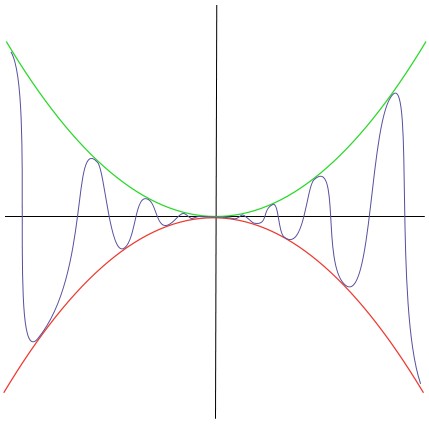
In math, if we have a function that is always "squeezed" between two other functions, and , and we know that and have the same limit at a certain point, then must have that same limit too.
Formally, if for all near , and , then it must be true that .
What does the concept of a limit in calculus primarily describe?
Evaluate the following limit:
These concepts form the foundation for much of calculus. Understanding how to find what value a function approaches is the first step toward understanding rates of change and accumulation.