Calculus Fundamentals
Understanding Limits
Approaching a Value
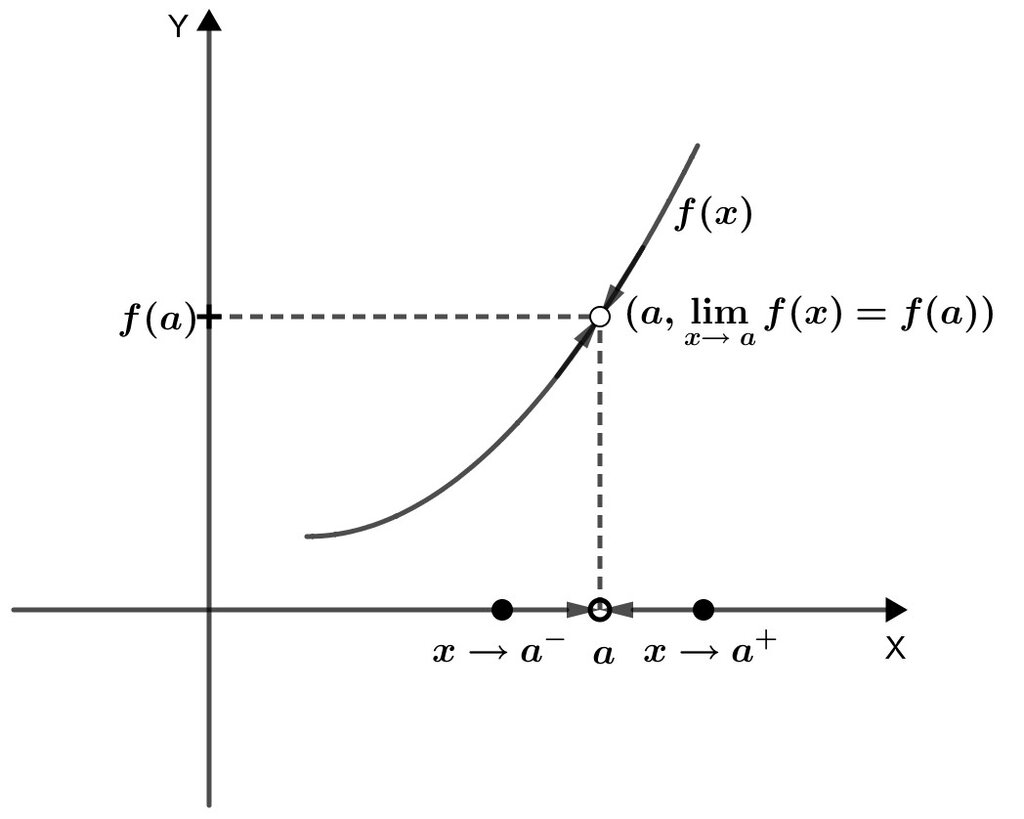
In calculus, we often care about what happens to a function as its input gets really close to a certain value. This idea of “getting close” is captured by the concept of a limit.
A limit is the value a function approaches as its input gets nearer and nearer to a specific point. Think of it like walking towards a wall. As you get closer, your distance to the wall approaches zero. The limit is zero, even if you never actually touch the wall.
A limit is the value a function gets infinitely close to. The function doesn't necessarily have to reach that value.
We have a special notation for this:
This is read as “the limit of as approaches equals .” It means that as the input gets arbitrarily close to the value , the output of the function, , gets arbitrarily close to the value .
Coming from the Left and Right
Sometimes, a function's behavior depends on the direction from which we approach a point. We can look at the limit as approaches from values less than (from the left) or from values greater than (from the right).
These are called one-sided limits.
| Notation | Meaning |
|---|---|
| The limit as approaches from the left (negative side). | |
| The limit as approaches from the right (positive side). |
For a general limit to exist, the left-sided and right-sided limits must be equal. If they approach different values, we say the limit does not exist at that point.
In the graph above, as approaches 2 from the left, the function's value approaches 2. As approaches 2 from the right, the value approaches 4. Since , the overall limit does not exist.
Reaching for Infinity
What happens when a function's value grows without bound near a certain point? This is an infinite limit. For example, consider the function . As gets closer to 0 from either side, the value of gets larger and larger.
We write this as:
This doesn't mean the limit is a real number called infinity. It's just shorthand for saying the function's values increase without any upper limit as approaches 0.
We can also examine a function's behavior as its input grows infinitely large or small. These are called limits at infinity.
Limits at infinity describe the end behavior of a function. What value does the function settle on as goes to the far right or far left of the graph?
For example, let's look at the function . As gets very large (approaching ), the value of gets very small, approaching 0. The same thing happens as becomes a very large negative number (approaching ).
Continuity and Connection
Limits give us a precise way to define what it means for a function to be continuous. Intuitively, a continuous function is one you can draw without lifting your pencil from the paper. There are no gaps, jumps, or holes.
Formally, a function is continuous at a point if three conditions are met:
- is defined (the point exists).
- exists (the left and right limits agree).
- (the limit equals the function's value).
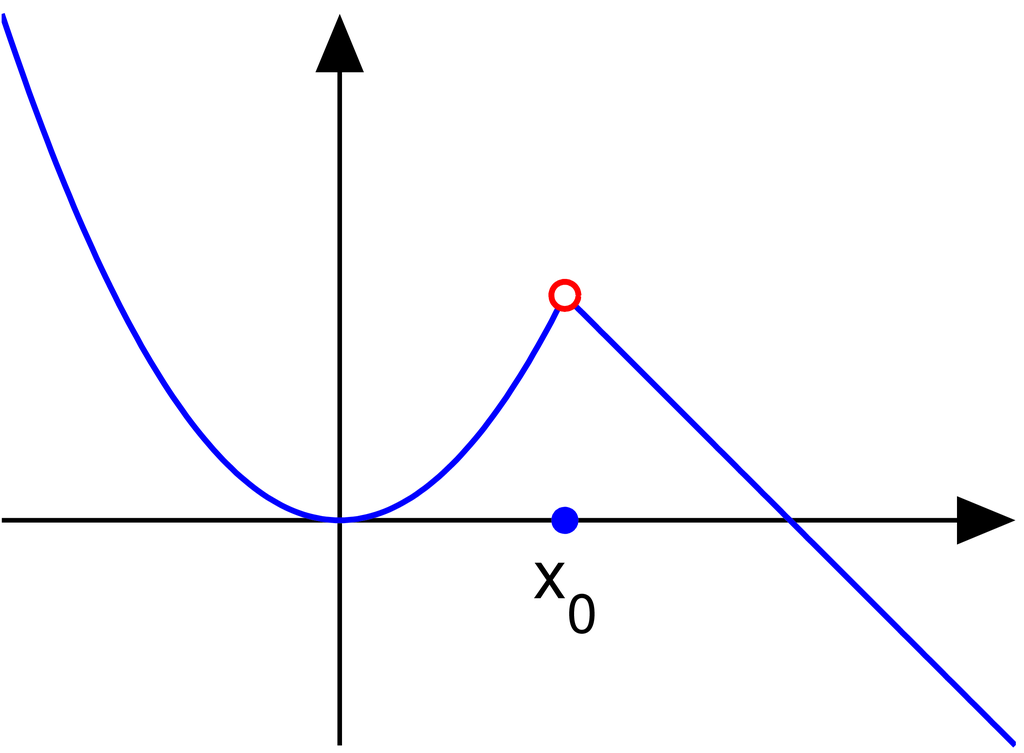
If a function is not continuous at a point, it has a discontinuity. The jump we saw earlier is one type. Another is a "hole" in the graph, which happens when the limit exists but doesn't equal the function's value, or the function isn't defined at that point.
For many simple functions like polynomials (e.g., ), finding the limit is easy. Because these functions are continuous everywhere, you can just plug in the value.
But for more complex cases, direct substitution might lead to an undefined expression like $0/0$. When this happens, we need other techniques, like factoring or simplifying, to find the true limit.
What does the expression signify?
For the general limit to exist, which condition must be met?