Calculus Foundations
Introduction to Functions and Limits
What is a Function?
At its core, a function is a rule. It takes an input, does something to it, and produces exactly one output. Think of it like a coffee machine. You put in a coffee pod (the input), and you get a cup of coffee (the output). For any specific pod, you always get the same type of coffee. A function works the same way: for any given input, there is only one possible output.
Function
noun
A mathematical relationship that takes an input value and produces a single, unique output value.
We often write functions using a special notation. You'll commonly see something like , which is read as "f of x." Here, is the name of the function (the rule), and is the input. So, if we have the function , it means our rule is to take any input and add 5 to it. If we plug in 3, we write . The input is 3, and the output is 8.
Domain and Range
Functions don't always accept every possible number as an input. The set of all valid inputs for a function is called its domain. The set of all possible outputs the function can produce is called its range.
Let's consider the function . Since we can't take the square root of a negative number (in the realm of real numbers), the domain is all non-negative numbers, which we can write as . The outputs will also only be non-negative, so the range is also all numbers greater than or equal to zero.
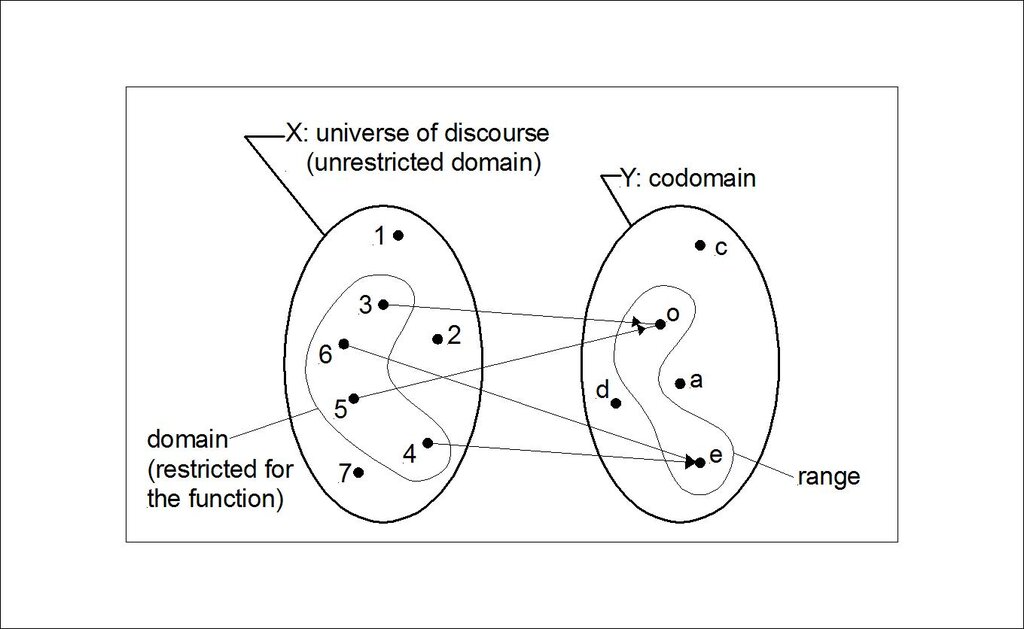
For another example, look at . You can square any real number, so its domain is all real numbers. However, the result of squaring a number is always non-negative. Therefore, the range of is all numbers greater than or equal to 0.
The Idea of a Limit
Now we get to a central idea in calculus: the limit. A limit describes the value that a function approaches as its input gets closer and closer to a certain number. The key here is the word "approaches." We don't care what the function's value is at that number, only what it's getting infinitesimally close to.
Imagine walking towards a door. A limit is concerned with the exact location of the door you're approaching, not with whether you actually walk through it.
We write the limit of a function as approaches a number like this:
Consider the function . If we try to plug in , we get , which is undefined. But we can ask what happens as gets very close to 1. If you plug in 1.1, you get 2.1. If you plug in 1.01, you get 2.01. If you plug in 1.001, you get 2.001. It seems like the output is getting closer and closer to 2. So, we'd say the limit of this function as approaches 1 is 2.
One-Sided Limits
Sometimes, a function approaches different values depending on which direction you approach the input from. This brings us to one-sided limits.
We can look at the limit as approaches from the right (values greater than ) or from the left (values less than ).
For a general limit to exist, the limit from the left must equal the limit from the right. If they are different, we say the limit does not exist at that point.
In the graph above, as approaches 2 from the left, the function's value gets closer and closer to 1. As approaches 2 from the right, the value gets closer to 3. Since the left and right limits are not equal, the overall limit as approaches 2 does not exist.
Limits at Infinity
We can also ask what happens to a function's output as the input gets incredibly large (approaching positive infinity, ) or incredibly small (approaching negative infinity, ). This is useful for understanding the long-term behavior of a function.
Consider the function . As gets larger and larger (100, 1000, 1,000,000), the value of gets smaller and smaller, getting closer and closer to 0. The same thing happens as becomes a very large negative number. So, we can say:
This tells us that the graph of the function has a horizontal asymptote at . The function gets arbitrarily close to this line but never quite touches it as goes to infinity in either direction.
Understanding functions and limits is the first major step into the world of calculus. They provide the language and tools needed to describe change and motion with precision.
What is the defining characteristic of a function in mathematics?
Given the function , what is the value of ?