Calculus for Computational Thinkers
Limits and Continuity
Approaching a Point
Calculus is the study of change. To understand change, we first need to understand how functions behave as they get incredibly close to a specific point. This is the idea of a limit.
A limit tells us what value a function approaches as its input gets closer and closer to a certain number. The function doesn't actually have to reach that value. It's all about the journey, not the destination.
Imagine walking towards a wall. With each step, you get closer. A limit is like describing the exact spot on the wall you're heading towards, even if you never actually touch it.
We can approach a point from two directions: from the left (with values that are slightly smaller) or from the right (with values that are slightly larger). For a limit to exist, the function must be heading towards the same value from both sides. We write the limit of a function as approaches some value like this:
In the graph above, the function has a hole at . It's undefined there. But as we get closer to 2 from either side, the function's value gets closer and closer to 4. So, the limit is 4.
Finding Limits
How do we calculate a limit without looking at a graph? The easiest way is direct substitution. For many functions, the limit at a point is simply the function's value at that point. You just plug the number in.
But sometimes, direct substitution gives you an "indeterminate form" like . This doesn't mean the limit doesn't exist; it just means we need to do more work. This often happens with rational functions.
An indeterminate form is a clue. It tells you there might be a hole in the graph, and you need some algebra to figure out where that hole is.
One common technique is factoring. If you can factor the numerator and denominator, you might be able to cancel out the term causing the problem.
Another method is using the conjugate, which is helpful when dealing with square roots.
The Idea of Continuity
Continuity is a simple but powerful idea. A function is continuous if you can draw its graph without lifting your pencil from the paper. There are no gaps, holes, or jumps.
This intuitive idea is directly tied to limits. For a function to be continuous at a point , three things must be true:
- The function must be defined at . (There is no hole.)
- The limit of the function as approaches must exist. (It's heading to one spot.)
- The limit must equal the function's value. (Where it's heading is where it actually is.)
A function can be discontinuous in several ways. It might have a 'removable discontinuity', which is just a hole in the graph. Or it could have a 'jump discontinuity', where the graph suddenly jumps from one value to another. Finally, it could have an 'infinite discontinuity', where the function shoots off to infinity, creating a vertical asymptote.
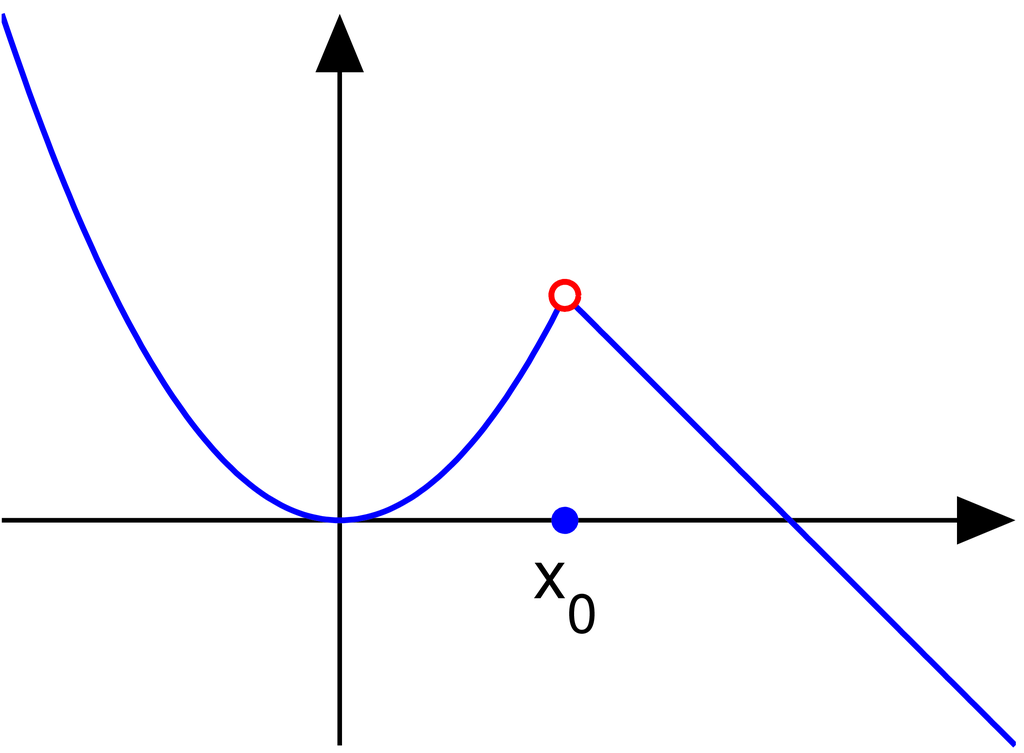
In the real world, continuity is often an assumption we make. For example, when we model the temperature of a room over time, we assume it changes continuously. It doesn't instantly jump from 68 degrees to 72 degrees. In computing, algorithms for finding the roots of equations often rely on the Intermediate Value Theorem, which only applies to continuous functions. This theorem guarantees that if a continuous function has a positive and a negative value in an interval, it must cross the x-axis somewhere in between.
What does the concept of a limit in calculus primarily describe?
Consider the limit: . What is the result?
Understanding limits and continuity provides the bedrock for all of calculus. It's the language we use to describe change with precision.