Calculus Essentials
Understanding Functions
What Is a Function?
Think of a function as a simple machine. It takes one thing in, does something to it, and gives one thing out. For every specific input, you get one specific output. A coffee grinder is a function: you put in coffee beans (input), and you get coffee grounds (output). You can't put in beans and get tea.
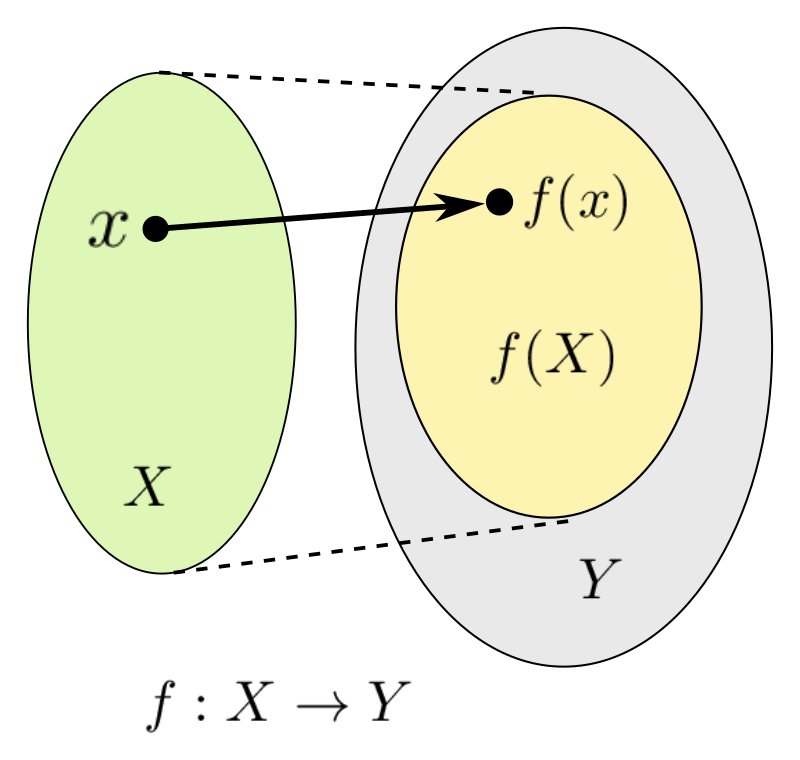
In math, a function is a rule that assigns each input value to exactly one output value.
We often use the notation to represent a function. Here, is the name of the function (the rule), and is the input. The entire expression represents the output.
For example, if we have a function , the rule is "add 2 to the input." If the input is , the output is . If the input is , the output is .
Domain and Range
Every function has a set of possible inputs and a set of possible outputs. These have special names.
Domain
noun
The set of all possible input values () for a function.
Range
noun
The set of all possible output values () for a function.
Let's look at the function . You can square any number, positive or negative, so its domain is all real numbers. However, when you square any real number, the result is always positive or zero. You can't get a negative number. So, its range is all non-negative numbers.
Sometimes a function's domain is restricted. Consider . Since we can't take the square root of a negative number (in the real number system), the domain of is only non-negative numbers (). The output, the square root, will also be non-negative, so the range is also all non-negative numbers.
A Tour of Common Functions
Functions come in many flavors. Getting to know the basic types and what their graphs look like is a key step in learning calculus. Each type describes a different kind of relationship between inputs and outputs.
Linear Functions: Constant Change
Linear functions describe a constant rate of change. Their graphs are always straight lines. The general form is .
Imagine a taxi that charges a $2 flat fee () plus $3 for every mile driven (). The cost function would be , where is the number of miles. For every extra mile, the cost goes up by exactly $3.
Quadratic Functions: The Parabola
Quadratic functions involve a variable squared, like . Their graphs are U-shaped curves called parabolas. These functions model things like the path of a thrown object or the shape of a satellite dish.
The simplest quadratic function is . Its graph is a U-shape that opens upward, with its lowest point at . The function is a parabola that opens downward.
Polynomial Functions: Smooth Curves
Polynomials are a step up from linear and quadratic functions. They are built from variables raised to positive integer powers, like . Their graphs are smooth, continuous curves that can have various hills and valleys. The higher the power of , the more turns the graph can have.
Rational Functions: Ratios and Breaks
A rational function is a ratio of two polynomials, like or . Their most interesting feature is that they can have "breaks" in their graphs. These breaks occur where the denominator is zero, creating vertical asymptotes—lines the graph gets infinitely close to but never touches.
Exponential and Logarithmic Functions: Growth and Scale
Exponential functions, like , model rapid growth or decay. Think of population growth or radioactive decay. Their graphs start slow and then shoot up (or down) very quickly.
Logarithmic functions, like , are the inverses of exponential functions. They answer the question, "What exponent do I need to get this number?" They are useful for dealing with quantities that span many orders of magnitude, like the Richter scale for earthquakes. Their graphs grow very slowly.
Understanding these basic function types and their graphs is like learning the alphabet before you start reading. They are the building blocks we'll use to explore the more dynamic ideas of calculus.
Ready to check your understanding?
Which of the following analogies best describes a function?
If , what is the value of ?
With a solid grasp of functions, you're ready to see how they change.