Calculus Essentials: From Limits to Derivatives
Understanding Limits
Approaching a Point
Calculus is the study of change. But to understand change, we first need to understand how things behave as they get closer and closer to a certain point. This is the idea of a limit.
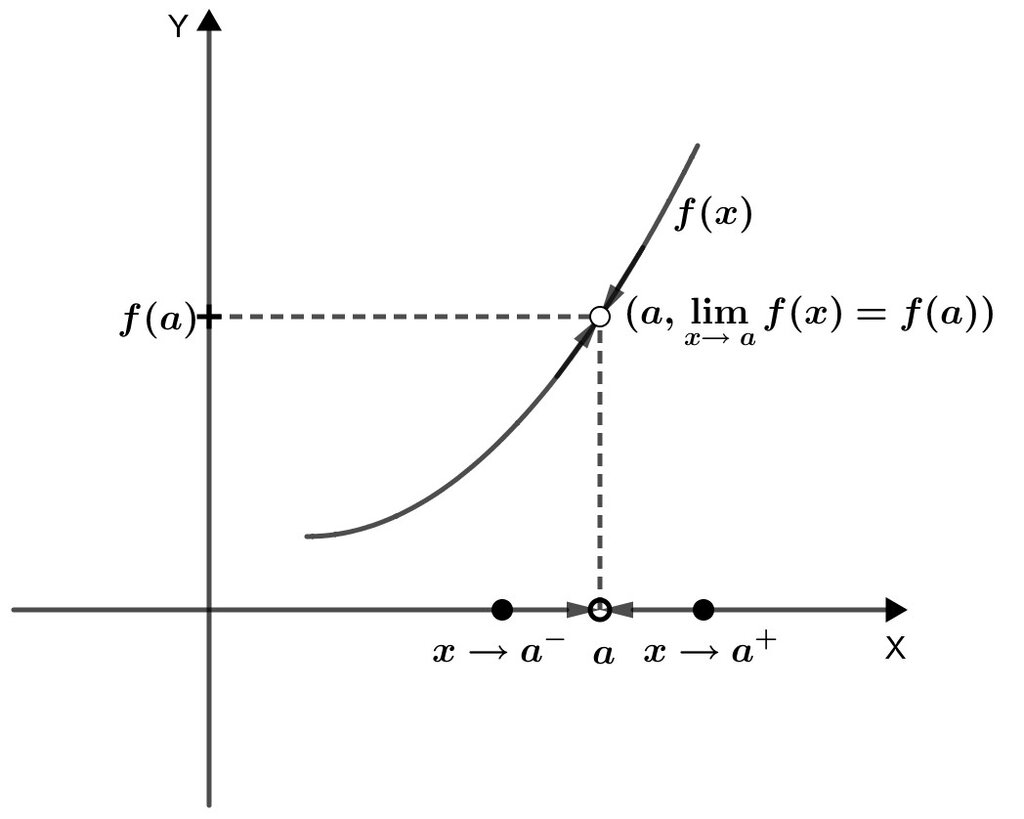
A limit is the value that a function approaches as the input gets closer to a specific number. The key word here is approaches. The function doesn't actually have to reach that value. It's all about the journey, not the destination.
Imagine you're walking towards a wall. A limit is like asking, "Where are you heading?" even if there's a small hole right at the wall that you can't step on. You're still heading towards the wall.
Look at the graph above. The function is undefined right at . If you try to plug 2 into the function, you get , which doesn't make sense. But if you look at the graph, as you get closer and closer to from either side, the value of the function gets closer and closer to 4. We say the limit of the function as approaches 2 is 4.
Finding Limits Algebraically
Looking at a graph is helpful, but we often need to find limits without one. The first strategy is always the simplest: just plug in the number.
For many functions, the limit at a point is the same as the function's value at that point. These are called continuous functions, and we'll talk more about them soon.
For example, to find the limit of as approaches 2, we can just substitute: .
But what about our earlier example, where plugging in the value gave us $0/0$? This is called an indeterminate form, and it's a clue that we need to do some algebra. Usually, it means there's a 'hole' in the function that we can simplify away.
One-Sided Limits
Sometimes, a function approaches different values depending on whether you're coming from the left (smaller numbers) or the right (larger numbers). This is where one-sided limits are useful.
In the graph above, as approaches 2 from the left side, the function's value gets closer to 2. As approaches 2 from the right side, the value gets closer to 4. We write these one-sided limits with a small plus or minus sign.
For a two-sided limit (the kind we've been looking at so far) to exist, the limit from the left and the limit from the right must be equal. In the example above, since , the overall limit does not exist.
Continuity
Now we can tie these ideas together with the concept of continuity. Intuitively, a function is continuous if you can draw its graph without lifting your pencil from the paper. There are no jumps, holes, or gaps.
Formally, a function is continuous at a point if three conditions are met:
| Condition | Meaning |
|---|---|
| 1. is defined. | There is no hole at . |
| 2. exists. | The left and right limits are equal. |
| 3. . | The limit equals the function's actual value. |
If any of these conditions fail, the function is discontinuous at that point. The functions we looked at with holes and jumps were examples of discontinuities.
Limits at Infinity
Finally, what if we want to know what happens to a function as gets extremely large, either positive or negative? This is called the limit at infinity, and it tells us about the function's end behavior. These limits describe horizontal asymptotes of a graph.
To find limits at infinity for rational functions (fractions of polynomials), we can look at the highest powers of in the numerator and denominator.
Let's analyze . As gets very large, the terms become insignificant compared to the terms. The function behaves like , which simplifies to 2.
This tells us that the graph has a horizontal asymptote at . The function gets arbitrarily close to this line but never quite touches it as heads towards infinity.
What does the concept of a limit in calculus fundamentally describe?
Evaluate the following limit:
Limits are a foundational concept. They allow us to precisely define the ideas of instantaneous change and the area under a curve, which are the core of calculus.