Calculus Essentials Differentiation and Integration
Limit Foundations
The Language of Closeness
In algebra, we often care about what happens at a specific point. What is the value of when ? Calculus is different. It's the study of change, which often requires us to understand what happens near a point. This is the job of a limit. A limit describes the value a function approaches as its input gets arbitrarily close to a certain number.
A limit doesn't care about the value of the function at the point, only the value it approaches near the point.
While the idea of "getting close" is intuitive, mathematics requires precision. The formal definition of a limit, known as the epsilon-delta () definition, provides this rigor. It’s a way to state, with no ambiguity, that a function has a limit as approaches .
The epsilon-delta definition frames this as a challenge and response. For any tiny positive distance you choose (epsilon, ), I can find another tiny positive distance (delta, ) such that if is within of , then will be within of .
This definition is powerful because it works even when a function is undefined at a point, like a hole in a graph. For example, the function is undefined at . However, the limit as approaches 1 is 2, because for any value other than 1, the function simplifies to .
Navigating Indeterminate Forms
Sometimes, trying to evaluate a limit by direct substitution leads to a meaningless expression like or . These are called indeterminate forms. They don't mean the limit is zero, one, or nonexistent; they mean we need to do more work.
A powerful tool for handling these forms is L'Hôpital's Rule. It states that if you have an indeterminate form of the type or , you can take the derivative of the numerator and the derivative of the denominator separately, and then try to evaluate the limit again.
Let's find the limit of as . Direct substitution gives . Using L'Hôpital's Rule:
Continuity and Squeezing
A function is continuous at a point if you can draw its graph through that point without lifting your pencil. Formally, a function is continuous at a point if three conditions are met: is defined, the limit as exists, and the limit equals the function's value.
If any of these conditions fail, the function has a discontinuity. This can be a hole (removable discontinuity), a jump (jump discontinuity), or a vertical asymptote (infinite discontinuity).
But what if a function's limit is very difficult to calculate directly? If we can find two other functions that are simpler to evaluate and that "squeeze" our target function between them, we can use the Squeeze Theorem.
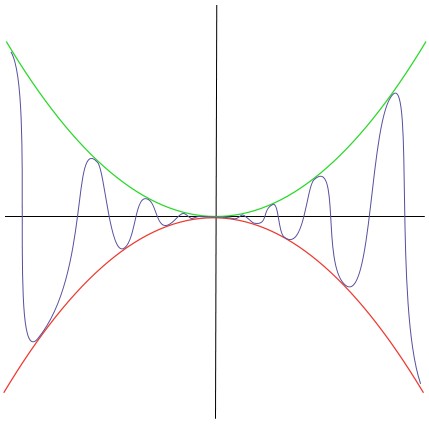
The theorem states that if a function is always between two other functions, and , near a point , and if and have the same limit at , then must also have that same limit at .
This theorem is especially useful for finding limits of functions involving trigonometric components, like as approaches 0. We know that oscillates wildly between -1 and 1, but by squeezing it between and , we can prove its limit is 0.
What does the limit of a function primarily describe?
Which of the following expressions is an 'indeterminate form', suggesting that more work (like using L'Hôpital's Rule) is needed to find the limit?
Limits provide the rigorous foundation for calculus. By understanding how to define and evaluate them, you have the tools to analyze the behavior of functions with a new level of precision, paving the way for derivatives and integrals.