Calculus Essentials
Introduction to Functions
What is a Function?
Think of a function as a simple machine. You put something in, it does something specific to it, and then something new comes out. The key rule is that for any single input, you will always get the exact same, single output. It's a consistent relationship between inputs and outputs.
function
noun
A mathematical relationship where each input has exactly one output.
In math, we use specific terms for the set of all possible inputs and the set of all possible outputs. These are called the domain and the range.
| Term | Definition |
|---|---|
| Domain | The complete set of all possible input values for a function. |
| Range | The complete set of all possible output values of a function. |
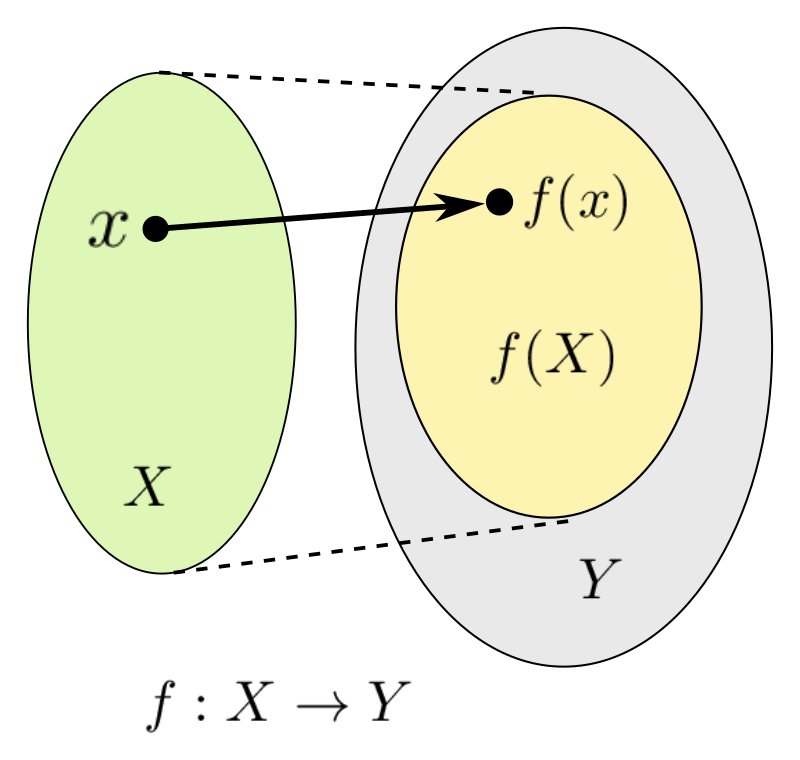
We often use the notation to represent a function. This is read as "f of x". The letter is just a name for the function, and is the input variable. For example, if we have the function , it means the function named 'f' takes an input and adds 5 to it.
So, to find the output for an input of 3, we write . We just replace every in the rule with 3. Here, 3 is the input from the domain, and 8 is the output in the range.
Common Types of Functions
Functions come in many different forms, each with its own unique properties and graphical shape. Let's look at a few of the most common types you'll encounter.
Linear Functions These have the form . Their graph is always a straight line. The value represents the slope, or steepness of the line, and is the y-intercept, where the line crosses the vertical axis.
Quadratic Functions The standard form is . Their graph is a U-shaped curve called a parabola. If the value is positive, the parabola opens upwards. If it's negative, it opens downwards.
Polynomial Functions This is a broader category that includes linear and quadratic functions. A polynomial function has the general form , where the exponents are all non-negative integers. Their graphs are smooth, continuous curves that can have various twists and turns.
Rational Functions These are functions that can be written as a fraction of two polynomial functions, like . A key feature is that their domain excludes any x-values that make the denominator, , equal to zero, as division by zero is undefined. This often creates vertical breaks in the graph, called asymptotes.
Exponential & Logarithmic Functions Exponential functions, like , show rapid growth or decay. Their graphs start flat and then shoot up (or down) very quickly.
Logarithmic functions, like , are the inverses of exponential functions. They grow very quickly at first and then level off, increasing much more slowly.
Finding Domain and Range
Figuring out the domain and range is a crucial part of understanding any function. For the domain, we ask: "What input values are allowed?" For many functions, any real number will work. But there are two common situations where the domain is restricted:
- Division by zero: You cannot have a zero in the denominator of a fraction.
- Even roots of negative numbers: You cannot take the square root (or any even root) of a negative number.
For the range, we ask: "What output values are possible?" This is often easiest to see by looking at the graph of the function.
Let's find the domain of . Since we can't divide by zero, the denominator cannot be 0. So, cannot be 3. The domain is all real numbers except 3.
Now consider . Since we can't take the square root of a negative number, the expression inside the root, , must be greater than or equal to 0. So, . The domain is all real numbers greater than or equal to 4.
Understanding these basic properties of functions is the first step into the world of calculus. They are the building blocks upon which the concepts of limits, derivatives, and integrals are built.
What is the fundamental rule that defines a relationship as a function?
Given the function , what is the value of ?