Calculus Essentials
Functions and Graphs
What is a Function?
At its core, a function is a rule that takes an input and produces exactly one output. Think of it like a machine. You put something in (the input), the machine does something to it, and something else comes out (the output). For any given input, you'll always get the same, predictable output.
In math, we usually work with numbers. We might have a function that takes a number and doubles it. If you put in 2, you get 4. If you put in 5, you get 10. The rule is consistent. We often write this relationship using function notation. If we call our function , we'd write the rule as . Here, is the input, and represents the output.
The key rule: For every input, there is only one possible output. If an input could lead to multiple outputs, it's not a function.
Domain and Range
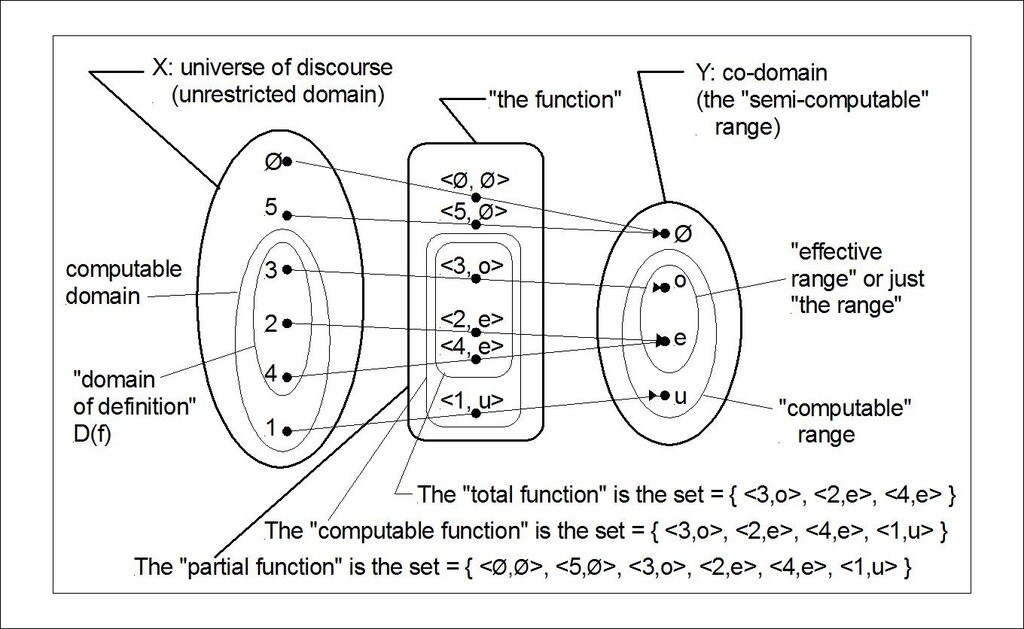
Two important terms go hand-in-hand with functions: domain and range. They tell us which inputs and outputs are possible for a given function.
Domain
noun
The set of all possible input values for a function.
The domain is everything you're allowed to put into the function machine. Sometimes, a function can take any number you can think of. Other times, there are restrictions. For example, in the function , you can't take the square root of a negative number (in the real number system), so the domain is all non-negative numbers ().
Range
noun
The set of all possible output values for a function.
The range is every possible result that can come out of the function machine. For our function , the input can be any real number (the domain). But since squaring any number, positive or negative, results in a positive number or zero, the output will always be non-negative. So, the range is all numbers greater than or equal to zero ().
A Family of Functions
Functions come in many different shapes and sizes. Learning to recognize the basic types is a key skill. Each type has a distinct algebraic form and a characteristic shape when graphed.
Linear Functions These are the simplest functions, creating straight lines when graphed. Their general form is . The value is the slope (how steep the line is), and is the y-intercept (where the line crosses the vertical axis).
Quadratic Functions These functions have the form , where is not zero. Their graphs are smooth, U-shaped curves called parabolas. If is positive, the parabola opens upwards. If is negative, it opens downwards.
Polynomial Functions Linear and quadratic functions are both types of polynomial functions. The general form is . They create smooth, continuous curves. The highest exponent, , is called the degree, and it influences the overall shape and number of turns in the graph.
Rational Functions These are fractions of polynomials, like , where and are polynomials. Their graphs are interesting because they can have breaks, called discontinuities. They often have asymptotes, which are lines the graph approaches but never touches. These occur where the denominator is zero.
Exponential Functions Written as , where the base is a positive constant. These functions model rapid growth or decay. The graph starts flat and then increases or decreases very quickly. A classic example is population growth.
Logarithmic Functions These are the inverses of exponential functions, written as . They answer the question: "what exponent do I need to raise the base to in order to get ?" Their graphs increase very quickly at first and then level off, growing much more slowly.
| Function Type | General Form | Key Feature of Graph |
|---|---|---|
| Linear | Straight line | |
| Quadratic | Parabola (U-shape) | |
| Polynomial | Smooth, continuous curve | |
| Rational | Can have breaks and asymptotes | |
| Exponential | Rapid growth or decay | |
| Logarithmic | Starts steep, then flattens out |
Time to check what you've learned.
What is the defining characteristic of a function in mathematics?
A function's graph is a smooth, U-shaped curve called a parabola. Which type of function is it?
Understanding these basic functions and their graphs is the first major step toward calculus. They are the building blocks for the more complex ideas to come.