Calculus 1 Fundamentals
Introduction to Limits
What is a Limit?
Calculus is the study of change, and the concept of a limit is its foundation. A limit describes how a function behaves as its input gets closer and closer to a particular value.
Think of it like walking along a path represented by a function's graph. You want to know the altitude you are approaching as you get infinitely close to a specific landmark. The limit is that altitude, regardless of whether you can actually stand on that exact spot. The spot might be a bottomless pit, but you can still know the altitude you were approaching.
Limits are the foundation of calculus, essential for understanding how functions behave near specific points or as they approach infinity.
The key idea is that the limit doesn't care about the function's actual value at the point, only the value it's heading towards. This is useful for dealing with points where a function might be undefined.
We write this relationship using special notation. If the value of approaches a number as approaches a number , we write:
This is read as "the limit of as approaches is .
A limit is about the trend, not the actual value. It describes where a function is heading, not necessarily where it ends up.
Finding Limits
So how do we find these limits? Sometimes it's as simple as plugging the number in.
For many simple functions like polynomials, finding the limit is easy. Just substitute the value that is approaching into the function. This is called direct substitution.
For example, to find the limit of as approaches 2:
But what about functions where direct substitution doesn't work, like when it gives you a zero in the denominator? Consider this function:
If you plug in , you get , which is undefined. This is called an indeterminate form. It's a signal that we need to do more work. Often, we can simplify the function algebraically.
When you get , try to factor the numerator or denominator and see if anything cancels. This often removes the part of the function causing the problem.
Let's factor the numerator of our function. The expression is a difference of squares, which factors into .
Since the limit only cares about what happens as gets close to 3, not when is 3, we can safely cancel the terms. This leaves us with a much simpler limit to solve:
So, the limit of as approaches 3 is 6, even though the function itself is undefined at .
The Idea of Continuity
The concept of limits leads directly to the idea of continuity. Informally, a function is continuous if you can draw its graph without lifting your pen from the paper. There are no jumps, holes, or breaks.
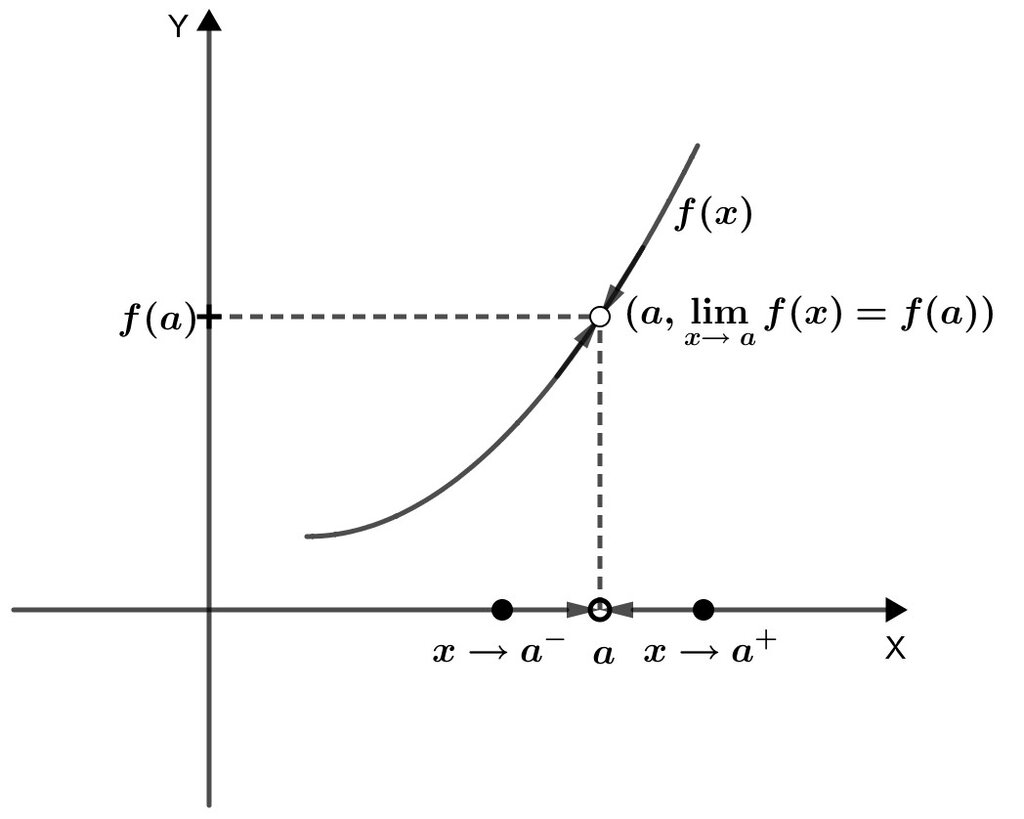
continuous
adjective
A function is continuous at a point if its graph has no interruptions, jumps, or holes at that point.
More formally, a function is continuous at a point if three conditions are met:
- The function is defined at . That is, exists.
- The limit of the function as approaches exists. That is, exists.
- The limit equals the function's value. That is, .
If the journey's destination matches the actual location on the map, the function is continuous at that point.
Continuity means the limit and the actual value agree. The value the function is heading towards is the value it actually has.
The function is continuous everywhere because for any value , . However, our earlier example, , is not continuous at because the first condition fails: is not defined. This type of discontinuity is called a 'removable discontinuity' because we could define to fill the hole.
Let's test your understanding of these foundational concepts.
What is the primary concept that a limit describes in calculus?
Evaluate the following limit:
Understanding limits and continuity is the first major step into the world of calculus. These ideas form the bedrock for everything that comes next.