Calculus 1 Fundamentals
Functions and Limits
What Is a Function?
At its core, a function is a rule that takes an input and produces exactly one output. Think of it like a machine: you put something in, the machine does its work, and something specific comes out. For every unique input, there is only one possible output.
The set of all possible inputs is called the domain, and the set of all possible outputs is called the range.
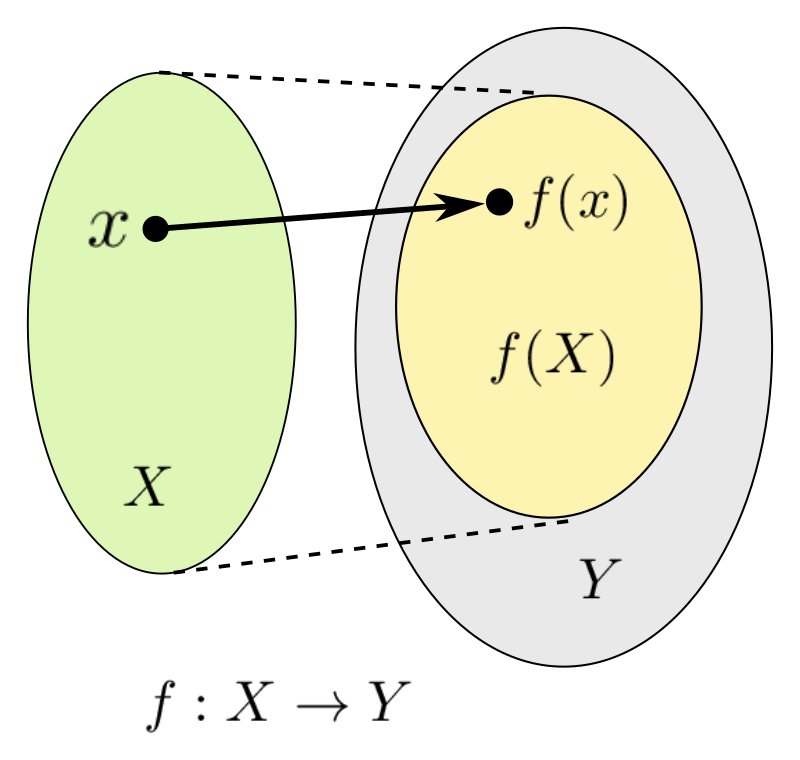
For instance, in the function , the input is , and the output is its square. If you input 3, the output is 9. You can't put in 3 and get both 9 and some other number. The domain could be all real numbers, but the range is only non-negative numbers, since squaring a number never results in a negative.
A Tour of Function Types
Functions come in many flavors, each with its own characteristic shape and behavior. Here are a few common types you'll encounter constantly.
| Type | General Form | Description |
|---|---|---|
| Linear | Creates a straight line. Describes constant rates of change. | |
| Quadratic | Forms a parabola. Models things like the path of a thrown ball. | |
| Polynomial | A generalization of linear and quadratic functions with whole number powers. | |
| Rational | A ratio of two polynomial functions. Can have breaks or gaps called asymptotes. | |
| Exponential | Describes rapid growth or decay, like population growth or radioactive decay. | |
| Logarithmic | The inverse of exponential functions. Used for things like the Richter scale. | |
| Trigonometric | Periodic functions that repeat in cycles. Essential for modeling waves and oscillations. |
The Idea of a Limit
Calculus is the study of change, and to understand change, we need to look at what happens as things get closer and closer to a certain point. This is the concept of a limit.
A limit tells us what value a function approaches as its input gets arbitrarily close to a specific number. We don't care about the value at the number, only the value it's heading towards. Imagine walking towards a wall. A limit is like asking, "Where will you be just before you hit the wall?"
Let's look at an example. Consider the function .
What happens when is exactly 2? If we plug it in, we get , which is undefined. The function has a hole at . But what value is the function approaching as gets close to 2?
| x | f(x) |
|---|---|
| 1.9 | 3.9 |
| 1.99 | 3.99 |
| 1.999 | 3.999 |
| ? | ? |
| 2.001 | 4.001 |
| 2.01 | 4.01 |
| 2.1 | 4.1 |
As gets closer to 2 from both sides, the output gets closer to 4. So, we say the limit of as approaches 2 is 4.
Finding Limits
While making a table works, it's not efficient. There are algebraic techniques for finding limits.
-
Direct Substitution: The first thing to try is always to just plug the number in. For , the limit as is simply . If you get a real number, that's your answer.
-
Factoring and Canceling: This is what we needed for our previous example. When direct substitution gives you , try factoring. We can factor the numerator of :
Since we're only concerned with values of near 2, not at 2, the terms can be canceled out. This leaves us with a much simpler limit to solve:
This confirms our finding from the table.
What Is Continuity?
Informally, a function is continuous if you can draw its graph without lifting your pen from the paper. There are no jumps, holes, or breaks.
For a function to be continuous at a point , three conditions must be met:
- The function is defined at that point ( exists).
- The limit of the function exists at that point ( exists).
- The function's value and the limit are the same ().
If any of these fail, the function is discontinuous at that point. The function we looked at earlier, , is discontinuous at because the first condition fails: is not defined. It has a removable discontinuity, or a "hole".
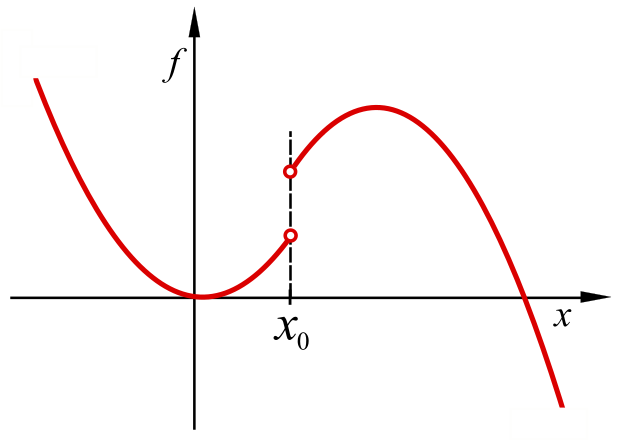
Continuity is a vital property. Many of the theorems in calculus only apply to functions that are continuous over a given interval. Understanding limits allows us to precisely define and test for this important characteristic.