Caesar and the Gallic Campaigns
Transalpine Geopolitics 58 BCE
The Helvetian Catalyst
In 58 BCE, the entire Helvetian people, along with several smaller allied tribes, initiated a mass migration. This was not a mere raid or seasonal movement; it was a permanent relocation of an estimated 368,000 individuals, a figure Caesar provides in his Commentarii. The logistical operation was immense, involving the systematic destruction of their own towns and villages to eliminate any incentive for return. Their objective was the Santoni territory, near the Atlantic coast, which offered more fertile lands.
The chosen route, however, presented a direct challenge to Roman interests. One path lay through the narrow pass between the Jura Mountains and the Rhone River, a corridor within the territory of the Sequani. The other, easier route, crossed the Rhone near Lake Geneva, directly through the Roman provincia of Transalpine Gaul. By petitioning for passage through Roman lands, the Helvetii created a geopolitical crisis that Caesar, as proconsul, could not ignore.
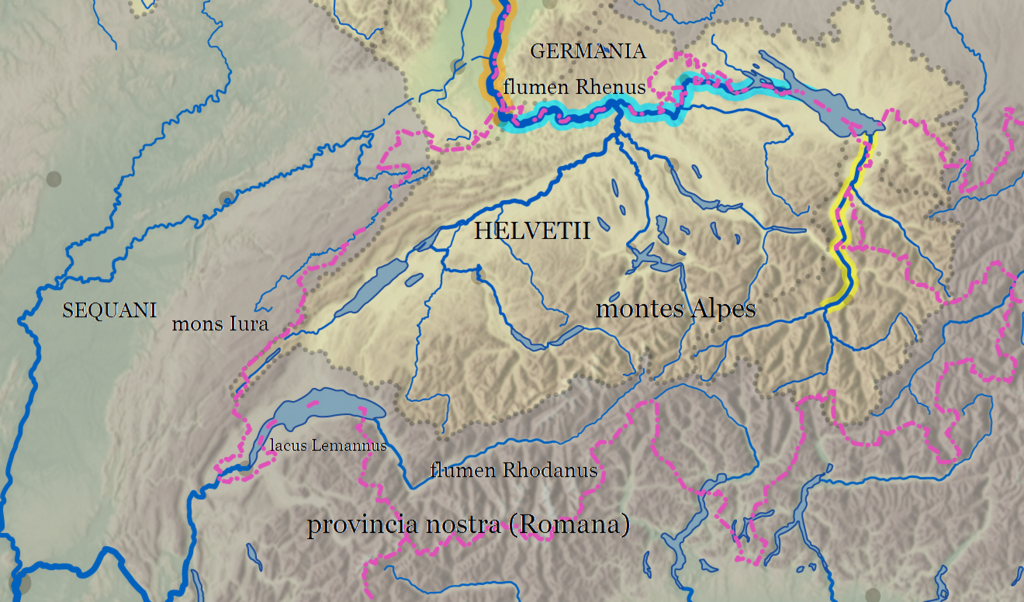
Caesar's initial response was to deny passage and fortify the Roman bank of the Rhone. This forced the Helvetii to negotiate with the Sequani for passage through their territory, a deal brokered by the Aeduan noble Dumnorix. For Caesar, this was a perfect pretext. The migration of such a large, armed population threatened the stability of the entire region and, more importantly, posed a potential threat to Roman allies and the provincia itself.
The Elasticity of Imperium
As proconsul, Caesar held imperium, the supreme authority to command an army and administer a province. His designated provincia included Cisalpine Gaul and Illyricum, with Transalpine Gaul added later. Critically, his authority was technically confined to these territories. Initiating a war outside these boundaries without Senate approval was illegal. To circumvent this, Caesar framed his intervention as a defensive necessity, leveraging the legal framework of bellum iustum—a 'just war'.
His primary justification was the protection of Roman allies, specifically the Aedui. When the migrating Helvetii began to plunder Aeduan lands after crossing the Saône, the Aedui formally requested Roman aid. This appeal provided Caesar with the legal cover he needed. He could now argue that he was not launching an offensive war of conquest but fulfilling a treaty obligation to defend an ally. This maneuver allowed him to move his legions beyond the formal borders of his province while maintaining a veneer of legality.
Caesar transformed a migration crisis on the edge of his province into a mandate for military intervention across all of Gaul.
This interpretation of was aggressive and expansive. Caesar acted unilaterally, raising new legions without direct senatorial consent and operating on the principle that the security of his province depended on neutralizing threats far beyond its borders. The Commentarii meticulously constructs this narrative, portraying every step as a reluctant but necessary reaction to Gallic aggression and instability. In reality, it was a masterful exploitation of legal ambiguity to serve personal ambition.
A Web of Alliances
The political landscape of Transalpine Gaul was a fractured network of rival tribes. For decades, the primary axis of conflict was between the Aedui and a coalition of the Sequani and the Arverni. The Aedui had long been cultivated as 'friends and allies of the Roman people,' a status that gave them significant prestige but also entangled them in Roman politics.
Struggling in their conflict, the Sequani and Arverni had taken the fateful step of hiring Germanic mercenaries under Ariovistus. While this secured their victory over the Aedui, it resulted in Ariovistus settling his people in prime Sequani territory and asserting his own dominance in the region. By 58 BCE, Gaul was caught between the threat of the Helvetian migration and the established presence of an expansionist Germanic king.
Into this environment stepped , the pro-Roman leader of the Aedui. He acted as Caesar's primary diplomatic contact and intelligence source. Speaking on behalf of several Gallic tribes, Diviciacus formally appealed to Caesar not only for protection from the Helvetii but also for intervention against Ariovistus. This was the second, crucial justification Caesar needed. First, he dealt with the Helvetii, defeating them at the Battle of Bibracte. Then, using the authority granted by the Gallic appeal, he pivoted his legions to confront and expel Ariovistus, shattering the Germanic presence in Gaul and establishing Rome as the ultimate arbiter of Gallic affairs.
What was the stated final destination for the Helvetian migration?
What was Caesar's primary legal justification for attacking the Helvetii outside the borders of his province?
Caesar's actions in 58 BCE were a masterclass in political and legal maneuvering. He transformed a regional migration crisis into a justification for a decade-long war of conquest by skillfully manipulating his proconsular authority, the legal framework of bellum iustum, and the complex web of Gallic rivalries.