C# .NET Core MVC with React
Introduction to MVC Pattern
Organizing Your Code
When you build a small application, you can often get away with putting your code wherever it seems to fit. But as projects grow, this approach quickly leads to chaos. Finding specific pieces of logic becomes a treasure hunt, and a small change in one area can unexpectedly break something else entirely.
To solve this, developers use architectural patterns. These are like blueprints for organizing code, ensuring that everything has a logical place. One of the most common and influential patterns is called Model-View-Controller, or MVC.
The Model-View-Controller (MVC) framework is an architectural/design pattern that separates an application into three main logical components Model, View, and Controller.
Think of it like a well-run restaurant. You have the kitchen, the dining area, and the waiter who moves between them. Each part has a distinct job, and they work together to serve the customer. MVC divides an application into three similar roles.
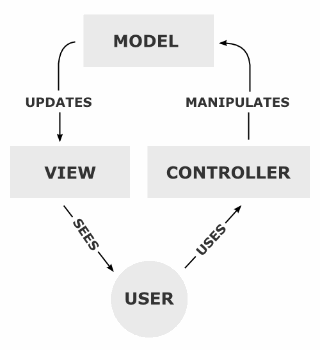
The Three Components
Let's break down each part of the MVC pattern.
1. The Model (The Kitchen) The Model is the brain of the application. It's responsible for managing the data and the business rules. It handles tasks like fetching data from a database, updating it, and enforcing any rules about how that data can be changed. The Model knows nothing about how the data will be displayed; its only job is to manage the data itself.
2. The View (The Plate) The View is what the user sees and interacts with. It’s the user interface (UI), like a web page or an app screen. The View's job is to present the data it receives from the Model in a user-friendly format. It doesn't handle any data logic; it simply displays what it's told to display. A single application might have many views for the same data, like a chart and a table showing the same sales figures.
3. The Controller (The Waiter) The Controller acts as the intermediary between the Model and the View. When a user clicks a button or submits a form, the request goes to the Controller. The Controller then tells the Model to fetch or update the necessary data. Once the Model has done its job, the Controller takes that data and chooses the right View to send it to, which then displays it to the user.
In short: The user interacts with the View, which triggers the Controller. The Controller updates the Model, and the Model's new state is then shown to the user by the View.
Why Use MVC?
Separating an application into these three parts has several major advantages.
First and foremost is the separation of concerns. Because each component has a distinct responsibility, the code is much cleaner and easier to understand. The logic for managing data (Model) is kept separate from the logic for displaying it (View). This makes the codebase much easier to manage, debug, and update.
This separation also allows for parallel development. A front-end developer can work on the View at the same time a back-end developer is working on the Model and Controller. Since their work is decoupled, they don't have to wait for each other to finish.
Finally, MVC promotes code reuse and scalability. You can create multiple views for a single model without rewriting the data logic. If you need to add a new feature, you can often add a new controller and view without touching the existing code, making the application easier to scale over time.
MVC in the Wild
The MVC pattern isn't just a theoretical concept; it's the foundation for many of the world's most popular web development frameworks. Its principles of separation have been adapted and used across many programming languages.
| Language | Popular MVC Frameworks |
|---|---|
| Python | Django, Flask, Pyramid |
| Ruby | Ruby on Rails |
| PHP | Laravel, Symfony |
| Java | Spring MVC, Struts |
| JavaScript | Express.js (often used in an MVC-like way) |
While each framework implements the pattern slightly differently, they all share the core idea of splitting the application into Models, Views, and Controllers. This common structure makes it easier for developers to switch between different frameworks and languages.
Time to check your understanding of these core concepts.
In the MVC architectural pattern, what is the primary responsibility of the Model?
True or False: In a well-structured MVC application, the View directly modifies the data in the database.
By organizing code this way, developers can build complex, powerful applications that are still manageable and easy to maintain.