C++ Fundamentals for Beginners
Introduction to C++
What is C++?
C++ is a powerful, general-purpose programming language. Think of it as a set of instructions you can give to a computer to make it do things. It was created in the early 1980s by Bjarne Stroustrup as an extension of the C language, adding features that make it easier to build large, complex software.
Because it’s fast and efficient, C++ is used to build things that need high performance. This includes video games, web browsers like Chrome and Firefox, operating systems, and high-frequency trading systems. It's a foundational language that gives programmers a lot of control over how a computer uses its resources.
Setting Up Your Workspace
Before you can write C++ code, you need two key tools: a compiler and an Integrated Development Environment (IDE).
compiler
noun
A program that translates the human-readable code you write into machine code, the low-level instructions that a computer's processor can execute directly.
The compiler acts as a translator. It takes your C++ source code and converts it into an executable file your computer can run.
An IDE makes writing code much easier. It's an application that combines a text editor (where you write your code) with the compiler and other helpful tools, like a debugger for finding mistakes. Popular IDEs for C++ include Visual Studio, Code::Blocks, and Visual Studio Code with C++ extensions.
To get started, you'll need to install both. A quick search for "how to install C++ compiler and IDE on [Your Operating System]" will give you the specific steps. For example, on Windows, you might install MinGW (a popular compiler collection) and Code::Blocks.
Your First Program
The traditional first program for any new language is "Hello, World!". It's a simple program that just prints the text "Hello, World!" to the screen. This is a great way to confirm that your compiler and IDE are set up correctly.
// This is your first C++ program!

#include <iostream>

int main() {
    // Print "Hello, World!" to the console
    std::cout << "Hello, World!" << std::endl;
    return 0;
}
Let's break that down line by line:
#include <iostream>: This line tells the compiler to include theiostreamheader file. This file contains code that lets us work with input and output, like printing text to the screen.int main(): This is the main function. Every C++ program has one. When you run your program, the code inside the curly braces{}of themainfunction is what gets executed first.std::cout << "Hello, World!" << std::endl;: This is the line that does the printing.std::coutis the standard character output stream (think of it as the console). The<<operator sends the text "Hello, World!" tostd::cout. Then,std::endladds a new line and makes sure the text shows up right away.return 0;: This tells the operating system that the program finished successfully. A return value of 0 means "no errors."
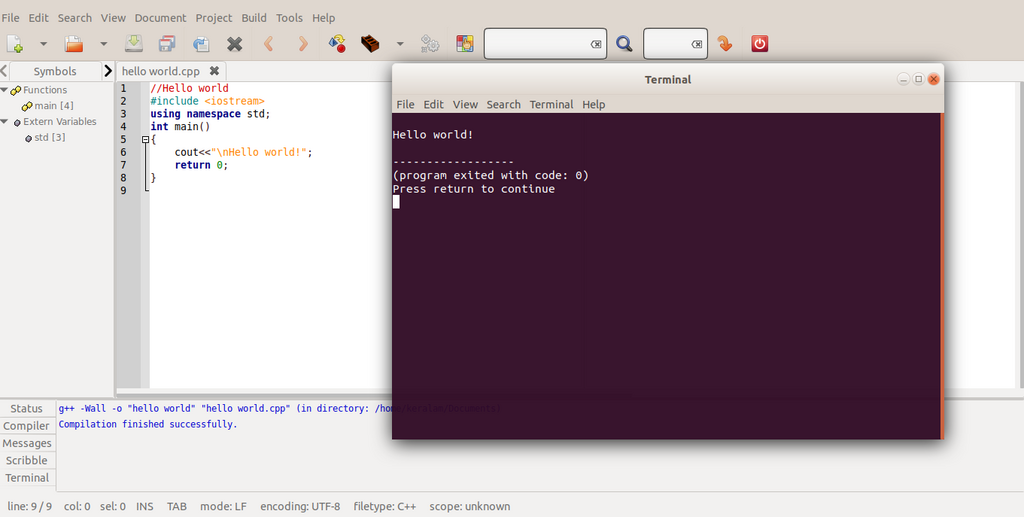
To run this code, you type it into your IDE, save the file (e.g., as main.cpp), and then hit the "Build and Run" button. The IDE will automatically compile your code into an executable file and then run it, showing you the output in a console window.
What is the primary role of a C++ compiler?
In a typical C++ program, which function serves as the entry point for execution?