C++ Fundamentals
Introduction to C++
A Language Built on C
In the late 1970s, a computer scientist named Bjarne Stroustrup was working on his PhD thesis. He needed a programming language that was both efficient for complex simulations and organized enough to manage large projects. The tools available at the time were either fast but too low-level, like C, or highly organized but too slow. He wanted the best of both worlds.
Stroustrup decided to add features from a language he admired, Simula, to the powerful and widespread C language. The result was initially called "C with Classes." This new language kept the speed and flexibility of C but added powerful tools for organizing code into logical, reusable pieces. By 1983, it was officially renamed C++.
The name C++ is a clever nod to its origins. In C, the
++operator is used to increment a variable by one. So, C++ is literally an incremental step up from C.
This evolution means C++ is a multi-paradigm language. It supports procedural programming, a step-by-step approach just like C. But it also fully supports object-oriented programming (OOP), which models the world using objects and their interactions. This dual nature is one of its defining characteristics.
What Makes C++ Special
C++ stands out in the crowded field of programming languages for a few key reasons. Its primary strengths are performance and control.
Because C++ is compiled directly into machine code, the instructions that a computer's processor can execute, it runs incredibly fast. This makes it a go-to choice for tasks where every millisecond counts. It also gives programmers direct control over memory management, which is crucial for optimizing resource-heavy applications.
Another key feature is its scalability. C++ can be used to write a simple command-line tool or a massive, complex system with millions of lines of code. Its object-oriented features help developers manage this complexity by breaking down large problems into smaller, more manageable parts.
Finally, C++ has a vast and mature ecosystem. It boasts a rich Standard Library that provides ready-to-use tools for common tasks, and it has been supported for decades by a large community of developers.
| Feature | C | Python | C++ |
|---|---|---|---|
| Paradigm | Procedural | Object-Oriented | Multi-Paradigm (Both) |
| Performance | Very Fast | Slower | Very Fast |
| Memory Mgmt. | Manual | Automatic | Manual/Automatic Options |
| Complexity | Simpler | Very Simple | More Complex |
Compared to Python, C++ is faster and offers more control, but it's also more complex to learn and write. Compared to its predecessor C, it adds a powerful layer of abstraction and organization through object-oriented programming, at the cost of a steeper learning curve.
Where You'll Find C++
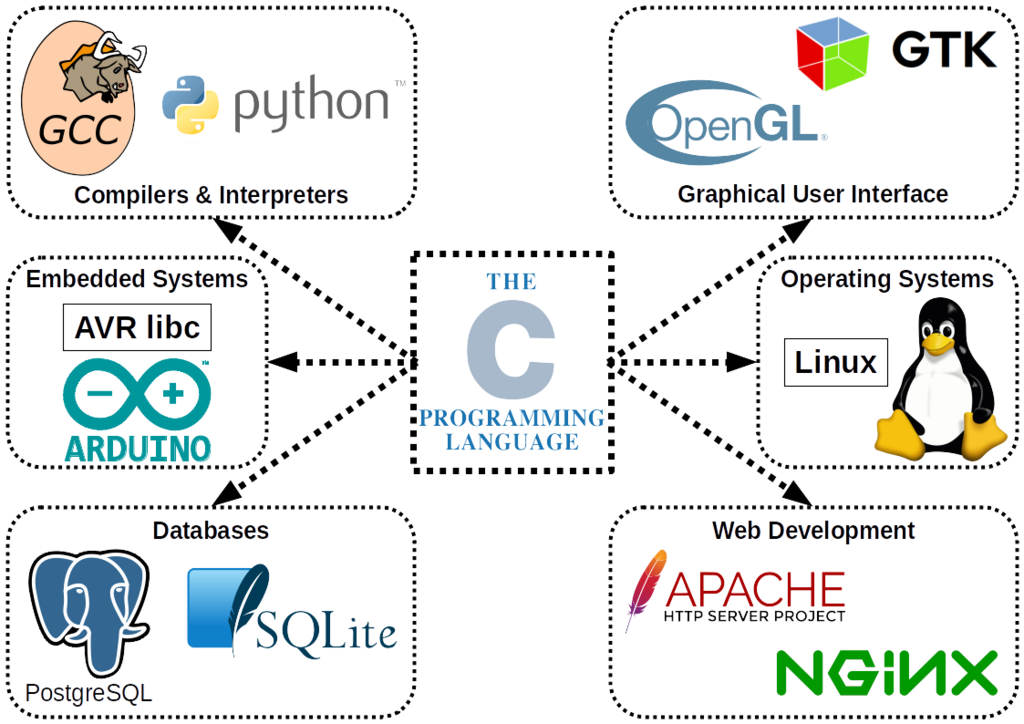
The unique combination of performance, control, and scalability makes C++ the engine behind some of the most demanding software in the world. You'll find it everywhere, even if you don't see it directly.
Video Games: Most major AAA games (like those for PlayStation, Xbox, and high-end PCs) are built with C++. Game engines like Unreal Engine and Unity rely on it for the raw speed needed to render complex graphics and physics in real time.
Operating Systems: Core components of Windows, macOS, and Linux are written in C++. The language is perfect for managing system resources where efficiency is critical.
High-Frequency Trading: In finance, algorithms need to make decisions in microseconds. C++ is the standard for building these ultra-fast trading systems.
Embedded Systems: From the software in your car to medical devices and smart appliances, C++ is used for systems where memory and processing power are limited and performance is essential.
It's also a popular choice for web browsers, database systems, and scientific computing. C++ is a language for builders, designed for creating the fast, powerful, and reliable foundations that other software often rests upon.
Now let's test your understanding of C++'s role and history.
What was the original name for C++ when Bjarne Stroustrup first developed it?
Which of the following application domains is the LEAST likely to use C++ as its primary language?
Understanding where C++ came from and why it's used is the first step. Next, we'll start looking at the actual building blocks of the language.